
As the Fourth Industrial Revolution gathers pace, science and technology, innovation, and digital transformation have become key drivers determining the competitiveness and quality of growth of each locality.
In recent years, the Dong Nai City Party Committee’s Standing Committee has taken decisive and coordinated measures to implement Politburo Resolution No. 57-NQ/TW on breakthroughs in the development of science and technology, innovation and national digital transformation (hereinafter referred to as Resolution No. 57).
Decisive leadership
At a working session with the 2026 inspection and supervision delegation of the Politburo and Party Central Committee’s Secretariat on the leadership, direction and organization of the implementation of Resolution No. 57 by the Dong Nai City Party Committee (CPC)’s Standing Committee, the CPC Standing Board reported on several key initiatives that Dong Nai has undertaken in implementing the resolution. These include developing a strategic technology map for 2026–2030 to master core technologies and create breakthroughs in spearhead economic sectors; applying artificial intelligence (AI) to administrative procedure processing, economic development and environmental protection; and accelerating the Long Thanh Concentrated Digital Technology Park project, which is positioned as a breakthrough hub and is expected to play a key role in attracting investment in strategic technologies to the city.
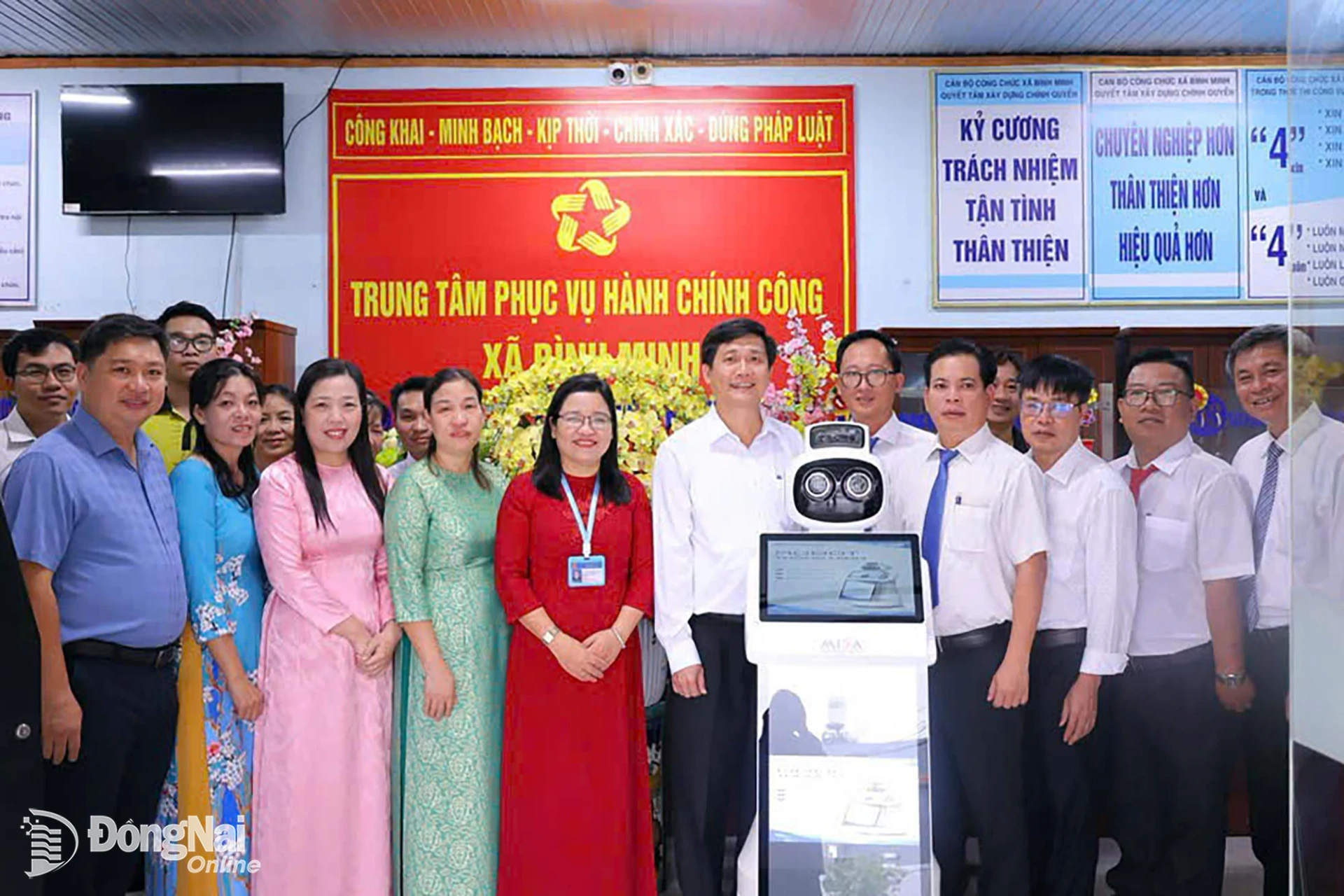 |
| Binh Minh Commune People's Committee has introduced a robot to assist residents at the commune's Public Administration Service Center. |
To date, the city has put its Intelligent Operations Center (IOC) into operation and rolled out the Digital Literacy for All Campaign in all communes and wards. It has also provided digital skills training to hundreds of thousands of officials, civil servants, public employees and residents, while training tens of thousands of officials, civil servants and public employees in AI applications.
Through various digital transformation measures in processing administrative procedures, Dong Nai has entered the country's top 10 localities in terms of connecting its administrative procedure settlement system with national databases. The rate of applications processed online has reached 99.86%. The Public Administration Reform Index (PAR Index) stood at 93.10%, ranking third among 34 provinces and cities. The Satisfaction Index of Public Administration Services (SIPAS) reached 87.16%, also maintaining third place among the 34 localities. These results show that digital transformation is no longer simply about applying technology. It has become a solution for improving the effectiveness and efficiency of state governance and the quality of public services. At the same time, digital transformation helps expand economic development space, laying the foundation for sustainable growth.
For example, as part of efforts to accelerate digital transformation and modernize administration, Binh Minh Commune has put a robot into operation to assist residents at its Public Administration Service Center. “With its intelligent communication capabilities, the robot can guide residents through administrative procedures, provide information, direct them to service areas and interact directly with them. It has become a ‘digital assistant’ working alongside officials and civil servants to better serve residents,” said Tran Duc Hoa, Deputy Secretary of the Party Committee, Chairman of the Binh Minh Commune People's Committee.
Developing the digital economy
While digital transformation was previously viewed mainly from the perspective of administrative reform, it has now become a driver of economic growth and improved local competitiveness. Dong Nai City has so far published 2,139 administrative procedures on the national database, including 1,716 city-level procedures with 1,111 fully online public services and 423 commune-level procedures with 254 fully online public services.
Building a transparent and convenient digital environment has helped improve Dong Nai's investment climate. In the first nine months of 2026, Dong Nai’s domestic investment inflows totaled approximately VND865 trillion, equivalent to 540.63% of the annual target. At the same time, a transparent and convenient digital environment has helped attract high-tech projects to Dong Nai. In the nine-month period, Dong Nai’s foreign investment attraction was estimated at USD2.5 billion.
Dong Nai has also successfully attracted a semiconductor manufacturing project by U.S.-based Coherent, with total investment of USD127 million. The project is expected to lay the groundwork for the development of the semiconductor and high-tech industries while creating new development opportunities for the city's spearhead manufacturing sectors.
Alongside investment attraction, many local businesses have gradually adopted digital technologies in management, production, e-commerce, logistics and digital finance.
Le Truong Son, Member of the City Party Committee’s Standing Committee, Vice Chairman of the City People's Committee, said Dong Nai has a very large business community and 44 operational industrial parks. Therefore, applying science and technology to increase productivity is critically important to the city's GRDP growth.
The application of digital technologies in key economic sectors and the development of an innovation ecosystem have produced concrete and measurable results. The city has mobilized the resources of nine universities and 36 science and technology organizations. A network of technology-based businesses has also begun to take shape, with 16 science and technology enterprises and 88 innovation enterprises.
The City Party Committee has taken decisive action to prioritize financial resources and complete the allocation of the 2026 state budget, with spending on science and technology, innovation and digital transformation reaching a record high. This has provided a strong impetus for strategic breakthroughs and placed Dong Nai among the country's leading localities in terms of the proportion of budget spending on science and technology and digital transformation.
According to the Dong Nai City Party Committee's report on the implementation of Resolution No. 57, several key highlights in Dong Nai can be summarized as follows: The Party Committee has effectively played its guiding role, while a coordinated innovation ecosystem involving government, research institutes and universities, and businesses has begun to take shape. Digital infrastructure and cashless payment systems are basically in place, creating momentum for high-tech investment attraction. The business community has significantly improved its digital skills, helping put the city among the country's leaders in cashless payments and electronic tax payments.
At a working session with the City Party Committee’s Standing Committee on September 7, Le Minh Tri, Politburo member, Party Central Committee Secretary and Head of the Party Central Committee's Commission for Internal Affairs, acknowledged Dong Nai's efforts to learn from experience and take effective action in applying science and technology, innovation and digital transformation.
Dong Nai has set ambitious development goals, he said, adding that achieving these goals requires a focus on two core requirements: personnel work and science and technology and digital transformation. Resolution No. 57 identifies the development of science and technology, innovation and national digital transformation as a top priority and a key driver for rapidly developing modern productive forces, improving production relations, reforming national governance, promoting socio-economic development, preventing the risk of falling behind and enabling the country to make breakthroughs and become prosperous and strong in the new era. If these priorities are pursued effectively, Dong Nai will not only strengthen its competitiveness within the Southern region but also enhance its position nationwide.
By Phuong Hang - Translated by Mai Nga, Thu Ha



Thông tin bạn đọc
Đóng Lưu thông tin