
In Dong Nai, digital transformation is being promoted with a focus on addressing bottlenecks and measuring progress through tangible results, creating conditions for grassroots Party organizations to demonstrate their role through concrete outcomes. In the digital era, a strong Party cell is not one that talks the most about technology, but one that knows how to turn policies into action, Party members into core drivers, and innovation into a shared capacity across the organization.
Part 1: From fear of technology to mastering technology
Digital transformation does not begin with grand concepts. For many workers in Dong Nai, it starts with pressing a button, using new software, giving a command to artificial intelligence (AI), and sometimes confronting the fear of whether they can keep pace with the times. Yet from those initial uncertainties, a noteworthy shift is taking place: workers who once felt apprehensive about technology are learning to use it, adapt to it and gradually master it.
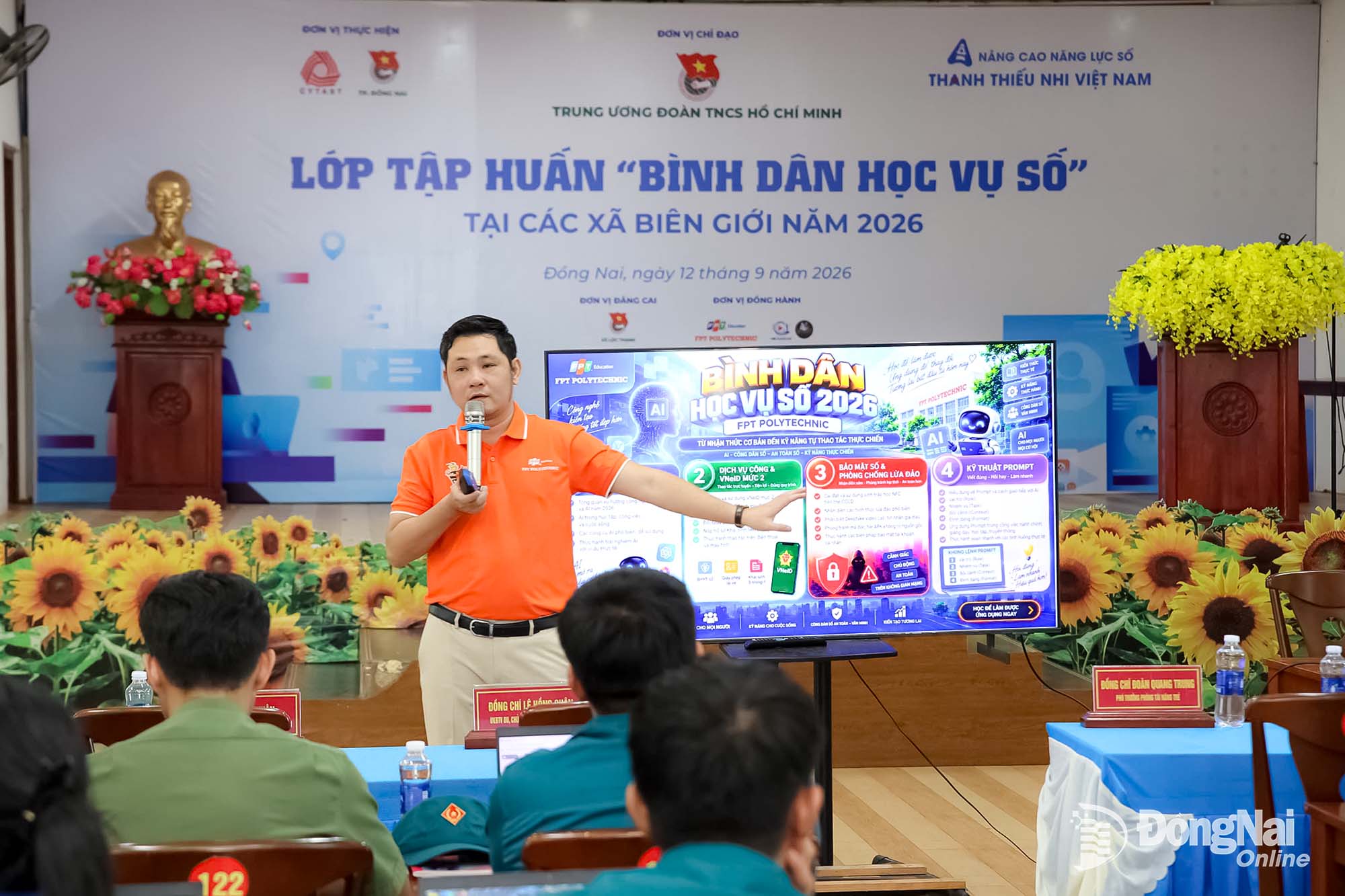 |
| Participating in the Digital Literacy for All Campaign makes an important contribution to digital transformation. In the photo: A digital literacy training class held in Loc Thanh Commune on September 12, 2026. |
Learning a trade for the second time
Bui Thi Ngoc has been working as a product packer at an office stationery manufacturing company in the city for 23 years. She used to package products by hand, but now operates machinery. The change may sound simple, but for someone accustomed to doing the same job for more than two decades, it has been almost like learning a new trade.
Ngoc's first challenge was not some abstract concept of digital transformation, but remembering the machine's operating buttons, understanding each stage of the process and identifying and fixing problems. She was guided by her team leader and experienced colleagues. From initially feeling unfamiliar with the machinery, she gradually became accustomed to it, enabling her to work faster, more efficiently and more safely.
According to Ngoc, she previously produced more than 150 products per hour when doing the work manually. After switching to operating machines, one worker can produce more than 1,000 products per hour. Behind this difference in productivity is not only the power of machinery, but also the result of workers changing their skills and ways of working.
What is even more noteworthy is the change in mindset. If her company introduces new technology tomorrow, Ngoc said she will no longer be as afraid of learning to use it as she was the first time. This is an important shift. In digital transformation, overcoming the fear of technology can be the first hurdle. Once workers have experienced learning and mastering a new tool, they gain the confidence to continue learning.
The same story is unfolding beyond production lines. At
At Dong Nai Hotel, Le Duc Tai, a Party member with 13 years of experience, proactively uses ChatGPT and Gemini to assist in communicating with foreign guests. After seeing the benefits, he has also guided his colleagues in using the tools. A seemingly small problem at a hotel reception desk illustrates the practical nature of digital transformation: a tool only has value when it solves a real problem and is incorporated into workers' daily workflows.
At Sonadezi Environment Joint Stock Company, Dang Thi Kieu Hanh uses AI to help look up tax- and accounting-related circulars and decrees. What she is concerned about is the accuracy of the information and how to formulate prompts so that AI can understand requests correctly. Meanwhile, Nguyen Ngoc Quynh Nhu uses accounting software, electronic invoices, Excel and AI to reduce manual operations, check information and compile data. Her processing time has been reduced by about 30–40%.
These cases show that digital transformation is not confined to an information technology department. It is present on production lines, at reception desks, in accounting offices, training rooms and even in the way workers seek knowledge. Digital transformation, therefore, is first and foremost a transformation in the way people work.
From Resolution No. 57 to the “Digital Literacy for All” campaign
Changes at the grassroots level are taking place as part of a broader policy direction set by the Party. Politburo Resolution No. 57-NQ/TW, dated December 22, 2024, identifies the development of science and technology, innovation and digital transformation as a top strategic breakthrough and a key driving force for developing a modern productive workforce, reforming governance methods and promoting national development. The Government's action program further concretizes these requirements by clearly defining tasks, responsibilities and expected results.
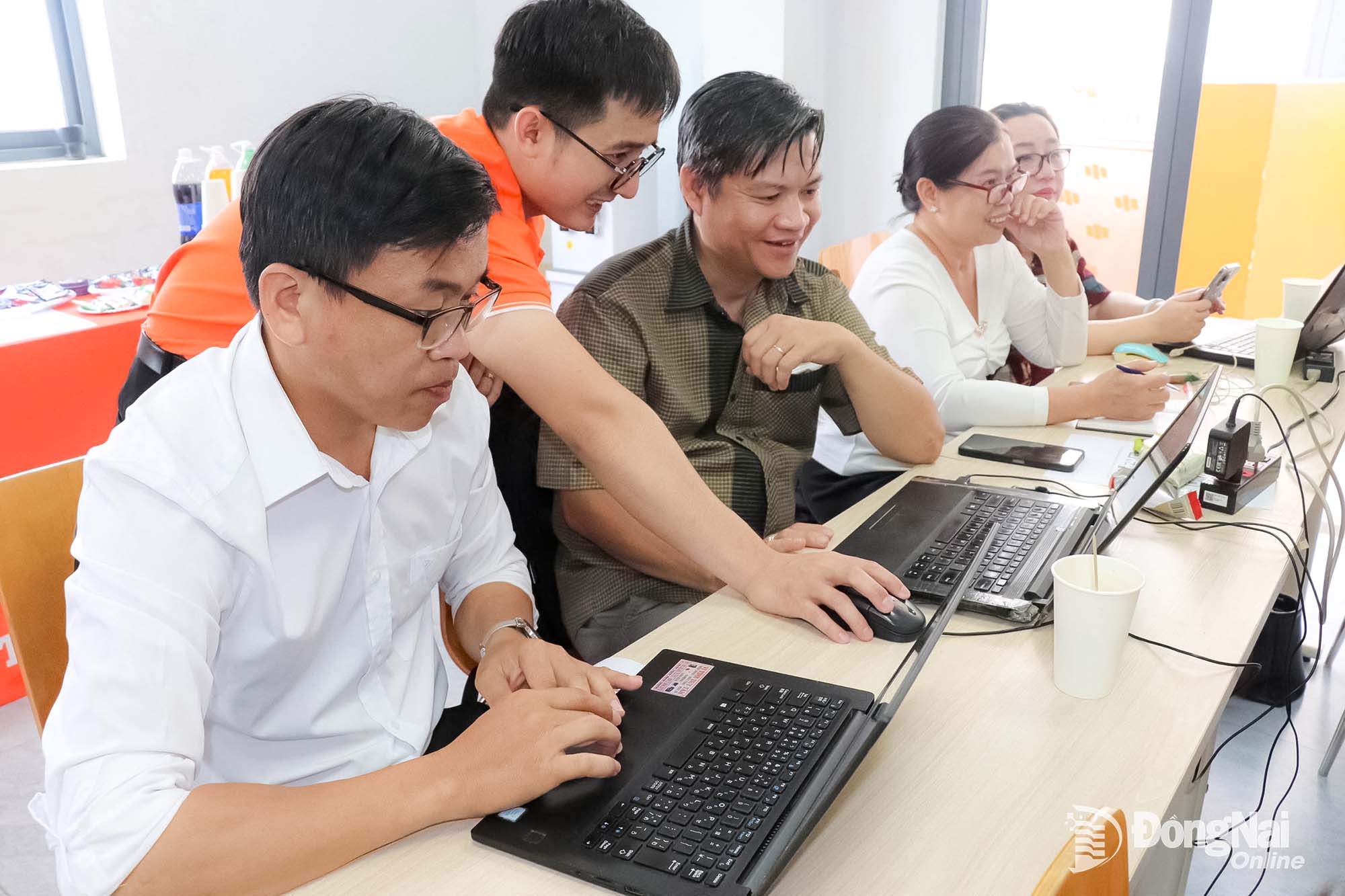 |
| Teachers from schools across the city attend a training class on AI applications. Photo: Hai Yen |
In Dong Nai, science and technology, innovation and digital transformation have been identified as one of the three breakthrough programs for the 2025–2030 tenure. The city has launched a 100-day action plan to address digital transformation bottlenecks, focusing on 10 groups of tasks ranging from institutions, infrastructure, data and digital platforms to the digital economy, digital society, human resources and implementation discipline.
Notably, Plan No. 216/KH-UBND, dated April 28, 2026, on implementing the Digital Literacy for All campaign in Dong Nai aims to provide people and the business community with essential digital knowledge and skills under the principle of “leaving no one behind.” This approach is reflected in the stories of Ngoc and many other workers: digital transformation is meaningful only when ordinary people can use technology in their work and daily lives.
Helping workers truly master technology
These real-life experiences point to three things that need to be done. First, businesses need to develop digital skills maps for different positions, identifying which skills each worker lacks. Second, training must be linked to real workplace problems, with changes before and after the training measured. Third, businesses need to establish mechanisms for those with digital skills to guide those who are less familiar with technology, allowing digital knowledge to spread within teams, departments and work units.
Another requirement is to view digital skills as part of professional competence rather than as an additional skill. As technology changes rapidly, workers cannot learn something once and expect to use it forever. Businesses need to facilitate continuous learning during working hours, develop short and user-friendly materials, and establish on-site support groups. If the Digital Literacy for All campaign is introduced into businesses in this way, it will go beyond basic digital education and become a process for upgrading production capacity and the quality of human resources.
The way technology investment is evaluated also needs to change. If businesses only count the number of machines, software applications or accounts provided, they may overlook the most important factor: the extent to which workers actually use them. Technology creates value only when users understand it, trust it and know how to combine it with their professional experience. Therefore, alongside productivity indicators, businesses should monitor usage rates, reductions in errors, workers' confidence levels and the number of initiatives generated by the users themselves.
But who should take the lead? In a Party organization, this question does not belong solely to technology departments or business leaders. Party members, with their responsibility to set an example and take the lead, should be willing to learn first, try first, act first and support their colleagues in moving forward together. From workers mastering technology, the story thus moves to a more important subject: the role of Party members in leading digital change at the grassroots level.
By Tran Dang Ninh - Translated by Mai Nga, Thu Ha





Thông tin bạn đọc
Đóng Lưu thông tin