
Part 1: From the fields to major markets
Part 2: Businesses bring farmers into value chains
Part 3: Cooperatives forge stronger links among farmers
Over the years, Dong Nai has placed a strong focus on developing the collective economy, particularly by expanding effective new-style cooperative models. Cooperatives have played a key role in bringing farmers together, adopting scientific and technological advances, and creating sustainable links between agricultural production and distribution.
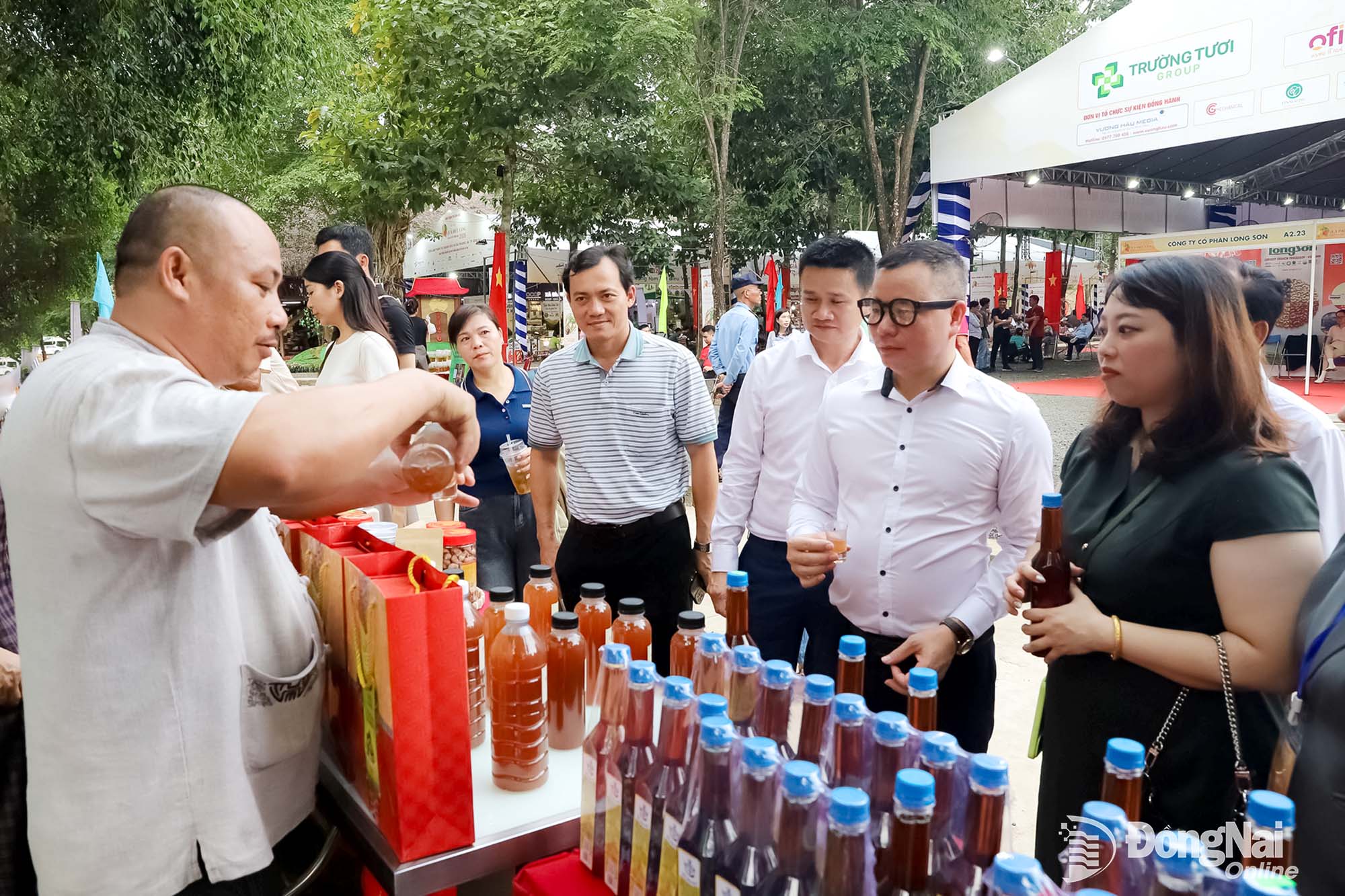 |
| Pham Van Hieu (left), Director of Hoang Anh Cooperative in Binh Phuoc Ward, introduces products made from fresh cashew apples at the 2025 Dong Nai Agricultural Achievements Exhibition. |
Building truly sustainable linkages requires a professional and capable farming workforce. Farmers are not only directly involved in agricultural production but are also key stakeholders throughout the value chain, from production and processing to distribution.
Cooperatives 4.0
In recent years, Dong Nai's collective economy has undergone significant transformation. Notably, new-style cooperatives have grown in both number and quality. The city currently has 523 agricultural cooperatives, while 194 cooperatives and cooperative groups are engaged in services linking agricultural inputs and outputs and in value-chain development. These new-style cooperatives are at the forefront of applying advanced technology to production and processing while adopting effective, innovative approaches.
A notable example is Thanh Binh Cooperative in Bau Ham Commune, which has successfully developed a large-scale banana-growing area for export. The cooperative has invested in a preliminary processing facility and processes off-grade bananas into dried banana powder for export, creating jobs for dozens of local workers. In particular, the cooperative also makes use of banana stems that would otherwise be discarded to produce dried banana sheaths for export to the United States, Canada, Japan, France and Malaysia. This allows farmers to earn nearly VND30 million more per hectare from selling banana stems.
Nguyen Thanh Hien, Vice Chairwoman in charge of the city's Cooperative Alliance, said cooperatives across the city have made great efforts to transform themselves by gaining a better understanding of the market, improving product designs and adopting new marketing approaches to bring their products closer to consumers. These efforts have helped expand their production and business operations while strengthening their competitiveness.
Ly Minh Hung, Director of Thanh Binh Cooperative, said that current policies supporting cooperatives in developing production linkages are highly favorable, and that cooperatives and farmers need to take the initiative to put these policies into practice. He noted that Politburo Resolution No. 57-NQ/TW on breakthroughs in the development of science, technology, innovation and national digital transformation has created fresh momentum for agriculture, opening up opportunities for farmers and cooperatives to embrace innovation and apply science and technology to production, thereby boosting exports and generating significant foreign-exchange earnings.
Sharing the same view, Pham Van Hieu, Director of Hoang Anh Cooperative in Binh Phuoc Ward, said the cooperative has three- and four-star OCOP products under the One Commune One Product (OCOP) program, including cashew nut cakes and roasted salted cashews. Fresh cashew apples are highly nutritious, but they have been discarded for years. This has always been a concern for me. That is why I have spent years experimenting and have successfully developed products such as vegetarian fish sauce, juice and wine from fresh cashew apples. Each cashew season, the cooperative purchases hundreds of tonnes of fresh cashew apples from farmers, helping increase their incomes by 30-40%. The cooperative's ambition is to continue investing in modern machinery and equipment and expand production, not only to better serve the domestic market but also to reach global markets.
According to Dr. Nguyen Trung Dong, Rector of the School of Public Policy and Rural Development, farmers are not only the direct producers of agricultural products but also key stakeholders throughout the agricultural value chain, from production and processing to distribution. Farmers need opportunities to make full use of their knowledge and initiative and contribute meaningfully to sustainable agricultural development. This requires equipping them with knowledge, management skills and the ability to apply science and technology. He said building a professional farming workforce requires preferential policies and support, including access to unsecured loans, assistance in adopting new varieties and technologies and opportunities to participate in pilot agricultural extension, technology transfer and value-chain production programs.
Bu Lach Grassland Organic Cashew Agricultural Cooperative in Tho Son Commune has made a breakthrough in adding value to aging cashew orchards with relatively low economic returns. Capitalizing on the traditional farming practices of local ethnic minority communities, who generally use simple cultivation methods, apply little fertilizer and allow trees to grow naturally, the cooperative has pioneered a shift toward clean and organic farming. These conditions have also facilitated the cooperative's introduction of rau nhip, a traditional vegetable long associated with local ethnic communities, as an intercrop in cashew orchards.
Thi Khui, Director of Bu Lach Grassland Organic Cashew Agricultural Cooperative, said intercropping rau nhip beneath cashew trees creates livelihoods for the S’tieng, M’nong and other ethnic minority communities in the area. Cooperative members grow rau nhip beneath the cashew canopy, helping increase their incomes while preserving cashew-growing areas, as cashews remain a key local crop.
Rau nhip is not only a distinctive and delicious food but also a valuable medicinal plant with a range of health-supporting benefits, making it well-suited to growing consumer demand for clean food. Recognizing the high economic value of this wild vegetable, the cooperative has expanded its cultivation area and is gradually developing rau nhip into a market-oriented commercial product.
It currently supplies about 16 tonnes of rau nhip a year to restaurants and safe-food stores in provinces and cities across the country at high prices. The cooperative is also working to obtain OCOP certification for rau nhip products in an effort to build a brand for this specialty organic vegetable, ensure traceability and target export markets.
Farmers at the heart of digital transformation
Today, agricultural import markets are imposing increasingly stringent requirements on product traceability, particularly transparency in farming practices. As a result, digitizing information from production areas has become essential. Accelerating digital transformation and applying artificial intelligence (AI) are opening up new opportunities for precision and transparent agriculture, from managing growing areas and tracing product origins to marketing agricultural products. Farmers are at the heart of both digital transformation and the development of sustainable production linkages.
Queen Farm Vietnam in Phuoc Son Commune is a pioneer in applying high technology and digital transformation to develop a specialized durian-growing area for export. Covering 55 hectares of durian orchards, the farm supplies hundreds of tonnes of durians to the market each year and meets the export requirements of demanding markets.
Nguyen The Tung, Chairman of the Board and CEO of Queen Farm Vietnam, said: “We create a profile for every durian tree. Workers responsible for caring for the trees must maintain electronic farming logs and update them daily with information on cultivation practices, including the fertilizers and pesticides applied and the quantities of each agricultural input used. As a result, everyone from workers to farm managers can monitor the health of each individual tree, identify trees that are underperforming or diseased, and provide them with special care until they recover. High technology is applied throughout the operation, from crop care and farm management to agricultural product quality control.”
Sharing his experience in helping Dong Nai farmers embrace digital transformation and build linkages along export-oriented agricultural value chains, Wilson Lieu, Director of the Institute of Applied AI & Digital Workforce Development under the Vietnam Scientific Association for Development of Talents - Human Resources, emphasized that people are the most important factor in driving digital transformation in agriculture.
“Digital transformation must start with cooperatives, and every farmer needs to know how to apply it. We will support farmers in applying AI to make their work easier and, in turn, build digital transformation capabilities across the entire agricultural value chain,” he said.
By B. Nguyen, K. Minh – Translated by M.Nguyet, Minho

Thông tin bạn đọc
Đóng Lưu thông tin