
Improving the quality of agricultural cooperatives through organic farming and the adoption of high technology is not only about modernising production methods. It is also a way to reorganise production, increase the value of agricultural products and raise members' incomes.
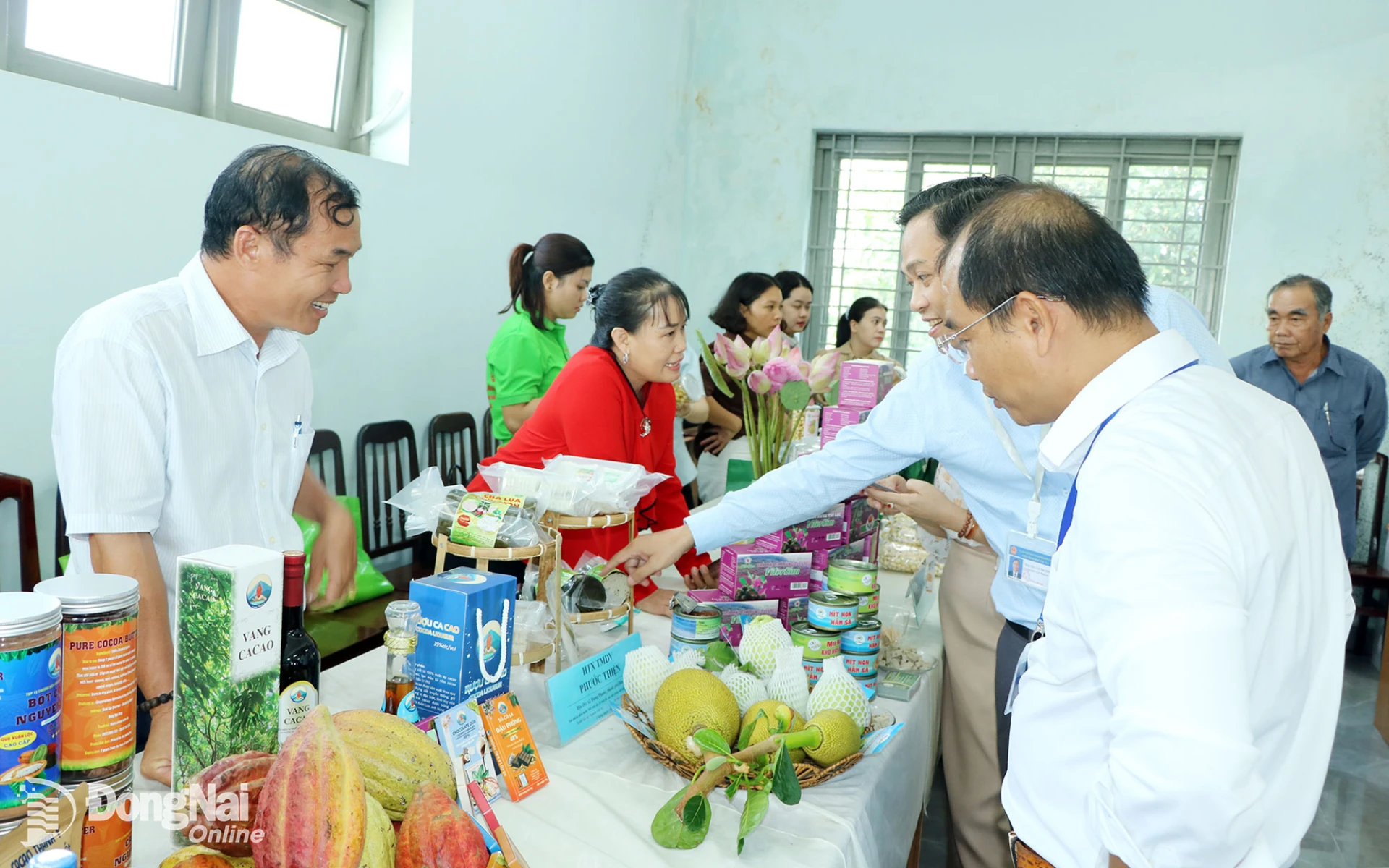 |
| Agricultural products from local cooperatives are displayed at a conference on improving cooperative performance held on October 29. |
By adopting scientific and technological advances, standardising production processes and linking production with processing and marketing, cooperatives can increase the value of their agricultural products. However, these models need coordinated support in areas such as capital, land, infrastructure, human resources and policy if they are to develop sustainably.
Strengthening capacity and improving operational efficiency
Dong Nai currently has more than 560 agricultural cooperatives, of which approximately 348 are rated as fairly good or good. These cooperatives have developed 363 production linkage chains. In addition, 68 cooperatives and cooperative groups have a total of 79 products recognised as three- to four-star products under the One Commune, One Product (OCOP) programme.
These figures show that many cooperatives have taken steps to modernise their operations, adopt technical advances in production and seek new markets. However, their performance remains uneven. Some are still limited in scale and capital, with weaknesses in management and the ability to organise concentrated production. In many areas, technology adoption, the development of raw material production areas, quality control and market linkages have yet to meet current requirements. Many cooperatives also struggle to bring members together, establish common production standards and maintain long-term commitments among partners. As production remains fragmented and product quality and output are often inconsistent, cooperatives find it difficult to meet companies' orders, let alone take on a greater role in higher-value stages of the supply chain.
At a thematic conference held on October 29 to discuss ways of improving agricultural cooperative performance through organic farming and high-tech applications in production, leaders of the city's Cooperative Alliance stressed that developing organic farming and adopting high technology must be based on each cooperative's actual needs and conditions. Investment in technology should follow a clear roadmap and align with each cooperative's financial capacity, management capabilities and market demand. Cooperatives should avoid adopting technology simply to follow trends or investing beyond their means. Above all, technology must help cooperatives increase productivity, improve product quality, reduce costs and deliver greater benefits to members.
Many cooperatives in Dong Nai are increasingly adopting technology in their production activities. Suoi Cat Cocoa Agricultural Service Cooperative in Xuan Loc Ward manages a cocoa-growing area of more than 200 hectares. Its director, Truong Van My, said the cooperative aims to develop an integrated value chain, covering cultivation, preliminary processing, deep processing, brand building and farm-based tourism. For the cooperative, the challenge is not simply to expand its growing area, but also to improve its management of production areas and strengthen ties among members.
Similarly, Long Thanh Phat High-Tech Agricultural Cooperative in Long Thanh Ward brings together households raising white-feathered broilers under closed-house farming systems. The cooperative supplies chicks and farming inputs, provides technical guidance and connects members with buyers, while farmers invest in their own facilities and follow common production standards. Each year, the cooperative supplies millions of broilers, most of which are processed by Koyu & Unitek Co., Ltd. for export to Japan. Its director, Le Van Quyet, said cooperatives could strengthen their competitiveness by standardising production processes, maintaining quality control and building reliable links with buyers.
Meanwhile, Hang Gon Beekeeping–Trading–Service Agricultural Cooperative in Hang Gon Ward is focusing on standardising beekeeping practices and diversifying its product range. Deputy Director of Hang Gon Cooperative Nguyen Thi Dao said limited capital, a lack of information technology skills and difficulties in changing traditional production habits remained major obstacles.
Integrating cooperatives into supply chains
One of the main weaknesses of the cooperative sector is its weak links with processing, distribution and export companies. Many contracts remain seasonal in nature and lack long-term commitments. Cooperatives are concerned about securing buyers for their products and the prices they receive, while companies worry about product quality, production volumes and continuity of supply. Without mechanisms for sharing risks between the two sides, these partnerships are vulnerable to disruption when market conditions fluctuate.
Tran Van Son, Chairman of the Board of Gia Bao Group Joint Stock Company (JSC) in Binh Phuoc Ward, said cooperation between cooperatives and businesses should move beyond one-off transactions towards long-term partnerships. At the start of each crop season, both sides should agree on production plans, quality standards, output, crop calendars and purchasing arrangements. Businesses should take a more active role in developing raw material production areas, providing technical guidance and monitoring quality, rather than waiting until products are ready before stepping in to purchase them.
To make this possible, cooperatives must strengthen their management capacity and ability to honour contractual commitments. Contracts should clearly specify output, quality standards, prices or pricing mechanisms, delivery schedules, payment terms and each party's responsibilities. Models in which businesses place orders, advance funds, supply materials, provide technical support and commit to purchasing the output should be encouraged.
Alongside securing market outlets, cooperatives should pay greater attention to post-harvest handling, storage, grading, packaging and product traceability. Digitising data on production areas, output, quality and delivery schedules would help them manage their operations more effectively and provide transparent information to business partners. However, investment should be tailored to each cooperative's scale and capacity to avoid overextending its financial resources.
To support agricultural cooperatives, the city's Cooperative Alliance has identified several key priorities: encouraging each cooperative to adopt organic farming practices and high technology in line with its actual conditions; addressing difficulties related to land, infrastructure, capital and quality standards; linking technology adoption with standardised production processes, data management and product traceability; and strengthening partnerships with businesses across production, processing and marketing.
Vy Vu Hong Thao, Vice Chairwoman of the city's Cooperative Alliance, said improving the quality of cooperatives must begin with the cooperatives themselves. They need to strengthen management, improve coordination among members, adopt standardised production practices and proactively identify and develop markets. When cooperatives become capable and reliable business partners, supply chain linkages can be sustained over the long term, creating greater value for members and contributing meaningfully to the development of the city's collective economic sector.
By V.The – Translated by M.Nguyet, Minho



Thông tin bạn đọc
Đóng Lưu thông tin