
The eight border communes of Dong Nai City: Bu Gia Map, Dak O, Hung Phuoc, Thien Hung, Tan Tien, Loc Tan, Loc Thanh and Loc Thanh cover a total land area of more than 1,343 sq.km and have a combined population of over 145,700, with ethnic minorities accounting for more than 28%. Agriculture and forestry account for more than 60% of local economic activity. Despite challenging conditions, many farmers have ventured into new crops and explored alternative production models in an effort to increase their incomes.
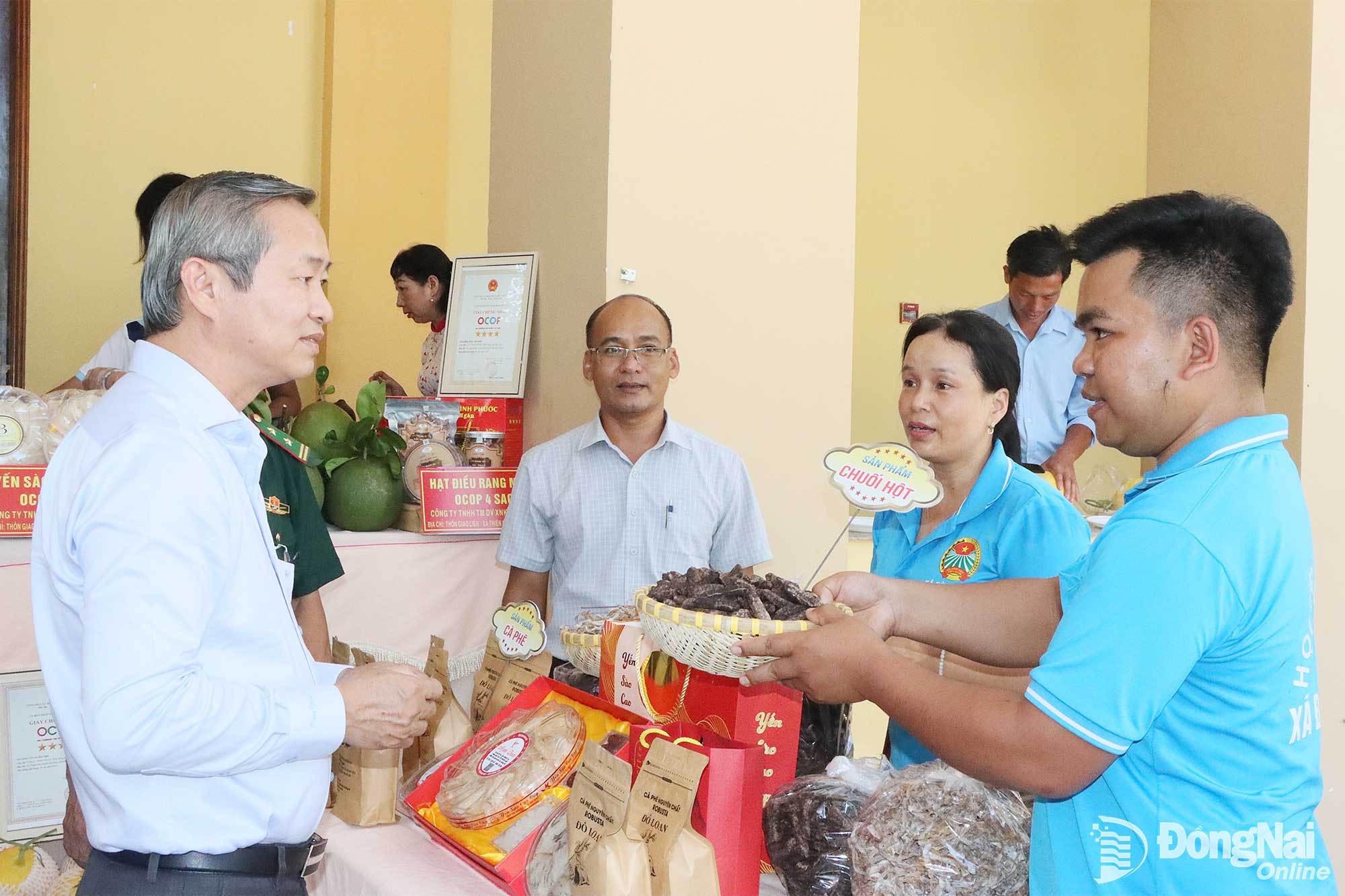 |
| Cao Tien Sy, Vice Chairman of the Vietnam Fatherland Front (VFF) Committee of Dong Nai and Chairman of the Dong Nai Farmers’ Association (DNFA) (left), looks at agricultural products displayed by farmers in Bu Gia Map commune. |
However, volatile agricultural prices, uncertain market outlets and concerns over substandard agricultural inputs remain major obstacles that must be addressed to give farmers greater confidence to invest and improve their livelihoods.
Production models pave the way to prosperity
In 2014, after travelling to Cambodia to learn about agricultural production, Nguyen Thi Kim Chi, a resident of Loc Thanh Hamlet in Loc Thanh commune, decided to introduce Keo mango trees on a trial basis. Finding that they were well suited to the local climate and dry, rocky soil, she gradually expanded her orchard to 14 hectares.
"Under favourable weather conditions and with pests and diseases kept under control, Keo mango trees can yield around 20 tonnes per hectare a year. At an average price of about VND6,000 per kilogram, this generates revenue of approximately VND120 million per hectare, making the crop more economically attractive than some other alternatives," Chi said.
Recognising that many households in the commune were struggling to earn adequate income from underperforming crops, Chi took the initiative to establish the Tan Loc Thanh Fruit Cooperative. The cooperative now has 21 members cultivating a total of 34 hectares, including 23 hectares of mango orchards. The cooperative has seven member households from the S'tieng and Khmer ethnic groups, each cultivating between 0.5 and one hectare. As the economic benefits of Keo mango cultivation became increasingly evident, cooperative members invested more confidently in caring for their orchards. Some households also began using techniques to induce off-season fruiting, thereby increasing the value of their produce. Nguyen Thai Binh's family is among those adopting this approach. The family recently harvested 12 tonnes of marketable off-season Keo mangoes from one hectare, selling them at an average price of VND20,000 per kilogram and generating approximately VND240 million in revenue.
Beyond selling fresh mangoes, the cooperative also processes mangoes into original-flavour soft-dried mangoes and salt-seasoned dried mangoes. Through partnerships with other businesses, its products have been exported to Malaysia, with dried mangoes shipped to Russia and young mangoes to South Korea.
In Loc Tan commune, Bui Thi Huong, a resident of Thanh Tay Hamlet, has also boldly shifted to a new production model after several previous attempts to change farming methods failed to deliver the desired results. Two years ago, her family invested in a net house to grow melons on two sao of land. According to Huong, each crop can yield around five tonnes per sao. At a selling price of approximately VND40,000 per kilogram, this translates into revenue of about VND200 million per sao per crop. With four crops a year, the model has the potential to generate substantial revenue, although actual profitability depends on investment costs, crop maintenance expenses, and market demand.
Meanwhile, in Loc Thanh commune, Nguyen Viet Duong, a resident of Ta Te Hamlet, has specialised in growing Hong mandarins since 2019. The crop requires intensive care, with growers needing to regularly inspect their orchards and take timely measures to control pests and diseases. By the fifth harvest season, Duong's orchard was yielding an average of around 70 tonnes per hectare, with prices ranging from VND23,000 to VND25,000 per kilogram. However, he said sales remained heavily dependent on traders and market conditions. As Hong mandarins are commonly used for ornamental display during the Lunar New Year, their appearance and quality have a significant impact on their market value. Counterfeit fertilisers and substandard pesticides can cause blemishes on the fruit and make trees more vulnerable to pests and diseases, potentially resulting in heavy losses after months of investment and care.
Tackling challenges from farm inputs to market access
Duong's concerns are shared by many Farmers’ Association members and farmers in the border communes. At the 2026 “Listening to Farmers” Forum for Border Areas, organised by the DNFA, participants highlighted the continued presence of counterfeit and substandard fertilisers and pesticides, as well as seedlings of unknown origin circulating on the market. They said tighter controls were needed to address these problems.
In communes such as Thien Hung, Hung Phuoc and Loc Tan, durian cultivation areas have been expanding, but market access remains uncertain. Meanwhile, farmers continue to face substantial demand for capital to restructure their crops, invest in technology and expand production.
To meet farmers' financing needs, the DNFA has earmarked VND16 billion from the Farmers Support Fund for the eight border communes, with VND2 billion allocated to each to support local production plans in the coming period. The union is also working with banks and credit institutions to help members access appropriate credit facilities. It is also identifying obstacles related to loan documentation, collateral requirements and lending procedures and will propose solutions to the relevant authorities.
Faced with these difficulties, farmers called on authorities at all levels and relevant agencies to find solutions. Speaking at the forum, Le Thi Anh Tuyet, Deputy Director of the Department of Agriculture and Environment, said the city currently has 2,482 establishments engaged in the production or sale of pesticides, fertilisers, seeds and seedlings. In 2026, the department drew up a plan to inspect compliance with the requirements for producing and trading these products, with inspections scheduled from September to December 2026. The department also called on People's Committees of border communes to strengthen oversight of agricultural input trading activities and coordinate with specialised agencies and market surveillance authorities to review businesses operating in their localities.
To improve market access, the agricultural sector has identified the reorganisation of agricultural production and stronger links among farmers, cooperatives and businesses as key solutions.
Local authorities are urged to organise farmers into cooperative groups and cooperatives, develop concentrated raw material production zones and promote standardised farming practices. The department will work with specialised agencies to help cooperatives and businesses develop projects and establish partnerships that link agricultural production with product marketing and distribution. The assignment of growing area codes and the use of product traceability labels are also essential to meeting buyers' requirements and facilitating exports through formal trade channels.
Border farmers' aspirations for more prosperous livelihoods are gradually taking shape through concrete production models. Turning these efforts into sustainable development, however, requires practical support and close cooperation among authorities at all levels, relevant agencies and businesses. Such partnerships will help farmers produce higher-quality agricultural goods, secure more stable market outlets, increase product value and improve living standards in border areas.
By Q. Minh – Translated by M.Nguyet, Minho


Thông tin bạn đọc
Đóng Lưu thông tin