
>>> Part 1: New vision paves the way for development
Part 2: Innovating leadership methods,
turning vision into action
Resolutions do not become reality on their own. Between policy orientations and practical results lies a crucial stage: implementation. It is through this process that the role of Party committees is demonstrated not only in formulating sound policies and guidelines but also in their capacity to organize implementation, translate policies into concrete actions, and achieve tangible results.
For Dong Nai, this requirement has become even more evident as the city enters a new phase of development while operating under the two-tier local government model. The administrative apparatus is changing, authority is being redefined, and relations between levels of government are also evolving. Therefore, leadership methods cannot remain unchanged.
From leadership center to action center
The leaner the administrative apparatus and the greater the decentralization, the more clearly Party committees must demonstrate their leadership capacity. This does not mean encroaching upon or assuming the responsibilities of authorities. Rather, Party committees must focus on the essential functions of leadership: accurately assessing issues, selecting key priorities, mobilizing appropriate forces, clearly assigning responsibilities, and ensuring that tasks are carried through to completion.
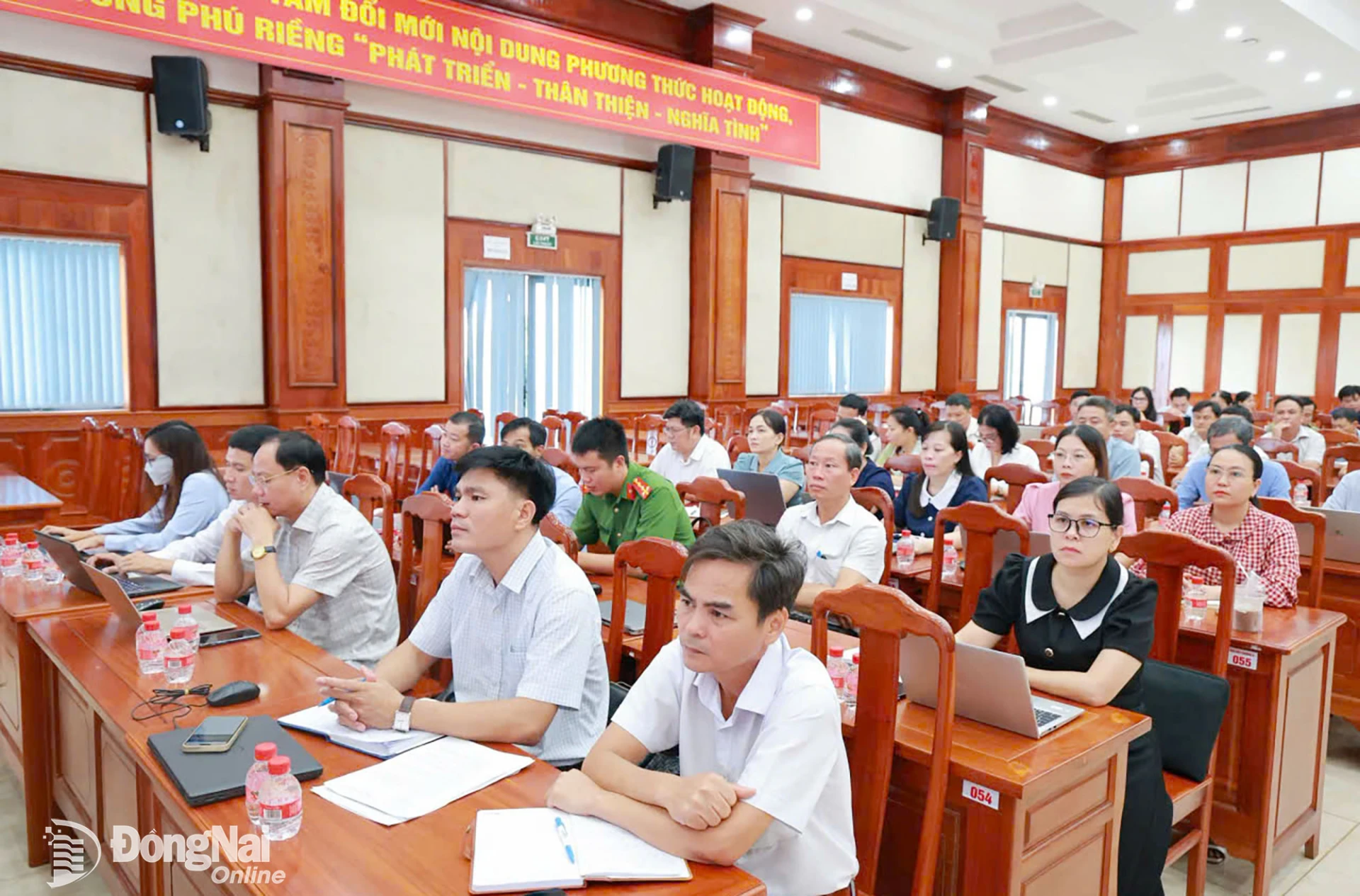 |
| Delegates at the Phu Rieng Commune online venue attend the National Conference to study, disseminate, and implement several resolutions and directives of the Politburo on September 3. |
At a working session with the Party Central Committee’s Organization Commission on August 26, 2026, concerning the drafting of a new resolution on personnel work, Party General Secretary and State President To Lam stressed that decentralization must be accompanied by oversight, while authority must go hand in hand with accountability. Higher-level authorities must not undertake tasks that have already been decentralized or delegated to lower levels. However, they remain responsible for inspection, supervision, post-implementation review, and early warning of potential risks.
This also marks the distinction between substantive and nominal decentralization: delegating authority without relinquishing leadership; encouraging initiative without diminishing accountability; and ensuring that higher-level authorities do not perform tasks already assigned to lower levels while continuing to monitor, inspect, and promptly address emerging issues.
Resolution No. 05-NQ/TU, issued by the Dong Nai City Party Committee’s Executive Board on May 1, 2026, launching the special 500-day-and-night emulation campaign themed “Unity – Discipline – Efficiency – Breakthrough, building a civilized and modern Dong Nai” explicitly underscored these requirements. It also called for ensuring the Party's leadership, improving the effectiveness and efficiency of government administration, and promoting the supervisory and social criticism roles of the Vietnam Fatherland Front and socio-political organizations.
Therefore, renewing leadership methods does not mean adding another layer of direction. What must be improved is the quality of leadership itself.
Leadership cannot stop at declaring that tasks have been "disseminated," "assigned," or "planned." It must go further by addressing fundamental questions: Has the work made progress? Have obstacles been removed? Has accountability been clearly defined? What results have been achieved?
Translating resolutions into specific tasks and responsibilities
A resolution setting out major orientations and policy decisions can only be effectively implemented when its broad objectives are translated into specific tasks, clearly assigned responsibilities, defined deadlines, and measurable outcomes.
The guiding principle of "clear personnel, clear tasks, clear timelines, clear responsibilities, clear authority, and clear results" has been reaffirmed. This principle goes far beyond routine administrative procedures. Every task must be assigned to a clearly identified responsible individual or entity, accompanied by a specific completion deadline and a tangible final outcome. This is how resolutions are translated into practice.
The strength of a Party committee cannot be measured by the number of meetings it holds or the documents it issues. Rather, its leadership capacity must be demonstrated through its ability to identify priority tasks, recognize bottlenecks, and seek solutions until problems are fully resolved.
Difficult tasks and longstanding problems cannot be addressed through general statements alone. Problems must be clearly identified, responsibility must be explicitly assigned, and implementation must be closely monitored until substantive changes are achieved.
Therefore, "strengthening leadership" cannot remain merely a slogan. It must provide concrete answers to specific questions: Which issues require concentrated attention? Who is responsible? When must the tasks be completed? What results must be achieved?
Monitoring tasks through to completion and evaluating based on results
Even when responsibilities are clearly assigned, delays may still occur without proper inspection. Similarly, when tasks are delegated but not closely monitored through to completion, accountability may become diluted. Inspection and supervision must therefore accompany implementation at every stage. Progress must be regularly monitored, warnings about delays must be issued promptly, the accountability of leaders must be linked to actual results, and data must be used to identify bottlenecks and delays in a timely manner.
At the National Conference to study, disseminate and implement the Resolution of the 14th National Congress of the Communist Party of Vietnam on February 7, 2026, Party General Secretary and State President To Lam emphasized that accountability and discipline must take precedence. Individuals who make commitments but fail to fulfill them, or who take action without delivering results, must be considered for replacement or reassignment.
For Party committees, this means not waiting until year-end reviews to discover that targets have been missed. It means not allowing bottlenecks to persist for prolonged periods before identifying their causes. Above all, it means ensuring that tasks do not pass through multiple stages of implementation without clear accountability for the outcome.
The leadership capacity of a Party committee is reflected not only in its ability to formulate appropriate policies but also in its capacity to identify the right priorities, assign the right personnel, see tasks through to completion, and turn words into action.
For a locality such as Dong Nai, which is experiencing rapid urbanization, implementing numerous large-scale infrastructure projects, and facing growing demand for public services from residents and enterprises, the effectiveness of renewed leadership methods must be demonstrated through specific indicators: Are administrative procedures being processed more quickly? Are obstacles affecting projects being resolved promptly? Are bottlenecks being removed? Is accountability being more clearly defined?
Citizens are not concerned with how many meetings a Party committee holds. What matters to them is whether their concerns and requests are addressed more promptly.
Likewise, enterprises do not assess the effectiveness of the administrative apparatus based on the number of documents issued. Instead, they look at whether obstacles to project implementation are removed quickly or slowly and whether an administrative procedure is handled smoothly or remains hindered by multiple bureaucratic obstacles.
Therefore, tangible results, operational efficiency, and the satisfaction of citizens and enterprises must become essential measures of leadership effectiveness. Ultimately, leadership capacity must be assessed where its value is most clearly demonstrated: in practice.
By Dr. Ta Van Soat, Dr. Nguyen Van Phuong – Translated by Minh Hong, Thu Ha
Final Part: Breakthroughs begin with contingent of cadres




Thông tin bạn đọc
Đóng Lưu thông tin