
As Dong Nai enters a new phase of development, the city is prioritising efforts to attract investment in high-tech, high-value-added and less labour-intensive industrial projects. To meet investors’ needs, it is developing infrastructure and urban facilities in a coordinated manner, with a focus on ensuring a safe, stable and uninterrupted power supply.
The city’s power supply capacity is also a major concern for investors assessing Dong Nai’s investment environment and an important factor in their decisions on where to locate their projects.
Ensuring reliable power supply
In the first 9 months of 2026, Dong Nai recorded strong investment performance, with registered domestic investment in projects inside and outside industrial parks (IPs) exceeding VND861 trillion, 5.4 times the full-year target. Registered foreign direct investment (FDI) reached nearly US$2.4 billion, equivalent to almost 80% of the annual target.
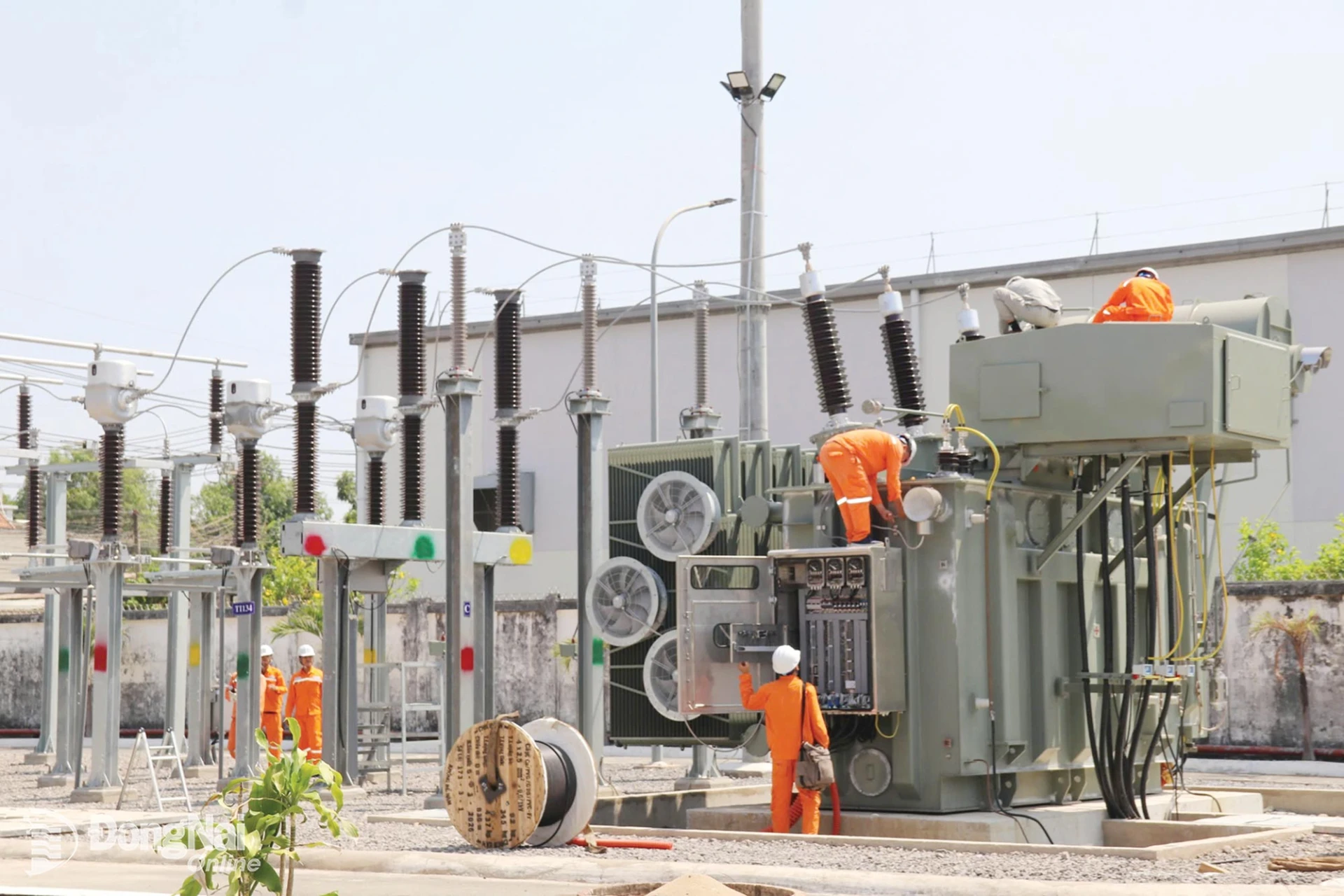 |
| Dong Nai Power Company (DNPC) technicians conduct technical checks before energising the third transformer at the An Phuoc 110kV substation. Photo: The Kiet |
With its strategic location, transport and urban infrastructure, and well-planned industrial parks, Dong Nai remains an attractive destination for investors. However, the city’s power supply capacity is a concern frequently raised by investors in their discussions with local leaders. A reliable electricity supply is essential for production and provides an important foundation for socio-economic development at both the local and national levels.
Pham Viet Phuong, Deputy Head in charge of the Dong Nai Industrial Parks and Economic Zones Authority, said investors need a comprehensive ecosystem that includes cleared land ready for immediate handover, a stable power supply, clean water, wastewater treatment, digital infrastructure, logistics services, standard-compliant factories, skilled technical workers and production support services. Power infrastructure is becoming a decisive factor in attracting projects involving data centres, artificial intelligence (AI), semiconductor manufacturing, highly automated production and the electrification of industrial operations. These projects require substantial amounts of electricity and impose stringent demands on power supply stability and quality, as well as access to green energy. Power generation capacity and grid infrastructure must therefore be developed in a coordinated manner from the site-selection stage.
According to Phuong, Dong Nai’s future competitiveness will depend on more than its geographical location and available land. The city must offer a comprehensive investment ecosystem, supported by a highly skilled workforce, a strong domestic supplier network and fast, transparent investment procedures. These conditions will help Dong Nai attract FDI projects that bring advanced technologies, establish supply chains and generate genuine added value for the local economy.
Ready to meet investors’ needs
Dong Nai has nearly 90 IPs planned, covering a total area of more than 43,000 hectares. The city aims to become a modern industrial and service centre and a regional hub for logistics and high technology. Its priorities include attracting projects in high technology, biotechnology, new materials and green energy, while developing an innovation ecosystem linked to Long Thanh International Airport, the Southeast region’s logistics network and next-generation industrial parks.
The Politburo’s Resolution No. 16-NQ/TW, dated July 21, 2026, on building and developing Dong Nai City through 2035, with a vision to 2065, has opened up new development opportunities. The resolution identifies Dong Nai as a major growth pole for the Southeast region and the country, as well as a hub connecting the region with international markets and a centre for industry, services, logistics and innovation.
In response to rising demand, DNPC has continued to ensure the safe and uninterrupted operation of the power system to support the city’s socio-economic development.
The power sector has consistently adhered to the spirit of Politburo Resolution No. 55-NQ/TW, dated February 11, 2020, which sets out strategic directions for Viet Nam’s national energy development through 2030, with a vision to 2045. The resolution affirms that ensuring robust national energy security is both a foundation and a vital prerequisite for socio-economic development. Prioritising rapid and sustainable energy development that stays one step ahead, while protecting the ecological environment, ensuring national defence and security, and advancing social progress and equity, is of particular importance and constitutes a central task throughout the country’s industrialisation and modernisation.
Do Huu Hoang, Deputy Director of the DNPC.
Do Huu Hoang, Deputy Director of the DNPC, said the company manages tens of thousands of kilometres of power lines and a network of substations across the city. To ensure safe and reliable electricity supply for more than 1.2 million customers, including investors who require an uninterrupted, high-quality power supply, the company considers infrastructure investment and improved service quality essential to attracting FDI to Dong Nai.
Going forward, DNPC will continue to improve power supply reliability, address bottlenecks and outstanding issues in the system, and accelerate progress on power projects. Investment will be carefully targeted at priority areas and specific locations based on electricity load requirements, in line with local development plans. Given Dong Nai's rapid growth, the company will focus its resources on investing in power infrastructure and developing its workforce to meet operational requirements, while ensuring safe and continuous operation of the power system. It will also introduce new technologies into power system management and operations to meet electricity demand both now and in the years ahead.
By N. Lien – Translated by M.Nguyet, Minho


Thông tin bạn đọc
Đóng Lưu thông tin