
Amid the accelerating fourth industrial revolution, science and technology (S&T), innovation, and digital transformation are increasingly playing key roles in enhancing competitiveness, labor productivity, and the quality of economic growth.
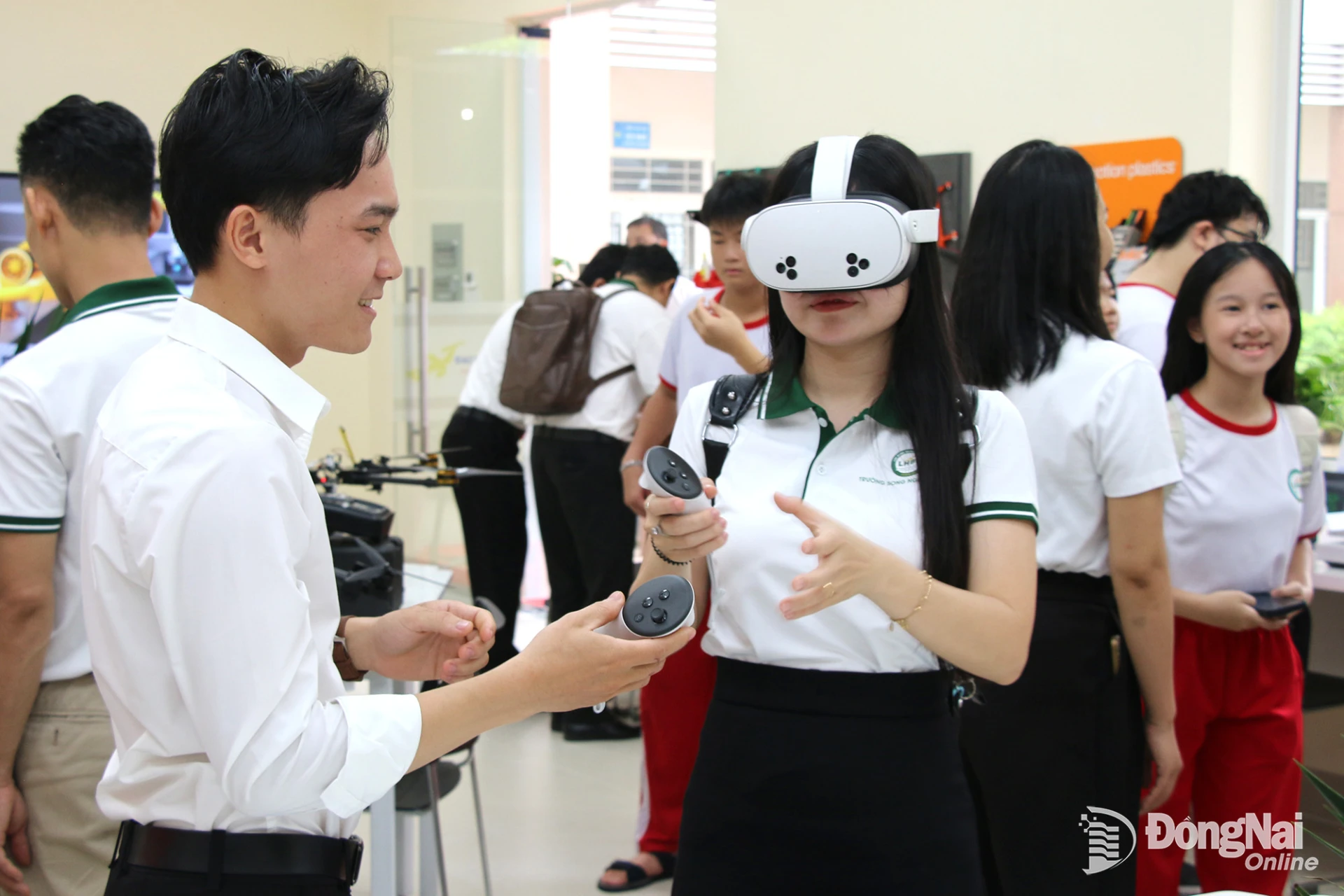 |
| Students experience virtual reality technology at the STEAMHub Technology Library on Campus 6 of Lac Hong University in Tran Bien Ward. |
For Dong Nai, which holds a strategic position in the southern key economic region, boasts a well-developed industrial base and a dynamic business community, and faces an increasingly pressing need to transform its growth model, promoting innovation and digital transformation is of paramount importance.
Enhancing competitiveness and labor productivity
Recently, the city has implemented a range of measures to develop infrastructure, create a favorable environment for innovation, strengthen digital communications, and foster cooperation among state agencies, educational institutions, enterprises, and investors to promote startups and innovation. These efforts have provided fresh momentum for Dong Nai to advance S&T, innovation, and digital transformation, contributing to sustainable economic growth in the new phase.
Dr. Nguyen Van Tan, Vice Rector of Lac Hong University, said, "Building a dynamic and effective innovation ecosystem with close cooperation among stakeholders is a prerequisite for making S&T, innovation, and digital transformation the main drivers of Dong Nai's new growth model. Within this ecosystem, local authorities must play a coordinating role, creating a favorable institutional framework. The city needs to promptly introduce breakthrough and attractive policies to encourage businesses to invest in research and development (R&D) at research institutes and universities, as well as in shared infrastructure."
In 2026, National Innovation Day (October 1) adopted the theme "Innovation – A Development Driver for the Whole of Society," aiming to spread the spirit of creativity throughout society and make innovation a driving force for national development. Every citizen can become an innovator, while every business should regard innovation as an essential prerequisite for growth.
The business community should proactively identify challenges and put forward research requirements for institutes and universities. Rather than focusing solely on recruiting qualified personnel, enterprises should become strategic partners of educational and research institutions by commissioning research projects, participating in curriculum development, and jointly establishing shared laboratories at universities. This is the most direct path toward accessing appropriate technologies and a skilled workforce.
Research institutes and universities must also transform their approaches toward greater market orientation, regarding the commercialization of research results as a key measure of success. Mechanisms should be established to encourage lecturers and scientists to launch startups and establish university spin-off enterprises.
"As part of the local innovation ecosystem, Lac Hong University focuses on training and improving the skills of digital personnel to ensure that graduates possess practical, well-developed capabilities that meet the requirements of the Fourth Industrial Revolution. At the same time, the university stands ready to serve as an external R&D department for enterprises, particularly small and medium-sized enterprises (SMEs), through technology transfer contracts and commissioned research projects," emphasized Dr. Nguyen Van Tan.
Meanwhile, many businesses across the city are increasingly prioritizing investment in S&T applications, digital transformation, and innovation to improve labor productivity and business performance. These efforts are aimed at shifting operations toward automation, optimizing costs, enhancing customer experience, and strengthening competitiveness, while contributing to the development of the local digital economy.
Dang Thi Bich Loan, Director of Mekong Logistics Co., Ltd. in Tran Bien Ward, said, "Our company focuses on applying digital technologies and innovative solutions to operational management, shifting from fragmented, experience-based management to data-driven decision-making and integrating logistics operations, business activities, and financial management into a unified digital ecosystem. In the coming period, we hope local authorities will strengthen connections between enterprises and digital transformation initiatives, technological solutions, and digital workforce training programs, enabling businesses to fully utilize technology platforms and enhance their competitiveness."
Promoting sustainable, in-depth growth
Dong Nai has focused on implementing policies and programs to support startups and accelerate innovation across the city. Particular attention has been given to developing the startup and innovation ecosystem through training, capacity building, the establishment of mentor networks, and stronger connections between enterprises, investors, research institutes, universities, and business support organizations. Within this framework, the S&T sector will expand support for startup incubation, technology transfer, and investment matching to stimulate entrepreneurship and innovation, thereby contributing to sustainable local economic growth.
In particular, the city aims to develop an interconnected data ecosystem. In early October 2026, the Department of Science and Technology, in coordination with the Institute of Innovation under the University of Economics Ho Chi Minh City, launched the Dong Nai Innovation Hub platform and began its pilot operation.
Vo Hoang Khai, Deputy Director of the Department of Science and Technology, emphasized, "Innovation is not solely the responsibility of state agencies, research institutes, universities, or technology enterprises. It must become a guiding principle, a method of operation, and a driving force for society as a whole. Every agency, unit, enterprise, organization, and citizen can participate in this innovation process through practical initiatives, effective solutions, and approaches suited to development requirements."
In response to new development requirements, the launch of the Dong Nai Innovation Hub platform marks an important step, demonstrating the city's determination to build a dynamic, open, and effective innovation ecosystem where ideas are generated, initiatives are disseminated, technologies are applied, and new value is created.
Speaking at the launch ceremony and commencement of the platform's pilot operation in early October 2026, Le Truong Son, Member of the Dong Nai City Party Committee’s Standing Committee and Vice Chairman of the City People's Committee, urged, "In addition to addressing specific, practical issues associated with local development needs, the Dong Nai Innovation Hub must prioritize solutions that connect data infrastructure, improve training effectiveness, and develop digital talent. Relevant departments, sectors, and units must translate innovation capacity into productivity, quality, and tangible technological solutions and products, thereby promoting smart manufacturing models and improving the quality of life of local residents."
By Hai Quan – Translated by Minh Hong, Minho



Thông tin bạn đọc
Đóng Lưu thông tin