
To ensure the timely, coordinated, consistent and highly effective implementation of the Law on E-commerce No. 122/2025/QH15 under the Prime Minister's Decision No. 776/QD-TTg dated April 29, 2026, the Dong Nai City People's Committee has issued a plan to implement the Law on E-commerce across the city.
The plan specifies tasks and completion timelines and clearly assigns responsibilities to departments, boards, agencies, functional units, and the People's Committees of communes and wards. Through the plan, the city is establishing a close coordination mechanism among specialized state management agencies and the two-tier local authorities to improve the effectiveness and efficiency of state management over e-commerce activities.
At the same time, the plan aims to raise awareness and a sense of responsibility among cadres, civil servants and public employees, while promoting widespread communication to encourage voluntary legal compliance among businesses, cooperatives, business households, and consumers engaged in online transactions.
Furthermore, the plan focuses on leveraging and affirming the strategic economic position of Dong Nai City, a major industrial hub and a key logistics gateway of the country, to guide and promote the development of digital technology infrastructure, support the integration of smart logistics with e-commerce, and create new momentum for increasing exports of industrial goods and key agricultural products to the global market through cross-border e-commerce.
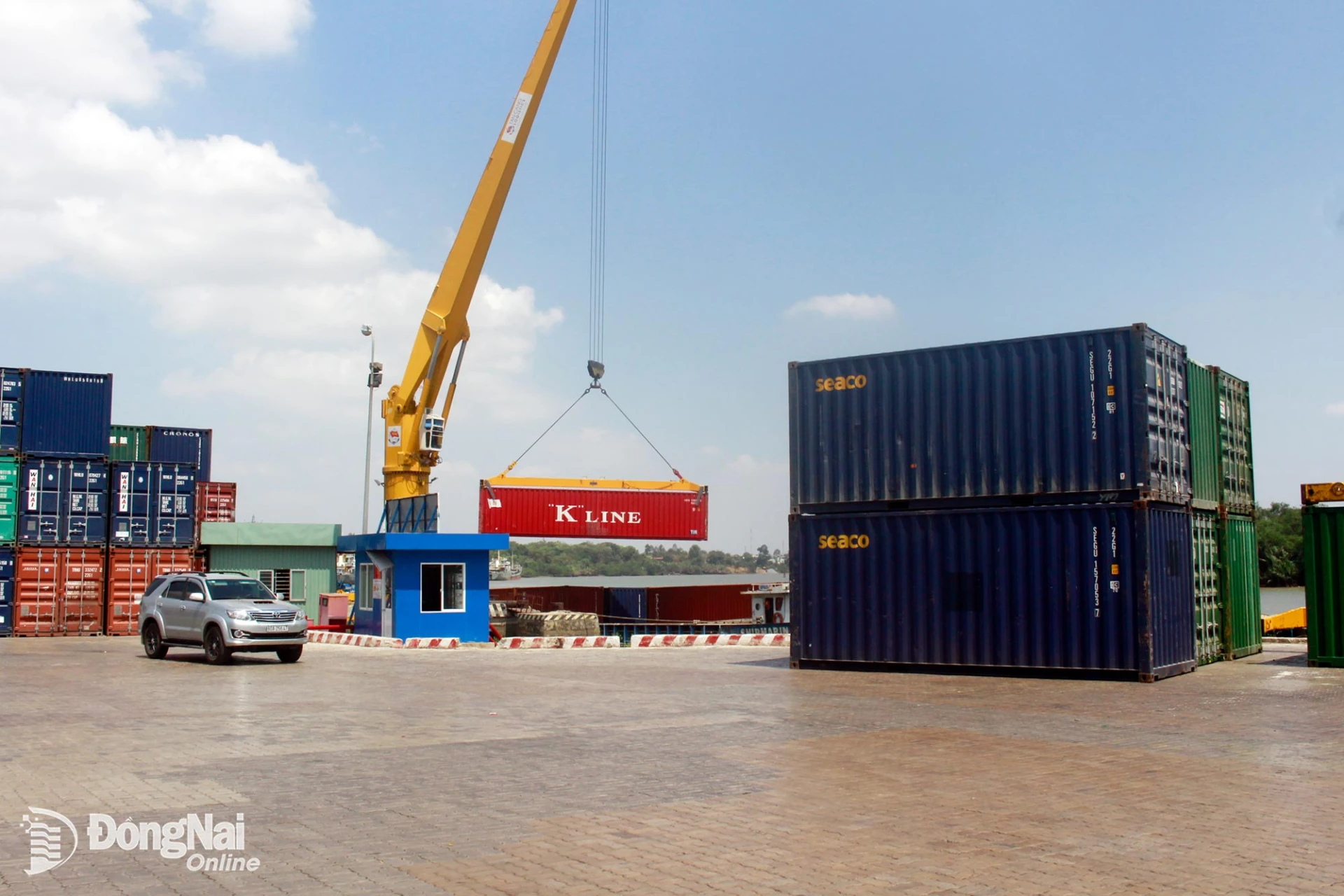 |
| Cargo loading and unloading operations at Tan Cang–Nhon Trach ICD. |
Regarding implementation requirements, the Dong Nai City People's Committee has directed that implementation must be focused and unified, along with regular, close, and effective coordination among agencies and units, while avoiding overlapping or overlooked tasks. Task assignments must be linked to the responsibilities and roles of the heads of departments, agencies, and localities, with an emphasis on proactivity, positivity, creativity, compliance with schedules, and the assurance of quality, practical effectiveness, and budget savings.
The city has established a specific roadmap to ensure that when the Law on E-commerce No. 122/2025/QH15 takes effect, legal regulations can be applied smoothly and synchronously and administrative bottlenecks can be promptly addressed. At the same time, inspections, supervision, and evaluations of the law's implementation are conducted regularly to promptly address difficulties and obstacles arising at the grassroots level, particularly those related to preventing tax revenue loss, controlling counterfeit goods, protecting consumers' personal data, and managing logistics activities associated with e-commerce in industrial parks and economic zones.
The plan's core content includes organizing the dissemination and education regarding the Law on E-commerce through various practical forms, with communication activities focusing on foreign direct investment enterprises, businesses in industrial parks, economic zones, cooperatives, and business households producing key products. The Department of Justice takes the lead and coordinates with the Department of Industry and Trade to publish the full text of the law and its guiding documents on the city's legal dissemination and education portal.
The city is organizing intensive professional training for cadres and civil servants engaged in state management and law enforcement; developing training programs on global online sales skills for small- and medium-sized enterprises, cooperatives and traditional craft villages producing fine-art wood products and processing agricultural products for export; supporting connections to bring the city's products onto major international e-commerce platforms; and developing pavilions for Dong Nai's agricultural and One Commune, One Product (OCOP) products on domestic platforms.
At the same time, functional agencies are conducting a rigorous review of legal normative documents issued by the City People's Council and People's Committee related to the e-commerce sector to promptly propose amendments, supplements, or the repeal of overlapping or outdated regulations. The city is also actively providing substantive written feedback on draft documents detailing implementation regulations prepared by the Ministry of Industry and Trade and central agencies.
To capitalize on its strategic geo-economic location and extensive transport infrastructure network, the city is focusing on developing digitized logistics infrastructure and smart warehousing dedicated to e-commerce, while encouraging major logistics corporations to invest in order fulfillment centers, cold and cool storage systems, and last-mile delivery solutions using green technology.
The city is also developing regulations on coordination in state management to ensure security and promote e-commerce activities, with the aim of establishing mechanisms for database sharing, applying technology to tax management, preventing tax revenue loss, and coordinating supervision and inspections, as well as strictly handling smuggling, tax evasion, the sale of counterfeit and substandard goods, and online intellectual property infringements, while ensuring comprehensive protection of consumer rights. At the same time, the city is establishing a regular inter-agency inspection mechanism, with the Department of Industry and Trade serving as the lead agency responsible for monitoring and compiling information and periodically organizing thematic inspection teams to examine e-commerce activities across the city.
By Diec Quyen – Translated by Minh Hong, Thu Ha



Thông tin bạn đọc
Đóng Lưu thông tin