
Dong Nai is among the country's leading localities in new-style rural development. In recent years, the city has prioritized investment in rural infrastructure, including clean water supply infrastructure. It has also set rural clean water standards above the national average and achieved notable results.
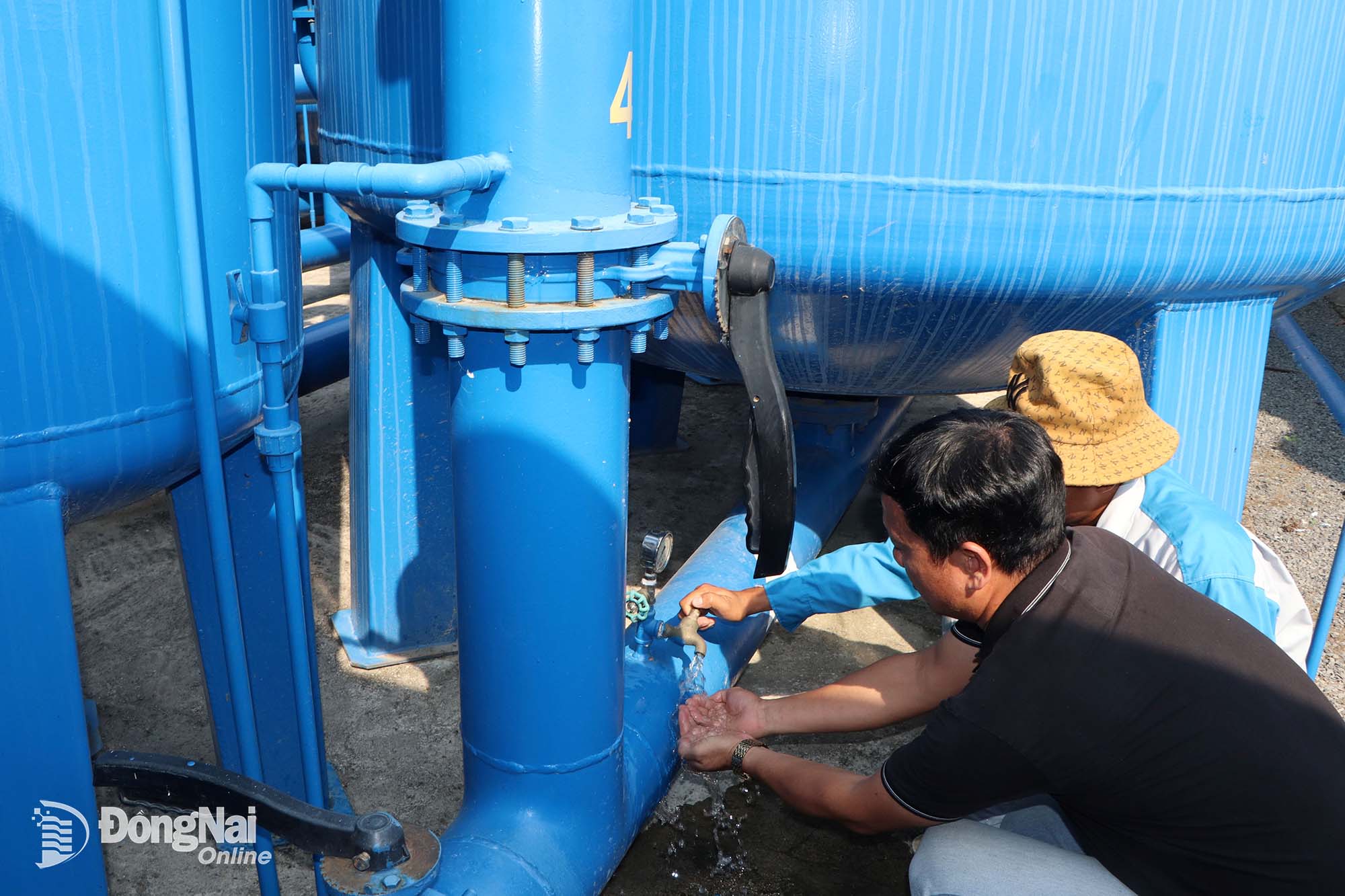 |
| The clean water supply project in Phu Lam Commune. |
However, some communes still lack centralized water supply facilities, while in other localities, piped water is available but the proportion of households using clean water from centralized supply systems remains low. The biggest challenge in investing in centralized clean water supply systems is the large amount of capital required, as rural clean water supply projects must cover vast areas with sparse populations. Meanwhile, rural residents still tend to use water from drilled wells and rainwater, relying on piped water only during the dry season or using it sparingly, resulting in relatively low investment efficiency.
Prioritizing investment in rural clean water
To date, Dong Nai has 139 centralized rural water supply facilities with a total designed capacity of more than 96,000 cubic meters per day. Of these, 85 are currently operational, with a combined capacity of more than 85,800 cubic meters per day. The facilities that have ceased operations are mostly small-scale systems built many years ago that have become damaged and deteriorated, making investment in upgrades ineffective.
Dong Nai has set a target for 81% of rural households to use water that meets quality standards in 2026, with the rate rising to 85% by 2030. In recent years, the city has prioritized investment in centralized water supply facilities. As a result, as of September 2026, 80.55% of rural households were using water that met quality standards. This result has been achieved thanks to continued investment by investors in new projects and the expansion of existing rural clean water supply projects.
Clean water has a significant impact on the health of generations of residents. Some localities still lack water supply projects, and residents continue to use unsafe water sources, affecting their health. Therefore, the Department of Agriculture and Environment, along with relevant departments, agencies and units, needs to review the current situation, identify existing shortcomings and difficulties and on that basis develop appropriate solutions and approaches for the coming period.
Nguyen Thi Cat Tien, Member of the City Party Committee, Vice Chairwoman of the City People's Committee
Ho Ngoc Long, Deputy Director of Dong Nai Water Supply Joint Stock Company, said the company currently supplies water to 17 rural communes and is completing procedures to increase the capacity of several water treatment plants to expand its service area to more communes. He said the main challenge was that administrative procedures and documentation remained complicated and time-consuming, and the company hoped to receive support so that the projects could be implemented soon. Regarding investment capital, the company currently has to rely on commercial loans at high interest rates and hopes to gain access to preferential loans for investment.
Dang Dinh Thuan, Director of Dong Nai Irrigation One Member Co., Ltd., said that irrigation demand is currently low, and water from major reservoirs will be prioritized for raw water supply for domestic use. The company is continuing to work with local authorities to meet local demand for domestic water. As water treatment plants seek to expand their capacity, the company is continuing to review and assess water reserves in major reservoirs and provide support to attract investors to water treatment projects. The company has proposed that the city's People's Committee develop support and incentive policies to attract investors to water treatment plant projects.
Removing obstacles to rural clean water projects
The biggest challenge currently facing investors in centralized rural water supply projects is the large investment required, while the proportion of households using piped water remains low even after the water plants begin operating.
Pham Thi Loan, General Director of Binh Phuoc Water Supply and Sewerage Joint Stock Company, said the company has so far expanded its water supply services to six rural communes. The company's difficulty is that in some communes where it has invested in water supply projects, the proportion of residents using piped water remains low, with many continuing to rely mainly on drilled wells for household use. In particular, during the rainy season, residents use rainwater, resulting in very low consumption of piped water. Nevertheless, the company is continuing plans to expand water supply investment into neighboring communes such as Phu Nghia, Phu Trung, Binh Tan and Dong Tam. These areas have large territories and hilly terrain, requiring substantial investment. At the same time, low household consumption of piped water means that investment efficiency remains limited. The company hopes to receive support in accessing preferential capital for clean water investment in rural communes.
Sharing the same concern, Nguyen Nhu Phong, Head of the Business Department at Gia Tan Water Supply Joint Stock Company in Thong Nhat Commune, said the company plans to invest in increasing its water supply capacity from 40,000 cubic meters per day to 99,000 cubic meters per day. However, financial difficulties have forced the company to temporarily suspend further investment in expansion due to losses. The reason is the low proportion of households using piped water. In some areas, 50% of households have had water meters installed but leave them unused, preferring to use piped water.
Nguyen Van Thang, Deputy Director of the Department of Agriculture and Environment, said that to address the challenge of increasing the proportion of residents using clean water, local authorities need to step up public outreach and communication. Relevant departments and agencies should provide information and publicly disclose the quality of water from drilled wells so that residents are better informed and become more interested in using clean water.
By Binh Nguyen – Translated by Mai Nga, Minho


Thông tin bạn đọc
Đóng Lưu thông tin