
The growing trend toward green buildings is placing new demands on the furniture industry, from material selection and production technologies to raw-material traceability. Businesses and the furniture industry as a whole risk missing opportunities to tap into the rapidly expanding market if they are slow to make the transition.
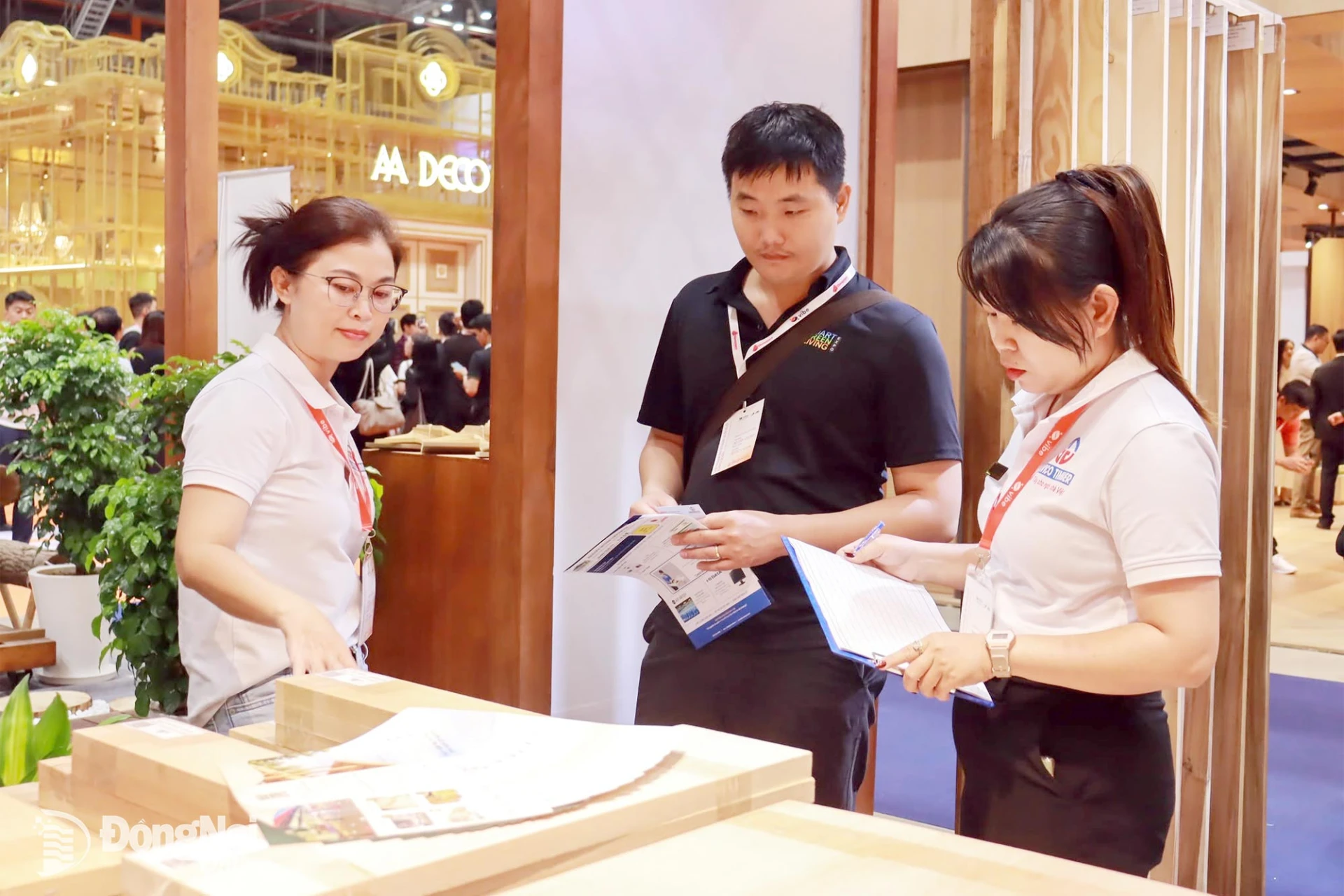 |
| Visitors at the booth of Tan Vinh Cuu Joint Stock Company (JSC) at the Vietnam Interior and Build Expo 2026, held in Ho Chi Minh City from September 30 to October 3. |
Dong Nai has a well-developed wood-processing industry, creating both pressure for businesses to innovate and opportunities to participate more deeply in higher-value furniture supply chains.
Adapting to changing market trends
At the “From Green Ambition to Action” seminar held on October 1 in Ho Chi Minh City as part of the Vietnam Interior and Build Expo 2026 (VIBE 2026), experts and businesses discussed requirements for materials, production processes and environmental data that companies need to address to adapt to the market.
Industry experts noted that although Vietnam’s exports of wood and wood products reached nearly USD18 billion in 2025, many businesses still mainly manufacture products according to designs and specifications provided by foreign partners. As customers become increasingly concerned about environmental standards, businesses need to take a more proactive approach to design, technology and production management rather than competing mainly on price and delivery capacity.
Le Duc Nghia, Chairman of the Board of Directors of An Cuong Wood JSC in Ho Chi Minh City, said the wood industry needs to shift from manufacturing according to partners’ designs to developing its own designs, mastering technology and building brands. For furniture products, these capabilities enable businesses to better control material use, minimise waste and improve quality from the design stage.
Environmental requirements are shifting from broad commitments to verifiable data. To Thanh Son, Director of Sustainable Development of SGS Vietnam Co., Ltd., part of Switzerland-based SGS Group, a global provider of testing, inspection, verification and certification services, said customers are increasingly concerned about emissions at the product, factory and supplier levels. Businesses, therefore, need to monitor electricity and fuel consumption, raw materials and production processes to assess their environmental performance and make necessary adjustments.
Accordingly, businesses need to review their entire production operations. Investing in technology, reducing waste, using materials more efficiently and saving energy can help lower costs and improve productivity. However, the transition requires adequate capital, human resources and appropriate management approaches, particularly for small and medium-sized enterprises.
Connecting raw materials with production
Alongside greening factory operations, building reliable and standardised raw-material supply chains is also critical. Ensuring a traceable source of timber is essential for the wood-processing industry to meet the requirements of the furniture market. In addition to production capacity, businesses need to pay greater attention to the quality and sustainability of timber sources and strengthen links with forest growers.
Vietnam’s wood-processing industry cannot continue to expand primarily on the basis of short-rotation timber plantations and imported raw materials. Building stronger links between forest growers and processing factories to develop sustainable models, increase self-sufficiency in raw materials and upgrade the value chain is becoming increasingly urgent. This will help determine Vietnam’s long-term position in the global wood-export market amid volatile global trade conditions, while increasing the value of processed products.
Dong Nai is one of the localities pursuing this approach, with businesses in the sector beginning to establish partnerships to develop local timber sources. Tan Vinh Cuu JSC in Long Binh Ward has worked with local protection forest management boards and forest growers to develop thousands of hectares of acacia plantations certified under the FSC sustainable forest management standard. Vo Quang Ha, Chairman of the Board of Directors of Tan Vinh Cuu JSC, said the model directly links timber-growing areas with processing businesses, helping establish a supply of certified timber and improve the traceability of timber origins.
However, developing certified plantations requires time, investment and coordination among multiple stakeholders. Forest growers must comply with management procedures and maintain records, while businesses need to establish purchasing plans and long-term partnerships to secure stable markets for the timber. Without clear economic incentives, expanding and maintaining certified raw-material areas will remain challenging.
With its strengths in wood processing and its network of businesses across the supply chain, Dong Nai is well-positioned to expand its role in the green furniture market. Businesses need to combine investment in technology with raw-material management, environmental data and stronger supply-chain linkages to increase value across the furniture production chain.
By V. The – Translated by M.Nguyet, Minho



Thông tin bạn đọc
Đóng Lưu thông tin