
On April 30, 2026, Dong Nai officially became Vietnam’s seventh city. Nearly three months later, the Politburo issued Resolution No. 16-NQ/TW, dated July 21, 2026, on the construction and development of Dong Nai City through 2035, with a vision to 2065 (referred to as Resolution No. 16).
Resolution No. 16 sets out a long-term development orientation for Dong Nai, under which the city will be developed into an airport city featuring a riverside, multi-polar, multi-center, green, smart, and globally connected model. Along with this, on August 24, 2026, the National Assembly passed the Law on Urban Development, establishing a legal framework, mechanisms, and tools for urban planning, investment, construction, and management in the new situation.
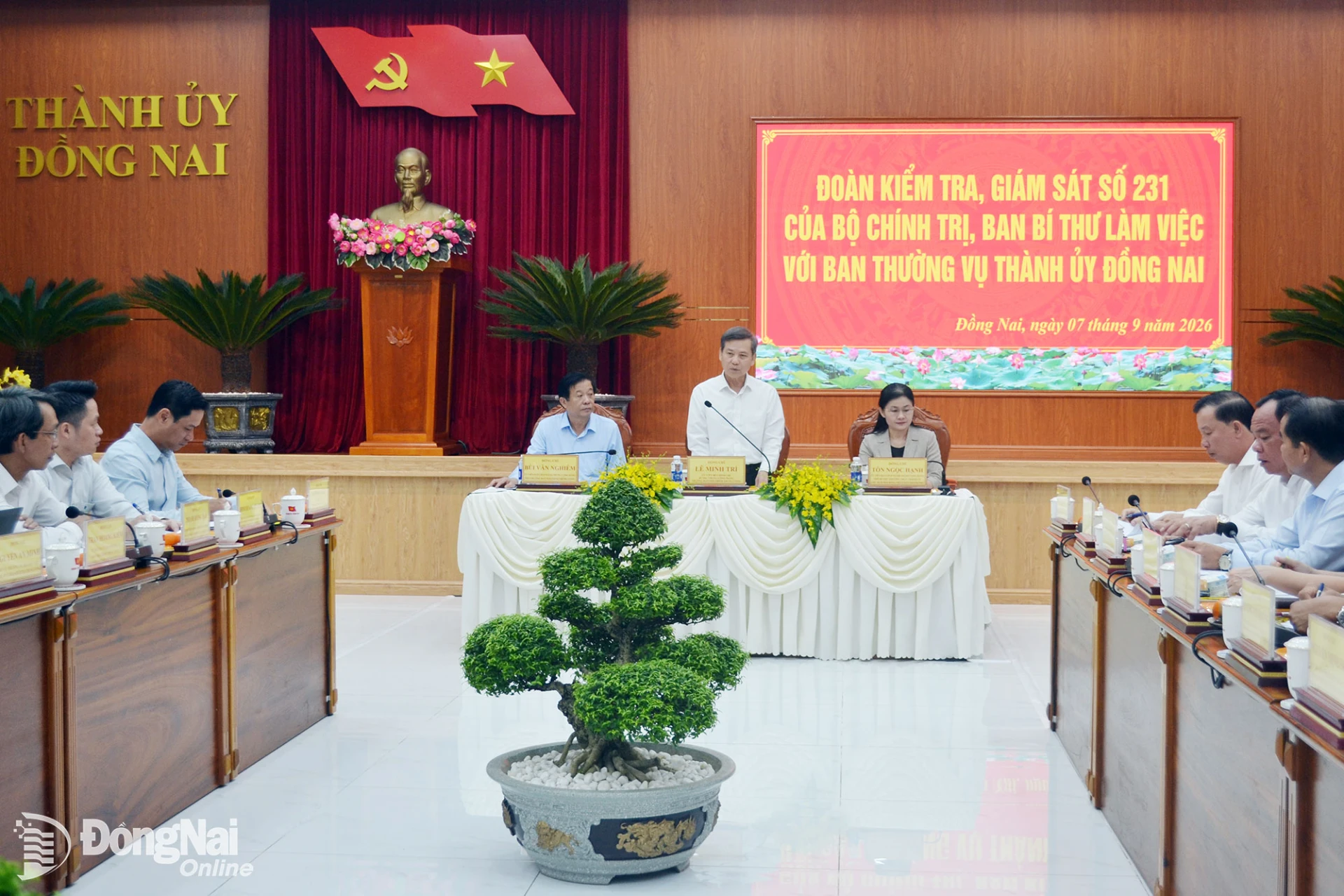 |
| The inspection and supervision delegation of the Politburo and the Party Central Committee's Secretariat monitors the leadership, direction, and implementation of personnel work in Dong Nai City. |
Opportunities for development
The two aforementioned milestones took place within a short period, but both aim to meet the same requirement: transforming Dong Nai's development vision into plans, projects, resources, and concrete changes in daily life. The resolution defines the strategic vision, while the law provides additional institutional tools for building and developing a civilized, modern, and happy city.
The immediate and long-term development goals outlined above place major responsibilities on Dong Nai’s contingent of cadres.
Resolution No. 16 clearly states that Party building and organizational and personnel work are important and core elements of city governance. It calls for building a contingent that is politically steadfast, united, patriotic, capable of meeting the demands of assigned tasks, and able to work in an international environment; taking products, progress, work efficiency, and the satisfaction of citizens and businesses as measures for personnel evaluation; and establishing specific mechanisms to protect dynamic and creative personnel who dare to think, dare to act, and dare to take responsibility for the common good.
At the conference to implement the Politburo's Resolution No. 16, Ton Ngoc Hanh, Member of the Party Central Committee, Permanent Deputy Secretary of the Dong Nai City Party Committee (CPC), and Chairwoman of the City People's Council, said that to ensure the Party's absolute and comprehensive leadership role, it is necessary to effectively apply the mechanism for protecting personnel who dare to think, dare to act, and dare to make breakthroughs for the common good in accordance with the Politburo’s Conclusion No. 14-KL/TW, dated September 22, 2021, on the policy of encouraging and protecting dynamic and creative personnel for the common good.
At the same time, Article 62 of the Law on Urban Development provides a legal basis for exemption from and exclusion of legal liability for cadres and civil servants who perform official duties for the common good and without self-interest, even if damage occurs. This removes the psychological barrier of fear of making mistakes, creating strong motivation for personnel to renew their thinking, improve their execution capacity, and devote themselves fully to the city's development.
Bui Thi Yen, Member of the CPC and Permanent Deputy Head of the CPC's Organization Commission, stated that the total number of cadres, civil servants and public employees across the city is 64,663. Of these, cadres and civil servants at the city and commune levels number nearly 9,900, accounting for nearly 15.3%; public employees in public non-business units at the city and commune levels number 54,785, accounting for 84.72%. Personnel under the management of the Standing Committee of the CPC currently number 522, while 75 people are under joint management.
With the implementation of the two-tier local government model, personnel across the city have been rearranged based on the task requirements and functions of the new organizational structure, with staff assigned according to their capabilities and strengths, thereby improving work efficiency. Most cadres, civil servants, and public employees are striving to renew their thinking and working methods and strongly promote digitalization in handling tasks.
Seizing opportunities
Nguyen Thi Hoang, Member of the CPC and Vice Chairwoman of the City People's Committee, said that in the first six months of 2026, Dong Nai's GRDP growth reached 9.81% compared with the same period. Export turnover exceeded USD24 billion, up 6% over the same period, while import turnover reached USD18 billion, up 9%, resulting in a trade surplus of USD6 billion.
To date, 51 countries and territories have investment projects in Dong Nai, with 2,296 valid foreign direct investment projects and a total investment capital of USD46.1 billion.
Resolution No. 16 sets out a vision through 2065 of building Dong Nai into a modern, green, and smart city with high competitiveness, extensive connectivity with the region and the world, and high levels of quality of life and happiness.
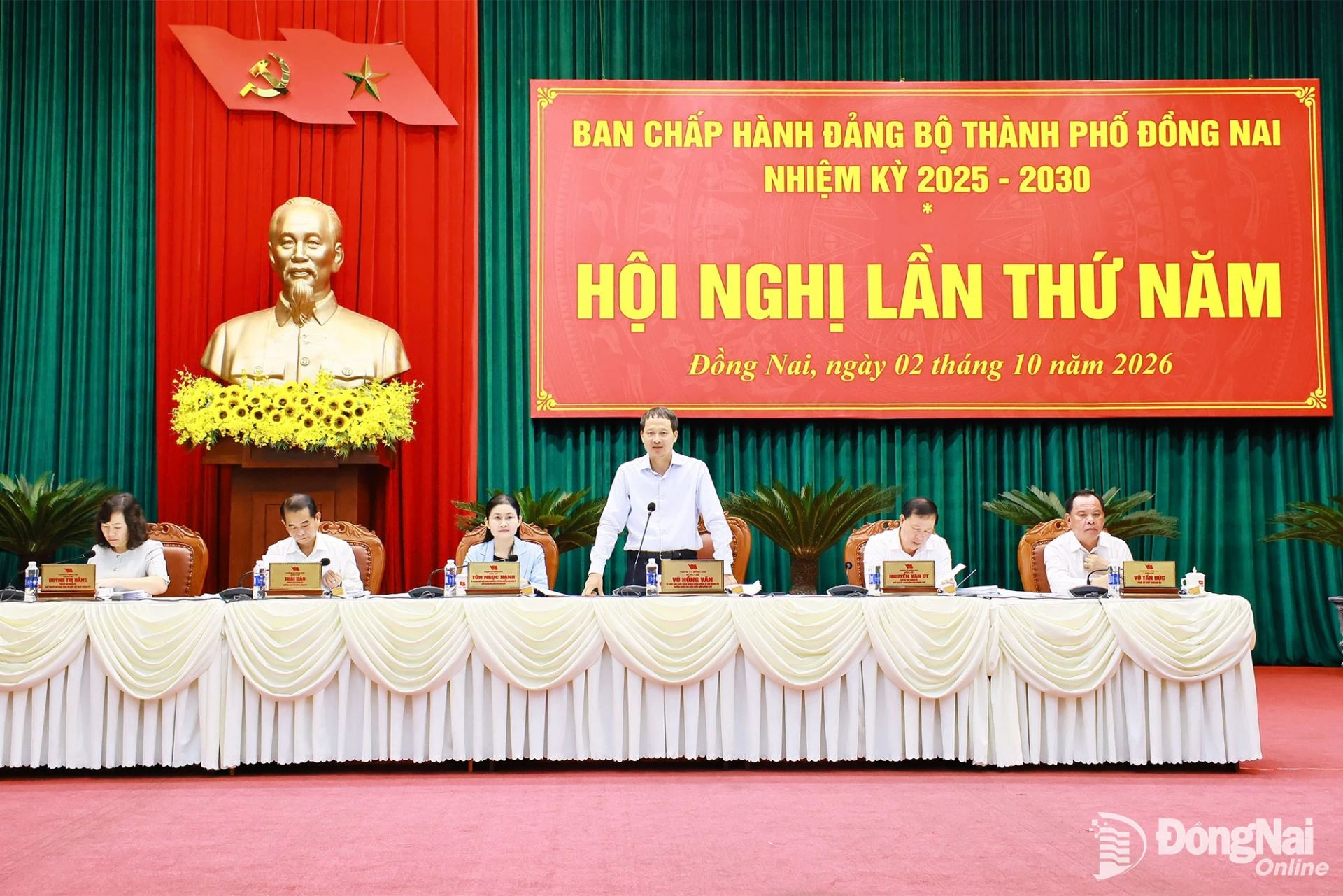
Speaking at the conference to implement the Politburo's Resolution No. 16, Vu Hong Van, Member of the Party Central Committee, Secretary of the CPC, and Head of the Dong Nai City National Assembly Delegation, emphasized that it must be determined that even a sound policy will miss opportunities if implementation is slow; if the mechanism is good but personnel do not know how to implement it and do not dare to act, it will not drive development.
The immediate goals from now through 2030 are to create a solid foundation in planning, infrastructure, institutions, resources, science, technology, and human resources. By 2035, Dong Nai is to form an airport city featuring a riverside, multi-center, multi-objective, green, and smart model and become a center for high-tech industry, the aviation and aerospace industries, and an aviation economy meeting international standards. By 2045, the city is to affirm its position as a modern aviation hub of the Asia-Pacific region, developing on the basis of the knowledge economy and modern urban governance.
The overarching goal is rapid and sustainable development, with a GRDP growth rate of 10% per year or higher during the 2026-2045 period. At the same time, the city will strongly shift toward a growth model based on science, technology, innovation, digital transformation, labor productivity, and high-quality human resources.
At the conference to implement the Politburo's Resolution No. 16, members of the Standing Board of the CPC suggested that, to successfully achieve the set goals, all Party committees, authorities, agencies, units, and every cadre and Party member must clearly define their responsibilities.
For the city and heads of agencies and units, the resolution must be translated into specific plans, programs, schedules, mechanisms, projects, resources, and implementation progress, with key tasks, the order of priorities, and responsible individuals clearly identified. The heads must personally direct, inspect, urge, remove bottlenecks, and take responsibility for the implementation results. Matters within their authority must be decided; matters beyond their authority must be proactively proposed; and interdisciplinary matters must have a single responsible focal point.
Each agency and unit must concretize the resolution into tasks to be carried out, completion deadlines, resources, responsible persons, and results to be achieved. General programs must not be developed, and backlogs of work must not be allowed to drag on. Each commune and ward must incorporate the resolution into specific local tasks associated with the daily lives and satisfaction of the people.
Each cadre and Party member must answer for themselves: What does Resolution No. 16 have to do with my work? What must be changed in the way things are done? What results must be achieved? This must become a regular requirement in the performance of duties.
The CPC leaders also emphasized that words must be matched by actions, tasks must be seen through to completion, and results must be produced; there must be a shift from "being assigned work" to "proactively acting," and from "doing things by the book" to "creating value and substantive effectiveness."
Resolution No. 16 has opened up a new vision, a new position, a new development space, and new opportunities for Dong Nai; the Law on Urban Development provides additional legal tools to realize that vision.
However, opportunities can only become reality through decisive action. The Central Government has placed its trust and paved the way; our task is to proactively seize the opportunity, turn vision into action, potential into resources, and resources into works, projects, and concrete development results.
The vibrant land of Dong Nai, located at a vital link, is being energized by important policies from the Central Government. The contingent of cadres and Party members of the Dong Nai CPC is working in the spirit of “until the job is done, not until the clock says stop,” with an aspiration to rise and a determination to achieve GRDP growth of 11% in 2026 and budget revenue of VND150 trillion, while preparing to assume its role as an important national growth pole.
By Duong An – Translated by Minh Hong, Thu Ha
Thông tin bạn đọc
Đóng Lưu thông tin