
>>> Part 1: Creating favorable conditions for citizens and enterprises
>>> Part 2: Developing contingent of friendly, people-oriented cadres
Final Part: From “Friendly Administration” model to raising service standards
Grassroots approaches that bring the government closer to the people are creating tangible changes in the way the administration serves citizens, making it more professional and modern.
The value of the Friendly Administration model lies not only in its effectiveness in individual localities but also in its potential to be standardized, sustained, and replicated as a regular operational method. In this way, a friendly administration is no longer merely a model but becomes a requirement for service quality, accountability, and work performance.
Standardizing through specific actions
In Dau Giay Ward, Dong Nai City, the friendly administration is being put into practice through measures ranging from service delivery methods to mobilizing residents and the community to participate. In addition to maintaining the "3-no Thursday" model, the "Four Courtesies, Four Always" behavioral standards, and the practice of sending congratulatory letters for births and marriages and condolences for bereavements, the ward also promotes the roles of mass organizations and community digital technology groups in guiding and assisting residents in accessing public services and digital utilities.
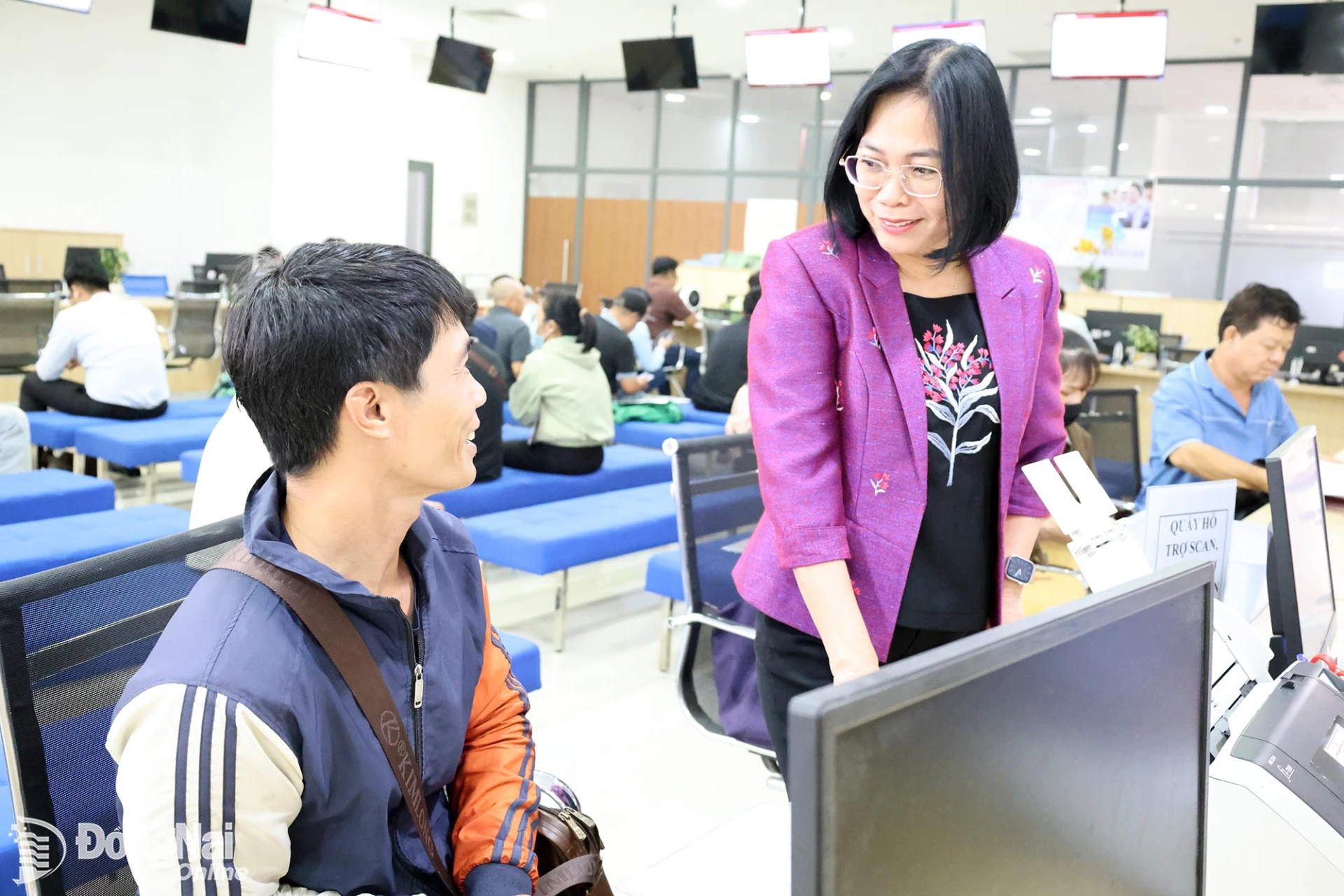 |
| Nguyen Thi Hoang, Member of the Dong Nai City Party Committee and Vice Chairwoman of the City People's Committee, talks with citizens carrying out administrative procedures at the City Public Administration Service Center. |
According to Vice Chairman of the Dau Giay Ward People's Committee Nguyen Le Truong Son, the ward is shifting from merely completing procedures to improving service quality at every stage, from providing information and guidance on documentation to receiving and processing dossiers and delivering results. With a citizen-centered approach, the ward proactively accompanies, supports, and listens to residents throughout the process, ensuring that each procedure is not only resolved in accordance with regulations but also carried out in the spirit of serving the people.
In Loc Hung Commune, this requirement is reflected in the way the entire system organizes its work. Deputy Secretary of the Party Committee and Chairwoman of the Loc Hung Commune People's Committee Nguyen Thi Xuan Linh said that building a friendly administration, promoting administrative reform, and advancing digital transformation are not merely tasks for specialized departments but require the involvement of the entire political system, particularly the responsibility of its leadership. Cadres and civil servants are required to provide clear guidance, avoid shifting responsibility, and ensure that tasks are handled thoroughly in accordance with the "six clear" principle: clear people, clear tasks, clear timelines, clear responsibilities, clear authorities, and clear results.
Grassroots approaches also place greater demands on the conditions underpinning service processes. Through thematic surveys and monitoring of digital transformation and the application of science and technology in resolving administrative procedures and providing public services during the implementation of the two-tier local government model in early September 2026, Member of the City Party Committee’s Standing Board and Permanent Vice Chairman of the City Vietnam Fatherland Front Committee Ha Anh Dung said that it was necessary to complete connectivity and data synchronization; increase the capacity for data extraction and reuse; minimize information re-entry; and reduce documentation requirements. Along with data, infrastructure needs to be upgraded to ensure the capacity to receive and process dossiers, promptly address technical errors, and enable service processes to operate stably so that citizens can access digital services more conveniently.
Measured by results, sustained through responsibility
For the Friendly Administration model not to remain a series of isolated initiatives, it must be standardized into a regular operational method and performance criteria. According to Dr. Ta Van Soat, Vice Principal of the Dong Nai City School of Politics, from both theoretical and practical perspectives, this requirement must be integrated into the task implementation process of the entire political system.
Dr. Ta Van Soat believes that Resolution No. 05-NQ/TU, dated May 1, 2026, issued by the City Party Committee’s Executive Board to launch the special 500-day-and-night emulation campaign themed “Unity – Discipline – Efficiency – Breakthrough, building a civilized and modern Dong Nai” (referred to as Resolution No. 05), is a broad political activity that requires action from the entire political system and is highly significant in gradually realizing the aspirations, vision, and development goals of Dong Nai City in the new era.
"Building and consolidating the people's strong trust in the Party and the State stem from the dedication and professionalism of the public apparatus. Realizing President Ho Chi Minh's ideology that 'the people are the root' through a spirit of service is the strongest fortress for protecting the Party's ideological foundation and effectively refuting false and distorted arguments in the new situation."
Dr. Ta Van Soat, Vice Principal of the Dong Nai City School of Politics
"Therefore, establishing a citizen-friendly administration is both a task and an urgent requirement in current local governance. To maintain sustainable momentum and achieve the goals of the emulation campaign, it is necessary to transform the content of the emulation campaign into standard operating procedures for the two-tier local government and into criteria for monthly, quarterly, and annual performance evaluations for each cadre and civil servant," proposed Dr. Ta Van Soat.
Dr. Ta Van Soat also suggested that actual results should be measured by citizen satisfaction through direct and reliable channels such as QR code scanning or independent surveys, serving as a basis for emulation rankings and cadre appointments. This would create a standard public service culture that nurtures the spirit of serving the people until it becomes a daily habit.
From the perspective of state management, Deputy Director of the Department of Home Affairs Ha Thanh Tung said that a friendly administration must be reflected throughout the process of citizens resolving matters with state agencies. For complex procedures, such as those in the land sector, citizens are concerned about whether their dossiers are clearly guided, processed in accordance with regulations and deadlines, and which agency is responsible for resolving issues when they arise.
According to Ha Thanh Tung, a friendly administration must be tied to specific responsibilities at each stage. For procedures involving multiple agencies, it is necessary to clearly define the lead agency, coordinating agencies, processing time, and responsibilities at each stage in line with the "six clear" principle. The management and evaluation of cadres and civil servants must be based on task performance results; information systems should gradually be applied to track progress and work quality, linking results to the evaluation and ranking of cadres and civil servants as well as the responsibility of the leadership.
Along with these efforts, digitization, connectivity, and data exploitation are being promoted to limit requests for citizens to resubmit information already held by state agencies. Regarding the replication of the model, reviews and evaluations must be based on actual effectiveness and citizen feedback. Effective practices should be standardized, with guidance provided for their wider replication, while content that is merely formalistic or inappropriate should be adjusted.
This orientation aligns with the city's requirements for implementing Resolution No. 05. The resolution clearly identifies the satisfaction of citizens and businesses as the yardstick for the operational efficiency of agencies and units, with a target rate of 95% or higher.
This spirit is also concretized by the city through the requirement to uphold the responsibility of the heads of the agencies and clearly define tasks, schedules, and performance results. In directing and administering operations, Deputy Secretary of the City Party Committee and Chairman of the City People's Committee Nguyen Van Ut has requested that agencies and units translate tasks into clear work items with specific schedules and results, strictly implementing the "six clear" principle. Accordingly, task performance results must be expressed in concrete numbers, creating substantive changes in each field and unit.
Based on the city's requirements, a friendly administration does not stop at introducing another model or a new approach but must be integrated into the apparatus's daily organization of work. At a broader level, the requirement to standardize government operations also aligns with the orientation set out in the Politburo’s Resolution No. 16-NQ/TW, dated July 21, 2026, on building and developing Dong Nai City until 2035, with a vision for 2065. The resolution defines the tasks of building a clean and strong Party and political system; building a streamlined apparatus that operates with high performance, effectiveness and efficiency; promoting decentralization and delegation of power in conjunction with inspection, supervision, and control of power; and building a contingent of cadres who dare to think, dare to act, and dare to take responsibility for the common good.
Amid demands to innovate management methods, the Friendly Administration model should not merely focus on doing things better but must become a standard for how the apparatus operates. When every process and working style is standardized and every result is tied to responsibility in the performance of public duties, citizens will clearly experience tangible service quality in their everyday tasks.
By Ho Thao – Translated by Minh Hong, Thu Ha


Thông tin bạn đọc
Đóng Lưu thông tin