
Immediately after implementing the two-tier local government model, Dong Nai has introduced a range of effective models and innovative approaches to organizing and operating grassroots government. In particular, the implementation of Friendly Administration model has further concretized practical, realistic, and professional approaches through specific actions in the way the administration serves citizens and enterprises.
Part 1: Creating favorable conditions for citizens
and enterprises
To professionalize services for citizens and enterprises, on August 21, 2025, the Dong Nai Provincial (now Municipal) People's Committee issued Plan No. 63/KH-UBND on building and implementing the Friendly Administration model in 2025.
The plan primarily aims to improve public service ethics, responsibility, and the service style of commune-level officials, civil servants, and public administrative service centers, following the motto, "Respect the people, be close to the people, understand the people, learn from the people, and be responsible to the people," thereby increasing the satisfaction of citizens and enterprises.
Innovating service delivery
On her first visit to the Dong Nai City Public Administrative Service Center to register land-related changes, Do Thi Minh, from Tran Bien Ward, was quite confused by the forms she needed to complete. Her anxiety was quickly eased when staff at the reception area reviewed her documents and guided her in completing the forms before she proceeded to the counter to submit her application. Instead of taking a number and waiting only to find out later that an application is incomplete or incorrect, citizens are now assisted in checking their documents from the outset.
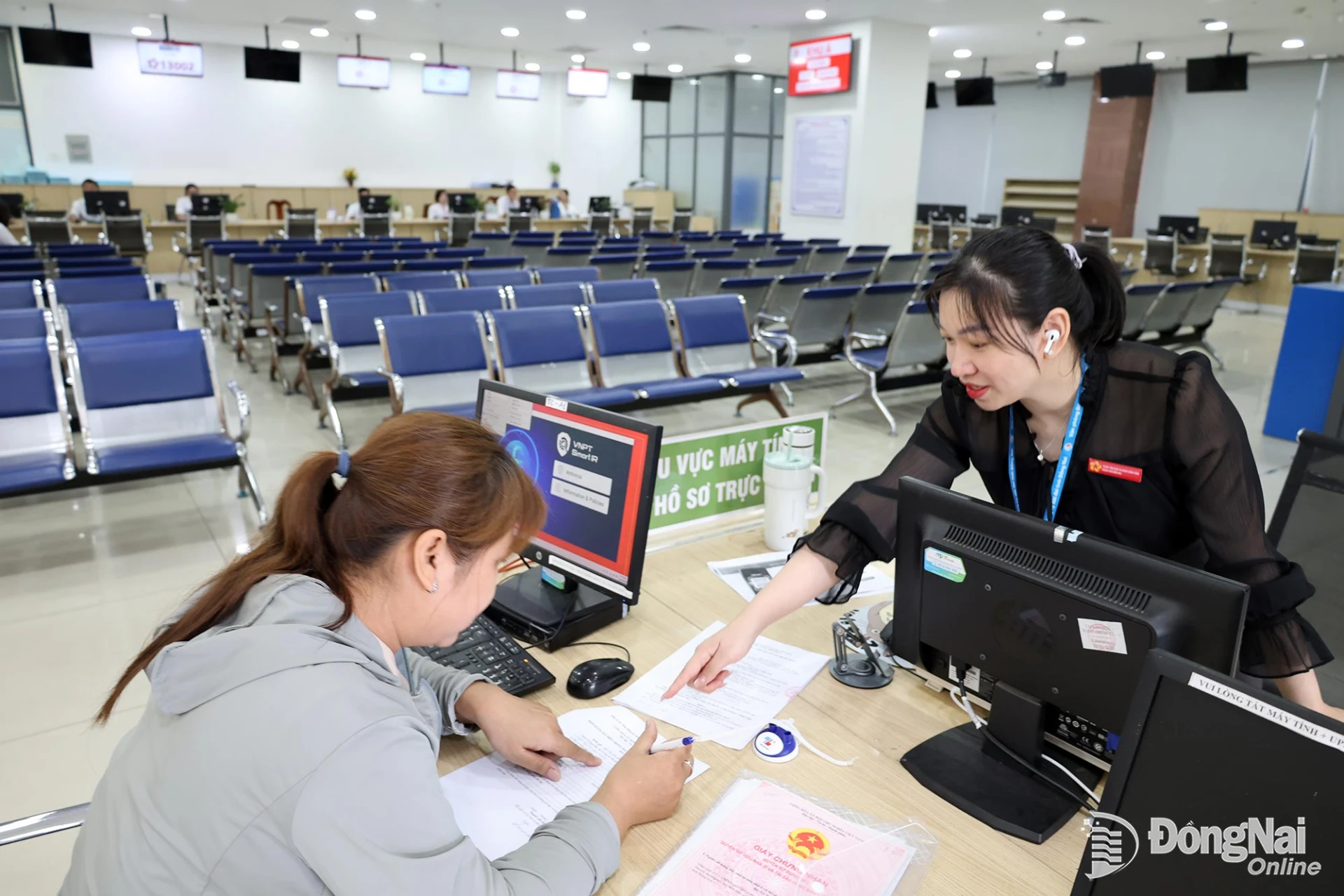 |
| A public employee from the City Land Registration Office guides a citizen in reviewing documents and completing a form. |
Pham Thi Huong Giang, a public employee at the City Land Registration Office, said, "Previously, citizens would take a number and wait for their turn. When staff checked and found missing documents, citizens had to go outside to redo them and then take another number, which was very time-consuming. We now proactively assist citizens in checking and completing their entire application from the start. Putting ourselves in the citizens' shoes, our goal is to provide maximum support and minimize waiting time."
This method of organization is further supported by upgraded infrastructure, including LAN systems, Wi-Fi, computers, and equipment for online public services. According to Deputy Director of the Department of Science and Technology Nguyen Minh Quang, the city has proactively allocated funds to repair and upgrade information technology infrastructure to better serve citizens every day.
Technology is not only making the reception stage more convenient but also being applied to a wide range of service activities. For example, Dong Xoai Ward has piloted a receptionist robot, a robot integrated with an artificial intelligence (AI) chatbot, and an internal smart AI system to assist in looking up administrative procedures and evaluating work efficiency. Deputy Secretary of the Party Committee and Chairman of the Dong Xoai Ward People's Committee Duong Hoai Pha emphasized that AI is being increasingly applied to serve citizens, support officials and civil servants, and manage internal operations, creating a foundation for building a digital government.
Supporting citizens at home
The way citizens are served is being adjusted to become more flexible, from innovating processes and applying technology to bringing services closer to the people.
In Binh Minh Commune, since August 2026, the locality has provided support for citizens to submit applications online directly from home, prioritizing the elderly, people with disabilities, policy-beneficiary families, and those living alone. Citizens can register directly or through hamlet officials, after which a support team visits their homes to provide guidance. Along with this, the "Appointment-free Friday" model has been implemented for certain procedures that can be resolved within the day. Vice Chairwoman of the Binh Minh Commune People's Committee Pham Thi Le Thuy said, "These solutions aim to resolve administrative procedures promptly, shorten time, and maximize people's satisfaction."
In Loc Hung Commune, the organization of services takes into account the characteristics of the population, with ethnic minorities accounting for more than 20% of residents. The locality maintains eight community digital technology teams, uses software for data collection based on the "once-only data" principle, and enhances "hands-on" guidance.
Le Dinh Long, Deputy Director of the Loc Hung Commune Public Administrative Service Center, said, "We are particularly focused on supporting ethnic minorities and the elderly. The goal is not just to resolve applications on time but also to create a friendly environment and minimize the need for people to travel back and forth multiple times."
In Long Thanh Ward, service hours have also been adjusted to suit the daily routines of local people, particularly shift workers. The "9th and 10th Hour" model operates from 5:00 p.m. to 7:00 p.m. every Wednesday, along with "Digital Sundays with residents" held at neighborhood cultural houses. Officials assist citizens in completing online applications, supplementing application documents, activating VNeID accounts, and handling issues related to identification cards.
Tran Van Nam, a worker at the Long Thanh Industrial Park, shared, "I work in back-to-back shifts, so it is very difficult for me to get time off during office hours. Thanks to the Wednesday evening and Sunday service hours in the neighborhood, I can manage to get things done without having to ask for time off or travel multiple times."
Through these specific approaches, local authorities are concretizing the requirement to serve citizens in ways tailored to each target group and actual conditions. Ha Thanh Tung, Deputy Director of the Department of Home Affairs, the agency advising on the implementation of the Friendly Administration model, emphasized, "After more than a year of implementing this model, a clear transformation is the gradual change in the perception and service delivery of local government toward being closer to the people, more responsive to their needs, and using the satisfaction of citizens and enterprises as a measure of service quality."
According to Deputy Director of the Department of Home Affairs Ha Thanh Tung, an important indicator is that Dong Nai's Satisfaction Index of Public Administrative Services (SIPAS) has continuously improved, from 80.44% in 2023 to 82.41% in 2024 and 87.16% in 2025. Specifically, satisfaction with public administrative service delivery increased from 80.74% in 2023 to 86.93% in 2025. In 2025, Dong Nai's SIPAS reached 87.16%, ranking third among 34 provinces and cities.
Ha Thanh Tung said, "Building a friendly administration is an ongoing process, it does not end with earning a title. The important thing is that the changes must be felt by the people in every contact and every specific application."
A friendly administration requires both standard conduct and the ability to resolve work effectively. These two factors are inseparable; when performed well, they complement each other and contribute to achieving the goals of state governance and local governance. The most substantive measure of a friendly administration is whether work is resolved legally, on time, effectively, and transparently.
Dr. Ta Van Soat, Vice Principal of the Dong Nai City School of Politics
Changes in the way public services are organized also help translate the requirement to improve the quality of services for residents into concrete actions as part of administrative reform efforts. At a seminar on solutions to improve the effectiveness of using SIPAS and PAR (Public Administration Reform) Index, co-organized by the Ministry of Home Affairs and the Dong Nai City People's Committee in June 2026, Deputy Minister of Home Affairs Nguyen Van Hoi assessed that Dong Nai is one of the localities with many outstanding results in administrative reform, shortening the time required to resolve procedures and building a contingent of responsible and dedicated officials.
Through specific actions, the spirit of the Friendly Administration model is increasingly permeating every procedural process, every locality, and every interaction when citizens come to work with administrative agencies. For this model to be truly effective, the core factor that Dong Nai City is focusing on is the development of a contingent of dedicated officials and civil servants who are wholeheartedly committed to serving the people.
By Ho Thao – Translated by Minh Hong, Thu Ha

Thông tin bạn đọc
Đóng Lưu thông tin