
Alongside trade unions, establishing women’s organisations in businesses would provide an additional channel for female workers to voice their concerns, aspirations and legitimate needs and receive appropriate support. This would help foster harmonious labour relations, create a more supportive working environment and gradually improve the quality of life of female workers.
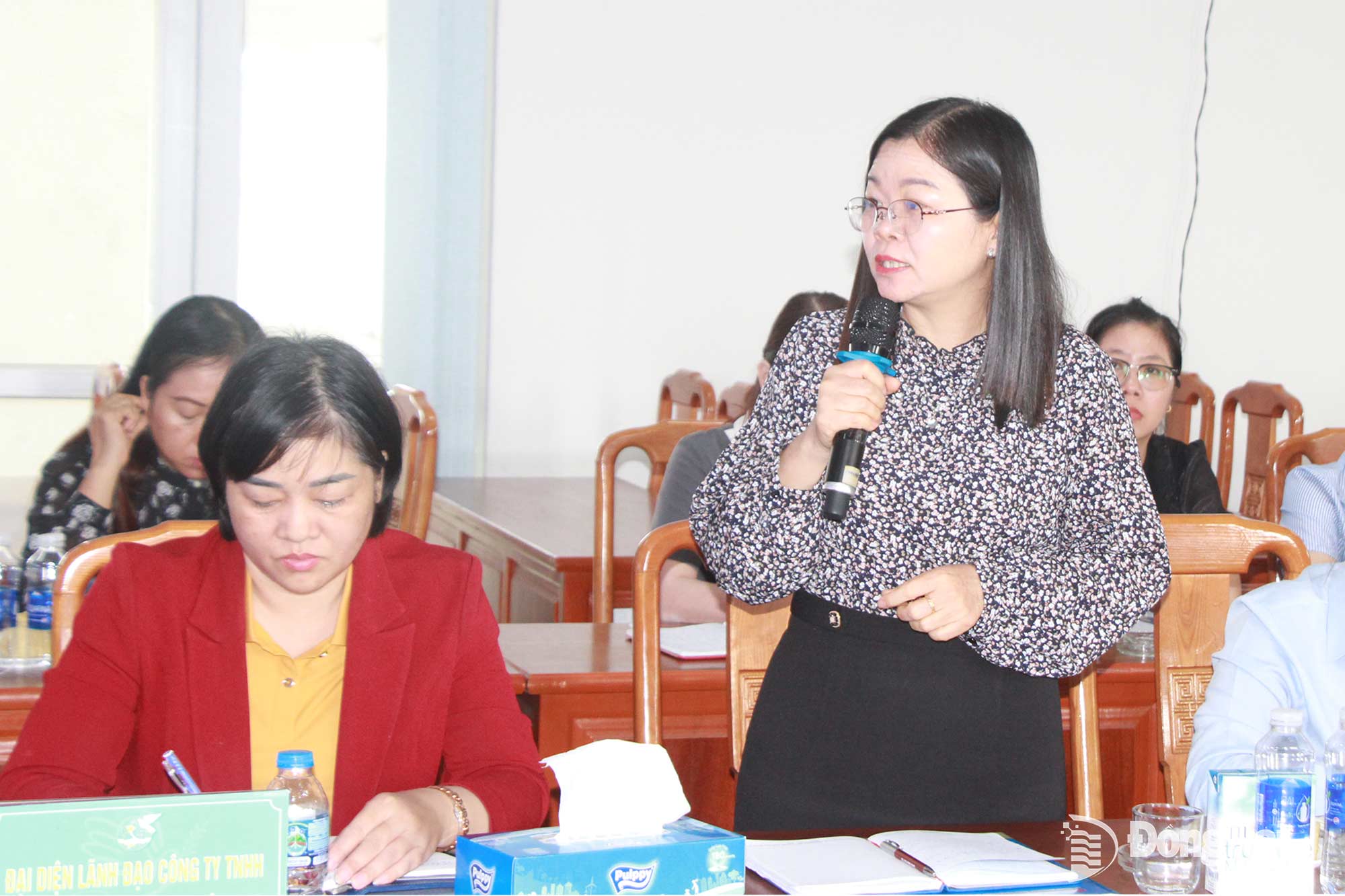 |
| A delegate speaks at a seminar on research and survey of the pilot organization and operation of women’s organisations in industrial parks (IPs). |
In recent years, women’s unions at all levels in the city have sought to engage women working in businesses and living in rented accommodation through various activities and organisational models. They have also coordinated programmes to provide female workers with knowledge and skills and improve their material well-being and quality of life.
Bringing female workers together
Speaking at a recent seminar on research and survey of the pilot organization and operation of women’s organisations in IPs in Dong Nai, Bui Thi Hanh, Vice Chairwoman of the Dong Nai city Women’s Union (DNWU), said that following the merger, Dong Nai has around 750,000 workers, of whom women account for about 55%. Female workers make up a major part of the workforce and play an important role in the city’s socio-economic development.
In recent years, to implement the plan of the City Party Committee’s Standing Committee to step up Party membership recruitment and develop Party organisations and socio-political organisations in non-State businesses, the DNWU has drawn up a plan that includes targets for monitoring female workers, developing women’s organisations in businesses and establishing models to engage female workers in emulation campaigns.
In the first six months of 2026 alone, women’s unions at all levels established two new women’s branches in businesses and 12 women’s groups in rented accommodation. The city now has 11 women’s branches in businesses, one women’s club in a business and 310 women’s groups in rented accommodation, with more than 7,200 members.
Amid the rapid development of the internet and social media, the DNWU has also developed and rolled out an online engagement platform based on the open-source NukeViet application to all 100% of commune- and ward-level women’s unions. By integrating online activities, communication materials, contests, paperless meeting rooms and information management functions, the platform enables grassroots women’s organisations to reach women in general and female workers in particular in a more flexible and effective manner without disrupting their shift-based working schedules.
However, given the size of the city’s female workforce, the proportion of female workers participating in these engagement models remains modest. Huynh Thi Truc Giang, Vice Chairwoman of the Vietnam Fatherland Front Committee and Chairwoman of the Women’s Union of Trang Dai ward, said establishing women’s organisations in businesses remains difficult because of limited access to business owners. Other obstacles include limited time and resources, workers’ shift schedules and the shortage of grassroots women’s union officials, all of which affect the establishment and operation of women’s organisations in businesses.
Adapting to new context
Speaking at the seminar, Dang Huong Giang, Member of the Central Committee of the Vietnam Women’s Union and Deputy Head of its Women’s Affairs Division, said women’s unions at various levels and in some localities had experimented with establishing women’s organisations in businesses for many years. However, these models were mainly introduced in small businesses. Following the COVID-19 pandemic, many small and medium-sized businesses were dissolved or changed their operations, resulting in a significant decline in the number of women’s organisations in businesses. In practice, the model has also seen limited implementation in some localities.
Dang Huong Giang said establishing women’s organisations in businesses is necessary under current circumstances. However, their operating models should be further studied and adjusted to better suit the current context, individual businesses and the needs of female workers.
In developing plans to establish women’s organisations within businesses, the Vietnam Women’s Union Central Committee will study ways to ensure that their activities do not overlap with existing organisations and models, while meeting the needs of female workers and building consensus and coordination among businesses and relevant organisations.
Dang Huong Giang, Deputy Head of the Women’s Affairs Division.
Nguyen Thi Tuyet, Vice Chairwoman of the city Labour Confederation, said at the seminar that the needs of female workers today go beyond employment, income, benefits and social protections. They also include reproductive healthcare, childcare, protection from social risks, work-life balance, and opportunities to interact and share experiences with colleagues.
According to Tuyet, appropriate forms of engagement are needed to bring female workers together. The focus should shift from “encouraging participation” to “meeting needs” so that female workers themselves are motivated to seek out these organisations. Trade unions and women’s organisations can also work together to avoid overlapping activities and complement each other’s roles, thereby providing better support for female workers.
From the business perspective, Tran Thi Thu Huong, General Affairs Director of Chien Vietnam Furniture MFG. Co., Ltd. in Tam Phuoc ward, said workforce stability is directly linked to a company’s productivity and business performance. The grassroots trade union already represents workers and protects their rights and interests. However, if properly organised, women’s activities within businesses could provide a more specialised channel of support for female workers.
According to Huong, women’s organisations in businesses will be welcomed if their activities are focused, practical and easy to participate in, address the specific needs of female workers and contribute to the stable development of businesses. Establishing women’s organisations in businesses, therefore, is not about creating another layer of organisation, but about providing an additional source of support through which female workers can receive better support and protection and have greater opportunities to realise their potential.
By N. Son – Translated by M.Nguyet, Thu Ha


Thông tin bạn đọc
Đóng Lưu thông tin