
The digital era offers students significant opportunities to access knowledge and keep up with information from around the world. However, excessive engagement with social media, including trivial entertainment, fleeting trends, negative comments and unverified information, can lead to serious consequences. Such habits not only undermine students’ ability to concentrate but also weaken their reading comprehension and critical thinking skills.
In response to this challenge, a group of teachers and students at Ngo Si Lien High School in Trang Bom Ward has developed a Smart Online Use model to limit the negative effects of social media on students.
Using social media in a controlled and responsible way
Le Thi Ngan, a teacher at Ngo Si Lien High School, said the Smart Online Use model emerged from a research project in which students examined the phenomenon known as “brain rot” and social media usage habits among students, under the guidance of their teachers.
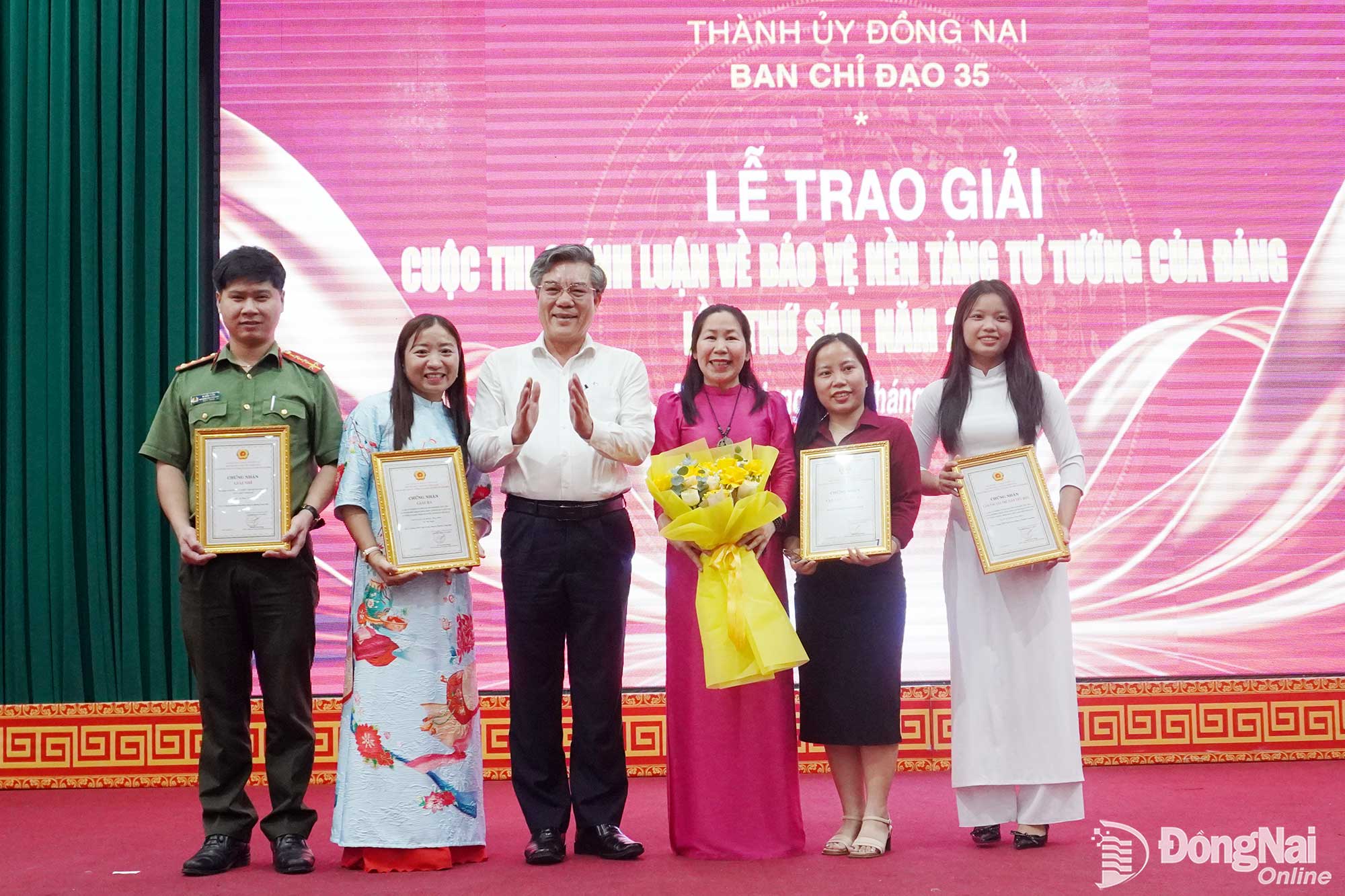 |
| Duong Minh Dung, Member of the City Party Committee’s Standing Board, Head of the City Party Committee’s Propaganda and Education Department, congratulates Le Hoang Thuy Phuc (far right), a Grade 12A2 student at Ngo Si Lien High School, and teacher Le Thi Ngan (second from the left) on winning awards in the sixth national political essay contest on safeguarding the Party’s ideological foundation in 2026. |
“Brain rot” is a commonly used term describing concerns about the effects of consuming excessive amounts of low-quality digital content. It is not the name of a medical diagnosis. Put simply, it refers to the perceived erosion of cognitive abilities caused by excessive exposure to low-quality digital content, particularly short, fast-paced material designed to stimulate emotions but offering little educational value.
The Smart Online Use model aims to help students recognize the negative consequences of uncontrolled social media use, develop information-selection skills, verify sources before sharing content and reduce their consumption of trivial material. At the same time, it encourages greater engagement with reliable information, useful knowledge and practical activities at school. Using online platforms intelligently also helps students and Youth Union members learn to identify misinformation, verify facts, access reliable sources, develop critical thinking and behave respectfully on social media. These skills can contribute to protecting the Party’s ideological foundation.
Le Hoang Thuy Phuc, a Grade 12A2 student at Ngo Si Lien High School, said that alongside authoritative and useful information, students can easily encounter sensationalist, negative, misleading or unverified content online. Social media platforms often recommend content based on users’ viewing habits. As a result, if students frequently watch short videos that offer light entertainment, spark controversy or provoke emotional reactions, similar content will continue to appear. Over time, viewers may be drawn into an information loop without realizing they are consuming too much low-quality content.
Building the model on survey findings
To develop the Smart Online Use model, Phuc’s group surveyed 968 students at the school about their social media habits. The survey found that 40.7% of students spent between two and four hours a day on social media, while 21.2% spent more than four hours a day on online activities.
If every hour spent online is devoted to learning, acquiring knowledge, accessing information from official sources and spreading positive values, cyberspace can become an environment that supports the holistic development of young people. Conversely, if time spent online is dominated by content that is of little value, unverified or negative, undesirable effects on perceptions and behavior are difficult to avoid.
The Smart Online Use model does not focus on banning students from using social media. Instead, it seeks to help them use these platforms for appropriate purposes, in the right way and with a sense of responsibility. The model’s activities are designed to be accessible and easy to understand. Rather than relying solely on theory, the student team presents practical situations for discussion, such as spending too long scrolling through short videos, sharing unverified news, getting drawn into negative comment threads, losing concentration in class because of a phone, or believing sensationalist online claims. Students then discuss these scenarios and propose ways to respond.
The model also equips students with the skills to “pause before sharing.” When encountering shocking, harmful or toxic information, students should ask themselves several questions rather than immediately clicking the share button: Where did this information come from? Has any reputable news organization published it? Has the content been edited or spliced together? What is the author's purpose? Could sharing it negatively affect someone else?
In addition to teaching practical skills, the model encourages students to develop a healthy “digital diet.” They share useful content, worthwhile articles and reliable information channels with one another.
“After participating in the model, many students have begun to change the way they view social media. They no longer see Smart Online Use as just a slogan; they understand that it is an essential skill for protecting themselves and their community.”
Le Hoang Thuy Phuc, Grade 12A2 student at Ngo Si Lien High School, Trang Bom Ward
According to Do Thi Hong Nhung, Vice Principal of Ngo Si Lien High School, the school’s management board recognized the model’s practical value and launched a Smart Online Use campaign throughout the school. Class officers and Youth Union officers serve as the core force in communicating the model’s positive message to the entire student body.
The model does not set overly ambitious or complicated goals. Instead, it aims to encourage every student to set time limits on social media use, turn off notifications during lessons, spend time reading books or participating in sports rather than spending too much time scrolling through social media, follow reputable information channels, refrain from making negative comments and proactively report harmful or toxic content involving students to teachers. When students learn to use social media responsibly, select information carefully, spread positive messages and stay away from harmful content, they are also laying the foundation for political steadfastness, civic consciousness and social responsibility among young people. These practices also represent a way for young people to protect the Party’s ideological foundation.
By Phuong Hang – Translated by Mai Nga, Minho
Thông tin bạn đọc
Đóng Lưu thông tin