
Dong Nai City is facing unprecedented opportunities to make a breakthrough development in the new era. However, the quality of its human resources has yet to keep pace with these opportunities, requiring fundamental solutions to address existing bottlenecks.
At a working session with universities and colleges in early September 2026, Ton Ngoc Hanh, Member of the Party Central Committee, Standing Deputy Secretary of the Dong Nai City Party Committee and Chairwoman of the City People's Council, stressed: “The Dong Nai City Party Committee has identified education and training as the foundation for sustainable development. High-quality human resources are the “golden key” to accessing modern technologies and, in turn, improving labor productivity during the city's new development phase.”
Identifying bottlenecks in education infrastructure
Dong Nai currently has more than one million pupils and students, ranking third nationwide after Hanoi and Ho Chi Minh City. Despite this scale, its education infrastructure has yet to meet actual demand. In remote and disadvantaged areas, school facilities remain inadequate, while in rapidly urbanizing wards and communes, particularly those near concentrated industrial parks, class sizes remain high. Consequently, areas undergoing rapid urbanization and industrial development often have a relatively low proportion of schools meeting national standards, largely due to limited land availability and overcrowding.
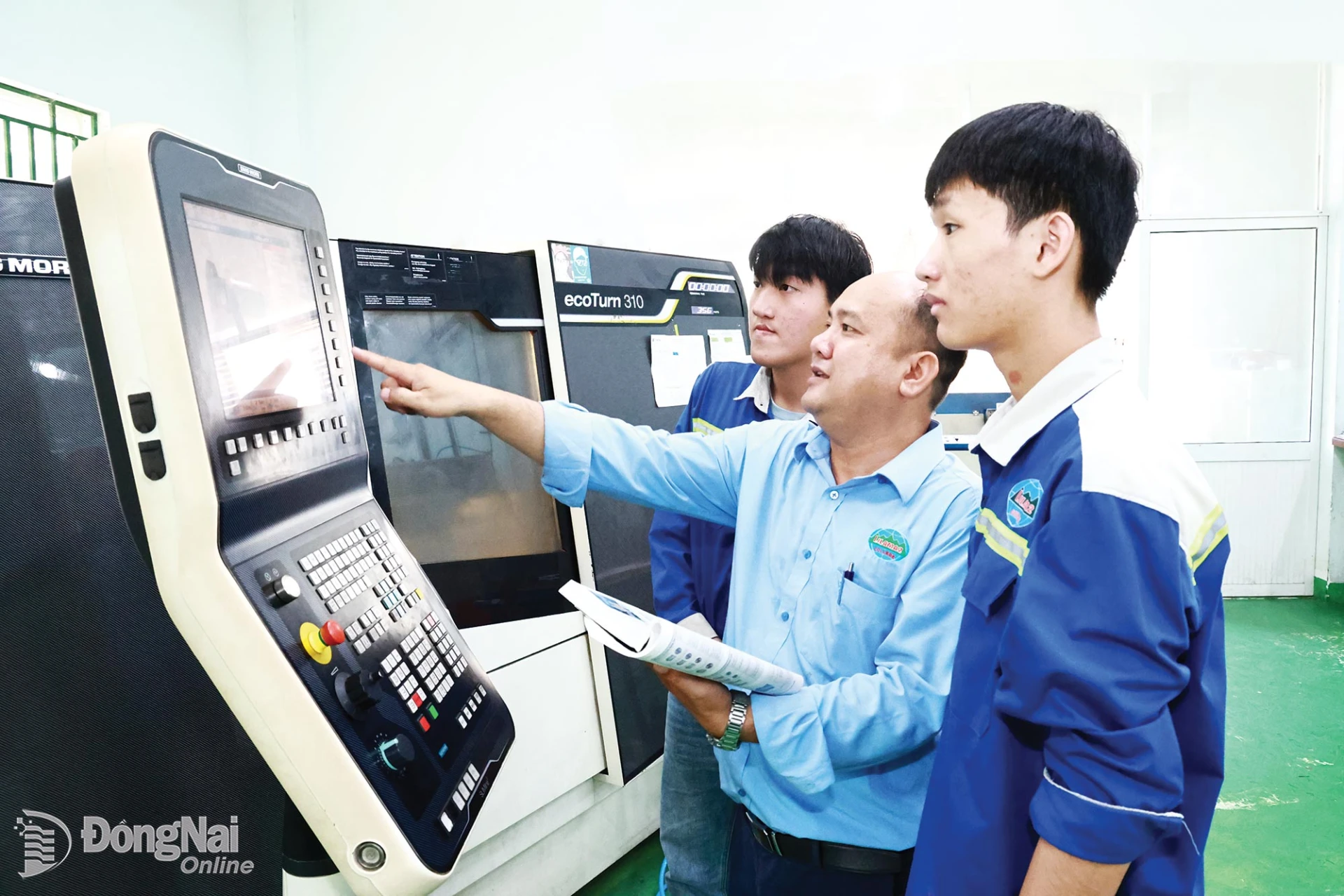 |
| Students at Lilama 2 International Technology College in Long Phuoc Commune is equipped with modern training equipment imported from Europe. Photo: Cong Nghia |
These shortcomings in education infrastructure have affected the quality of teaching and learning, from general education to higher education. This is reflected in the relatively modest performance of Dong Nai students in annual national contests for excellent students. Their achievements in regional and international competitions have also remained limited compared with their peers from other provinces and cities. In addition, the city's annual high school graduation results and rates have yet to reflect its position in the national economy.
Although Dong Nai is one of the country's major industrial cities, it still lacks higher education institutions commensurate with its development needs. Despite the growing availability of high-quality job opportunities locally, graduates of Dong Nai's educational institutions face stiff competition from those trained in Ho Chi Minh City. For example, during recruitment for operations at Long Thanh International Airport, the majority of successful candidates came from educational institutions in Ho Chi Minh City.
The need for high-quality human resources has become more urgent than ever as the nationally important Long Thanh International Airport project enters the final stage of preparations for commercial operations. The mega-airport, together with plans for new-generation industrial parks, entertainment and tourism complexes, and large-scale urban areas, is expected to further increase demand for highly skilled workers. The shortage of high-quality human resources could directly affect the city's investment and business environment as well as the quality of its long-term growth.
Phan Ngoc Son, PhD, Rector of Dong Nai Technology University: Hoping for a more open mechanism for further development
Education investors see major development opportunities emerging in the city. In particular, the Politburo has recently introduced breakthrough policy decisions expected to create opportunities for Dong Nai's significant development. At the same time, education investors want to make greater contributions, not only by providing high-quality human resources but also by undertaking research and technology-transfer projects that address the city's practical development needs. They hope the city will create the most favorable mechanisms for investment in facilities and modern training technologies that can directly support local development.
At present, Dong Nai's strategy for attracting foreign direct investment is shifting toward high-tech industries, automation, semiconductor manufacturing and the circular economy. To persuade multinational corporations to bring core technologies to the city, good infrastructure and open investment attraction policies alone are not enough; high-quality human resources are also essential. This will enable Dong Nai residents not only to access high-quality job opportunities but also to participate in the transfer of advanced technologies from around the world.
Taking a proactive approach to investment in education
To build a new generation of Dong Nai citizens equipped with knowledge and skills and familiar with a modern industrial working culture, the city needs an advanced and integrated education environment from the earliest stages of schooling. First, the city should reorganize its land resources and optimize public spending to ensure coordinated investment from preschool and general education through colleges and universities. In particular, adequate funding should be allocated to upgrade and modernize school facilities in remote and disadvantaged communes. At the same time, new schools should be built promptly to ease overcrowding in central areas.
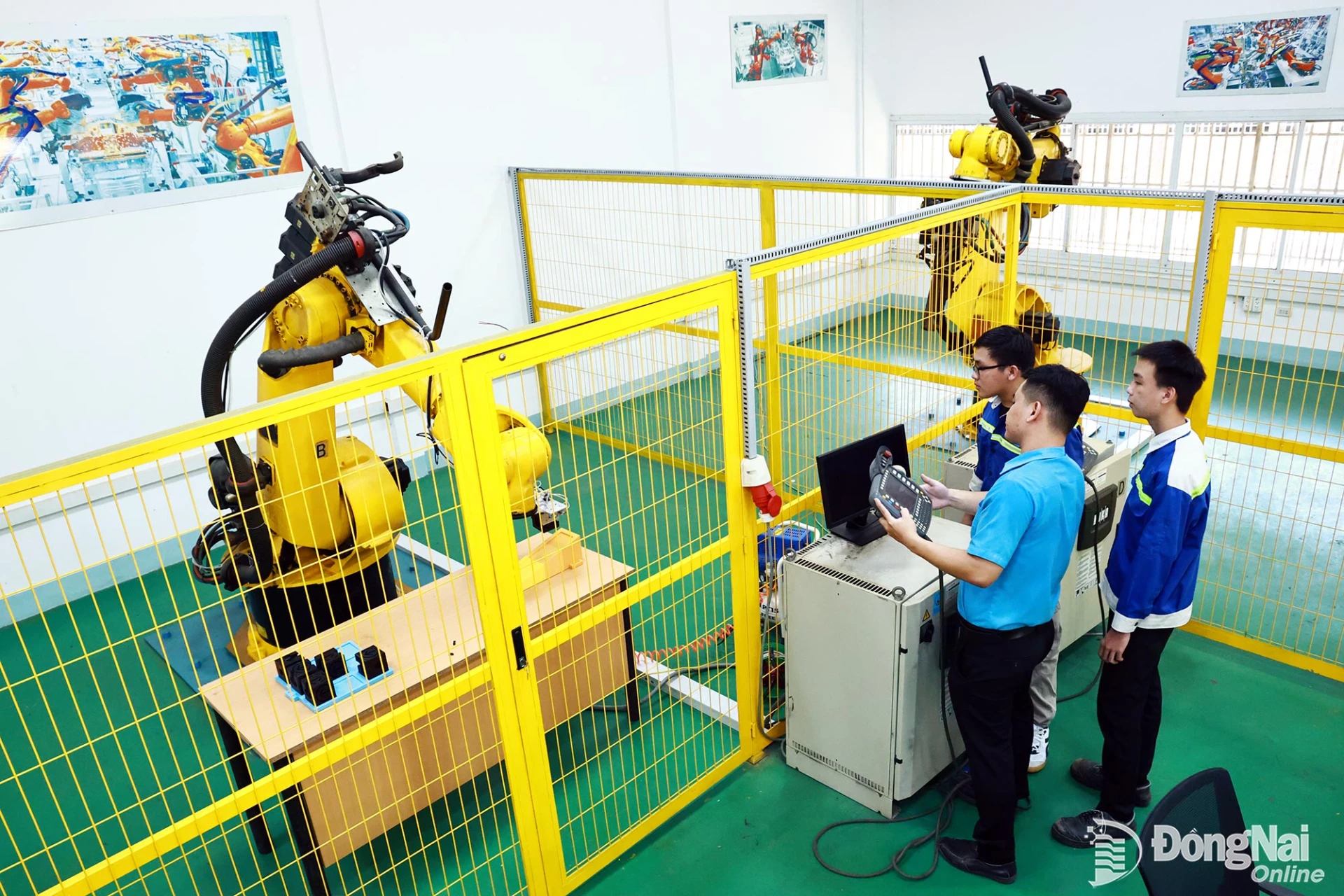 |
| Students at Lilama 2 International Technology College in Long Phuoc Commune receive training in accordance with international standards. |
Alongside investment in physical infrastructure, teaching and learning methods must also be comprehensively renewed to ensure greater effectiveness. In a modern education environment, particular attention should be paid to applying information technology and artificial intelligence (AI) to school administration and teaching. Regular professional training and capacity-building for teaching staff, combined with annual performance assessments, are also essential. As the city plays a leading role in the country's international economic integration, equipping students with foreign-language skills, particularly English, will be essential.
Regarding high-quality human resource training, Director of the Department of Education and Training (DoET) Dang Anh Tuan said the city is facing shortages in four key groups of human resources: the international aviation ecosystem; logistics and supply chain management; high-tech industries and digital transformation; and highly skilled technical workers. The training system therefore needs to shift its mindset from “training what is available” to “meeting specific market needs,” while fostering close cooperation among three parties: the State, educational institutions and businesses.
An immediate solution proposed by the education sector is to establish a centralized data system by compiling human-resource demand data by industry cluster every six months. The city will move toward commissioning training based on specific job positions, shifting from ordering training by headcount to specifying job titles, competency frameworks and clear learning outcomes. It will also introduce policies to encourage businesses to participate directly in three core stages: developing learning outcomes, organizing practical training, assessing and recruiting graduates.
Dong Nai needs to take the lead in attracting reputable universities and major companies in core technology fields to build a diverse ecosystem for training high-quality human resources across a wide range of sectors. It should also invest in laboratories and innovation centers that can support research and technology transfer while enabling businesses to gain access to highly qualified workers with strong practical skills.
As part of its long-term vision and pilot models, the city's DoET said Dong Nai is promoting a project to establish a university education urban area in Long Thanh for the 2026-2035 period. At the same time, the city is piloting a four-step closed-loop training model linked to technology transfer. Under the model, businesses first identify the specific job positions, workforce requirements and competency standards they need. The city then consolidates this information and selects priority occupations for commissioned training. Educational institutions and businesses jointly develop training programs and share experts and technological processes. Finally, businesses directly assess learning outcomes and give priority to recruiting qualified graduates.
By C. Nghia – Translated by M.Nguyet, Thu Ha

Thông tin bạn đọc
Đóng Lưu thông tin