
The Urban Development Law (UDL), which will take effect on October 1, 2026, is expected to strengthen decentralization, unlock resources and create conditions for urban areas to become new growth poles while improving people’s quality of life.
Key provisions of the UDL include comprehensive decentralization and greater autonomy for administrative apparatus; new models for urban planning and development; economic and financial mechanisms; and policies to attract strategic investment.
 |
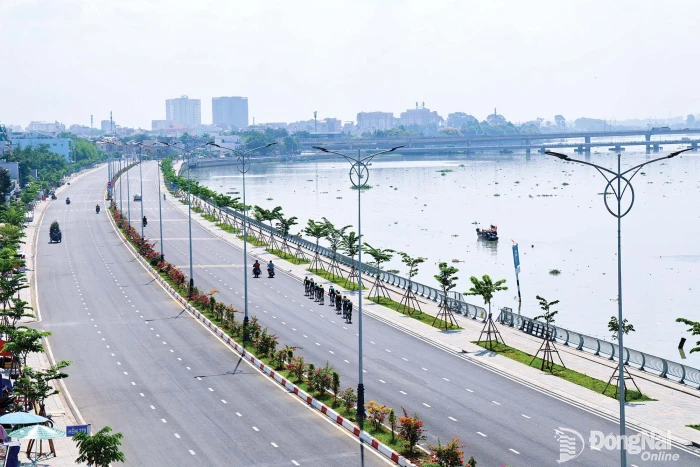
| An urban area’s corner in Dong Nai City. Photo: Cong Nghia |
Institutional breakthroughs
The UDL clearly provides for full and comprehensive decentralization of authority to the People’s Councils, People’s Committees and chairpersons of People’s Committees of cities. It allows the issuance of specific legal documents with provisions different from those promulgated by Central authorities, as well as pilot implementation of new mechanisms and policies not yet covered by law. The law provides for controlled socialization is permitted for professional and technical activities and for supporting the handling of administrative procedures. Cities may decide on a total number of staff positions not exceeding 20% of the number of civil servants and public employees assigned by the Central Government, provided that they can balance their own budgets and cover salaries from city budget revenues.
At the first extraordinary session of the 16th National Assembly (NA), Le Hoang Hai, a full-time NA deputy serving on the NA’s Committee on Science, Technology and Environment and a member of the Dong Nai City Delegation of NA Deputies, said the UDL carried strategic significance and represented a breakthrough in institutional reform. It would create a superior legal corridor, help unlock resources and strengthen governance capacity for urban areas.
In practice, many cities have significant potential but face difficulties in converting that potential into growth because resources remain fragmented. Land, infrastructure, transport, investment and planning are sometimes governed by different procedures, meaning that a single project can take a long time to complete. The UDL seeks to remove part of these bottlenecks by granting stronger decentralisation and delegation of authority to city governments.
Bui Xuan Thong, Member of the City Party Committee, full-time Deputy Head of the Dong Nai City Delegation of NA Deputies, said urban development should not be viewed merely in terms of construction management, planning, technical infrastructure and housing development. Instead, it should be regarded as an important driver of economic growth and improved quality of life.
The key is to implement the law in a way that creates a stable legal framework conducive to development, shifting from a mindset of “urban management” to one of “facilitating and developing urban areas,” shortening processing times and making it easier for residents and businesses. This approach puts people at the center, uses quality of life and development efficiency as key benchmarks, and gives urban authorities greater initiative in making decisions within their jurisdiction.
The UDL provides a legal framework, mechanisms and tools for urban planning, investment, construction and management under the new circumstances. It also adds mechanisms and policies for building and developing Dong Nai City into a civilized, modern and happy city.
A range of superior mechanisms
Dong Nai has numerous advantages for development. Following the restructuring of administrative boundaries, the city now has greater development space, with more diverse potential in land, industry, urban development, agriculture and the border economy. New growth drivers are also emerging from the strategic transport network, Long Thanh International Airport, expressways and connectivity with the Southeast region.
The UDL provides a legal basis for new development models, including free-trade zones, integrated logistics zones, hi-tech zones, science and technology urban areas, and models of digital, green, circular and low-altitude economies. This provides a foundation for attracting strategic investors to participate in large-scale projects worth tens of trillions of VND in innovation centers, semiconductor integrated-circuit industries and free-trade zones in accordance with the UDL.
To manage a broad, multi-layered and inter-regional development space, Dong Nai needs to take greater initiative in planning, infrastructure investment, urban management and resource mobilization. Politburo Resolution No. 16-NQ/TW on building and developing Dong Nai City through 2035, with a vision to 2065, calls for radical decentralization of authority to municipal People’s Councils, People’s Committees and the chairpersons of the municipal People’s Committees in all fields, except national defense and security, foreign affairs and religion. It also calls for stronger authority and greater responsibility for heads of agencies at all levels, coupled with mechanisms to control power.
The UDL supplements the legal framework, enabling local authorities to take the initiative in handling a wide range of tasks within their assigned jurisdiction.
At a conference on implementing Resolution No. 16 organized by the City Party Committee on August 29, 2026, Ton Ngoc Hanh, Member of the Party Central Committee , Standing Deputy Secretary of the City Party Committee, Chairwoman of the City People’s Council, said the municipal People’s Council would institutionalize the superior mechanisms and policies under the UDL based on the central government’s guidelines, policies and regulations. This would ensure that radical decentralization goes hand in hand with accountability, openness and transparency.
Also at the conference, Nguyen Van Ut, Deputy Secretary of the City Party Committee, Chairman of the Dong Nai City People’s Committee, said the city would soon complete its proposal for applying specific and superior mechanisms and policies in a number of fields. The city would also focus on developing and completing a project to establish a special economic zone. Such a zone would not only occupy a strategically important location and make a major contribution to Dong Nai’s economic development, but also contribute positively to the national economy.
Dong Nai is receiving strong attention from the Central Government, which has granted the city superior mechanisms to turn its potential, advantages and the shared aspirations of the Party organization, authorities and people into reality. However, to turn these advantages into actual roads, terminals, urban areas and logistics centers, as well as concrete resources and development outcomes, the decisive factor remains the capacity to organize and implement them effectively.
At the conference on implementing Resolution No. 16, members of the City Party Committee’s Standing Board conveyed a message of unity, consensus and decisive action. The city will focus on comprehensively implementing the strategic tasks set out in Resolution No. 16 while making full use of the mechanisms and policies under the UDL. The entire Party, people, armed forces and business community across the city will join hands and remain determined to turn potential and strengths into development drivers. This will help Dong Nai realize at an early date its goal of becoming a modern, smart and happy city with global connectivity, ready to join the rest of the country in entering a new era.
By Phuong Hang - Translated by Mai Nga, Thu Ha
Thông tin bạn đọc
Đóng Lưu thông tin