
Not all innovation begins with sweeping initiatives. Many positive changes in education grow out of small but meaningful actions, such as a teacher taking the time to listen to students or a Party committee proactively visiting a school to understand its situation, offer guidance, and help resolve difficulties.
These specific grassroots practices convey a clear message: when partnership becomes an approach, the gaps between managers and the grassroots and between teachers and students are narrowed, work efficiency is improved, and positive values spread.
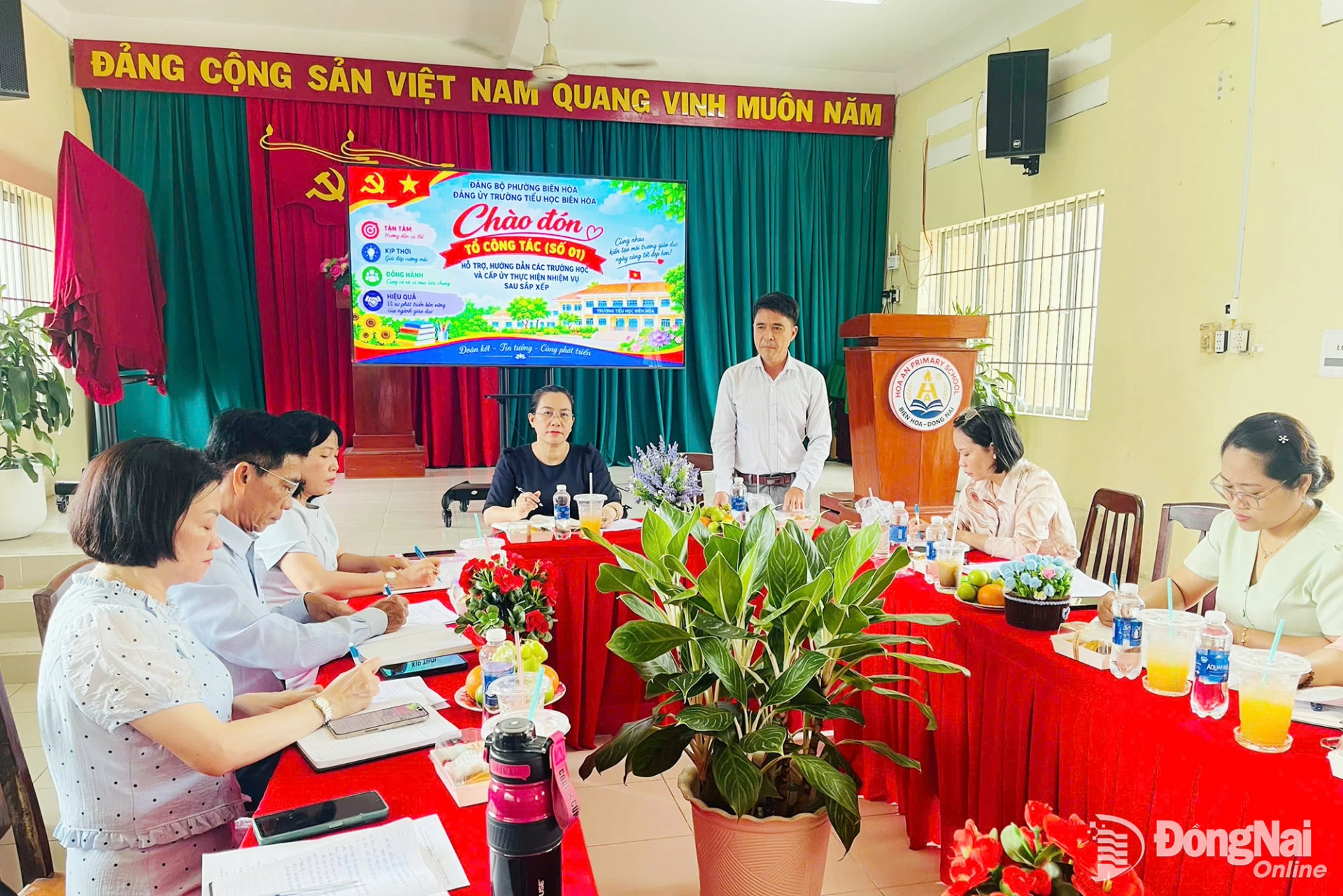 |
| The working group of the Bien Hoa Ward Party Committee meets with a local school to support and guide schools and their Party Committees in carrying out tasks following the restructuring. Photo: Phuong Hang |
It starts with understanding students
In education, accompanying students begins with understanding them. This is an effective approach adopted by Tran Thi Thu Hang, the homeroom teacher of Class 8/6 at Le Quang Dinh Secondary School in Tam Hiep Ward, at the beginning of the 2026-2027 school year. Instead of simply starting with explaining rules, academic requirements, or classroom discipline, she chose a more approachable and modern method: learning about her students through a survey. Through a 10-question online survey using Google Forms, students had the opportunity to share personal information, personality traits, strengths, interests, aspirations, and the specific areas in which they wanted support from their homeroom teacher during the new school year.
Behind this seemingly simple survey lies a complex way of thinking. By eighth grade, students have developed their own thoughts, feelings, and desires, but not all of them consider it easy to share these directly with teachers or parents. Therefore, the first step in helping teachers understand their students is to create a space for them to express themselves and be heard.
Notably, the questions go beyond merely collecting information. They include "What is one thing you feel you need to improve about yourself?" and "If you could choose a role in the class, which would you like to take on most?" The answers help the teacher identify each student's strengths, limitations, capabilities, and individual suitability for various roles within the collective.
In particular, the question, "What do you want your homeroom teacher to support you with in the 2026-2027 school year?" opens up a different approach to the teacher-student relationship. The teacher no longer serves merely as a classroom administrator but also proactively positions herself as a companion. More importantly, she does not wait until students encounter difficulties before getting to know them. From the start of the school year, she takes the initiative to learn who they are, their strengths, interests, needs, and how they want to be supported. Understanding students before educating them is therefore not merely a method; it reflects the teacher's sense of responsibility and dedication to the profession.
Supporting schools after restructuring
If the story at Le Quang Dinh Secondary School shows that partnership begins with understanding each student, the approach adopted by the Bien Hoa Ward Party Committee demonstrates another level of partnership: the Party committee proactively reaches out to the grassroots and works alongside schools to resolve issues arising during the process of restructuring and reorganizing operations. Following restructuring, schools must quickly stabilize their organizational structures, personnel, and operational routines while ensuring that their duties remain uninterrupted. In this context, if efforts are limited to issuing general directives and guidelines, many specific grassroots issues remain difficult to resolve in a timely manner.
Given this reality, the Bien Hoa Ward Party Committee established a working group to support and guide schools and their Party Committees in fulfilling post-restructuring tasks. Notably, the working group did not merely provide “paper-based guidance.” It works directly with the schools’ Party committees and school management boards under its oversight to grasp the situation and jointly address the challenges at hand.
The working group provides guidance on essential aspects of organization, personnel, working regulations, task assignment, work programs, inspection, and supervision. It also maintains discipline and improves the quality of Party committee and Party cell meetings, while providing guidance on the management of Party members, records, dues, and Party finances. Furthermore, the working group coordinates with school management boards to monitor post-restructuring activities and promptly support the resolution of matters involving both the Party organizations and the schools. This contributes to stabilizing the mindset of officials, Party members, public employees, and workers while ensuring the fulfillment of academic year objectives.
This sense of responsibility is also reflected in its readiness to address emerging issues. Difficulties, obstacles, and unresolved matters are promptly identified for resolution. Issues within its jurisdiction are addressed through guidance, while those beyond its authority are summarized and reported to the Standing members and the Standing Board of the Ward Party Committee for consideration and direction. This illustrates the difference between "directing" and "accompanying." Directing sets requirements; accompanying means working alongside the grassroots to understand how those requirements are implemented, where bottlenecks lie, and what support is needed.
A shared message
The two stories – one in a classroom and the other in a ward Party committee – differ in subject, scale, and method, yet they have one thing in common: using proactivity, listening, and partnership as means of improving work efficiency.
For teachers, accompanying students does not mean doing things for them. Rather, it means understanding them in order to assign tasks correctly, provide the right encouragement, offer appropriate support, and create conditions for each student to maximize their potential.
For the Ward Party Committee, accompanying schools does not mean doing the work on behalf of the school management boards or the Party organizations. It means proactively grasping the situation, providing guidance at the right time, resolving the right issues, and ensuring that newly consolidated organizations can quickly return to disciplined and effective operations.
This common thread highlights an increasingly clear requirement in practice: the effectiveness of leadership and management is measured not only by the number of documents issued but also by the ability to grasp reality, solve problems, and create changes at the grassroots level. In schools, changes can begin when even a student feels understood and heard by their teachers. At the Party committee level, it might be a newly formed Party cell quickly stabilizing its organizational structure, a record being fully transferred, a bottleneck being promptly resolved, or the mindset of officials, Party members, and employees being stabilized after restructuring. These things may not immediately produce significant figures, but they build a crucial foundation for long-term stability and development.
Driving changes through practical actions
In the process of educational innovation and operating the system at the grassroots level, effective approaches do not necessarily begin with elaborate models. What matters is whether the approach is grounded in reality, solves problems, and has the potential for scalability. A teacher proactively asking students, "What do you need?" represents an innovation in educational methods. A Party committee proactively asking a school, "What are the obstacles, and what support is needed?" also represents an innovation in grassroots leadership methods. Both begin with asking, listening, and acting. This is something worth spreading. It is because in education, there is no single method suitable for all students; in leadership and management, there is no one-size-fits-all solution that can replace staying close to realities. To perform well, one must remain close to the grassroots, understand the target audience, correctly identify problems, and collaborate in the resolution process.
From a classroom in Tam Hiep Ward to schools across Bien Hoa Ward, these practices point to a broader value: partnership is a resource that drives positive changes. When teachers know how to listen, students gain the confidence to share and grow. When Party committees know how to accompany, the grassroots gain a pillar of support to stabilize their organizations, overcome difficulties, and complete their tasks. When good practices at the grassroots are identified, shared, and multiplied, positive changes will not stop at one classroom, one school, or one locality but can spread more widely and sow the seeds of innovation, contributing to building an educational environment that is increasingly humane, disciplined, proactive, and effective.
By Dr. Vu Thi Nghia – Translated by Minh Hong, Thu Ha


Thông tin bạn đọc
Đóng Lưu thông tin