
Since January 1, 2026, all commune- and ward-level health stations (collectively referred to as health stations) and their satellite stations have been transferred from the regional medical centers under the Department of Health to the management of commune-level People's Committees.
According to the Department of Health, after nine months of implementation, health stations have basically maintained stable organizational structures, staffing and professional operations. However, the stations still need additional support to carry out their assigned tasks effectively.
Heavy workloads
Deputy Minister of Health Do Xuan Tuyen said that health stations are currently organized and operate under Circular No. 43/2025/TT-BYT, as amended by Circular No. 53/2025/TT-BYT of the Ministry of Health, which provides guidance on the functions, duties, powers and organizational structure of health stations of communes, wards and special zones of provinces and cities.
Health stations are public health service providers affiliated to commune-level People's Committees, responsible for providing advice and delivering professional and technical healthcare services in such areas as disease prevention; medical examination and treatment; community health management and improvement; maternal and child healthcare; care for older people and persons with disabilities; social assistance; population affairs; food safety; pharmaceuticals; medical equipment; and other healthcare services as prescribed by law.
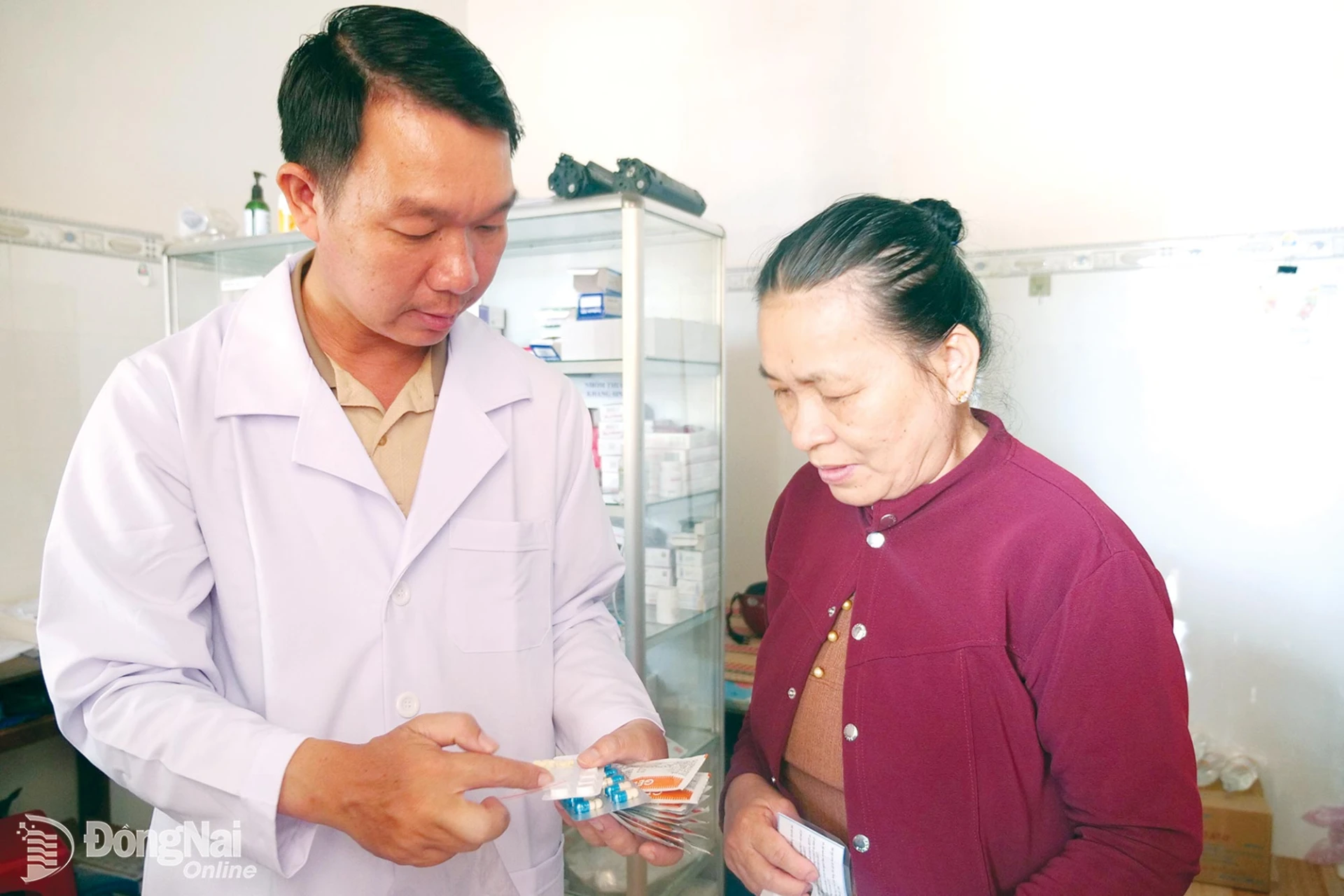 |
| A pharmacist at Loc Quang Commune Health Station instructs a resident on how to use medication after a medical examination. |
“The workload of health stations is now much heavier than before. The goal is to strengthen grassroots healthcare capacity so that people can access more high-quality medical services in their localities while reducing pressure on higher-level healthcare facilities,” Deputy Minister Do Xuan Tuyen emphasized.
Director of the Department of Health Do Thi Nguyen said that, to strengthen the grassroots healthcare workforce, in addition to the nearly 2,500 permanent positions already allocated by the city to 95 health stations, the Department of Health proactively reviewed and balanced staffing at its affiliated public service units and proposed that the city allocate an additional 56 permanent positions and 19 contract positions for professional and technical staff to health stations. To date, a total of 2,554 permanent positions have been allocated to health stations.
The Department of Health has also proactively reassigned 11 public employees from its affiliated units to work at health stations to help address staff shortages at some stations. In addition, it has carried out procedures to reassign and appoint four public employees to leadership positions at health stations, thereby gradually strengthening their management teams to meet the stations' organizational and operational requirements.
Challenges remain
Despite these initial positive results, implementation of the new health station model continues to face difficulties. So far, only about 30 of the 95 health stations have appointed their management leaders, including station directors and deputy directors. At the remaining stations, commune-level People's Committees have temporarily assigned public employees or local civil servants on a concurrent basis to oversee operations.
Dr. Bui Thai Chien, Director of the Xuan Loc Regional Medical Center, said the center has been assigned to support six health stations in the area: Xuan Phu, Xuan Loc, Xuan Thanh, Xuan Dinh, Xuan Bac and Xuan Hoa. Each station has between two and four doctors. A current challenge is that the leadership and management positions at the stations have not been fully established as required. None of the stations has appointed a director, while two are currently being managed by vice chairpersons of commune-level People's Committees on a concurrent basis. The workload is heavy while staffing remains insufficient, affecting the efficiency of operations and management to some extent.
In addition to staffing difficulties, many health stations also face challenges related to facilities and finances. Some former health station buildings have deteriorated or are no longer suitable for the population size following administrative mergers. Meanwhile, new construction or upgrades require a roadmap and medium-term public investment funding and therefore cannot be addressed immediately. The stations also have limited capacity to carry out bidding procedures and procure medicines and medical supplies. In addition, information technology infrastructure and digital transformation remain uneven, making it difficult for some stations to process data.
Dr. Tran Van Thi, Specialist Level I, in charge of Loc Quang Commune Health Station, said the station hopes to receive additional personnel and synchronized investment in human resources, facilities and medical equipment so it can provide better medical examination and treatment services. For remote areas such as Loc Quang, if health stations were sufficiently equipped to perform procedures such as laboratory tests, ultrasound and X-rays, residents would have less need to travel long distances to higher-level facilities, reducing both travel time and costs.
Providing health stations with staff and equipment
Dr. Do Thi Nguyen, Specialist Level II, Director of the Dong Nai Department of Health, said that as part of the reorganization of the healthcare sector, the department had advised the city People's Committee to dissolve seven regional medical centers under the department: Long Thanh, Long Khanh, Dinh Quan, Bu Gia Map, Dong Xoai, Hon Quan and Phu Rieng. The seven centers slated for dissolution have a combined workforce of 354 people. These personnel will be transferred to 34 health stations and several other units under the Department of Health. Medical equipment, machinery and other assets of the centers slated for dissolution will also be allocated to health stations and other units to ensure effective use.
According to the Department of Health, health stations across the city currently have about 2,400 staff members, including 287 doctors, 493 nurses, 353 pharmacists and 336 midwives, with the remainder holding other professional positions.
Director Do Thi Nguyen added that, to ensure adequate staffing, particularly doctors, during the peak period of the universal periodic health check-up program, the department has issued a number of guidance documents to commune- and ward-level health stations. In the coming period, the Department of Health will rotate or second a number of staff and doctors from provincial-level hospitals and regional general hospitals to work at health stations.
In addition, the department has asked regional general hospitals, which were reorganized from two-function regional medical centers, to consider reassigning personnel to health stations that were previously under their management, depending on the needs of each station. Such rotations, reassignments or secondments may last one, two or three months, until the health stations are able to adequately provide health examinations for local residents in their respective areas.
For free health examinations for children aged 0 to 6 under the program providing free periodic health check-ups for all residents, the Department of Health will assign doctors from higher-level facilities to support health stations. For health examinations for people over six years old, health stations may enter into contracts with suitable healthcare facilities. Where necessary, the Department of Health will assign doctors from hospitals to support localities.
By Hanh Dung – Translated by Mai Nga, Minho


Thông tin bạn đọc
Đóng Lưu thông tin