
A severed forearm and a severed lower leg, both seemingly beyond saving, have been successfully reattached by doctors at Thong Nhat General Hospital and Long Khanh Regional General Hospital.
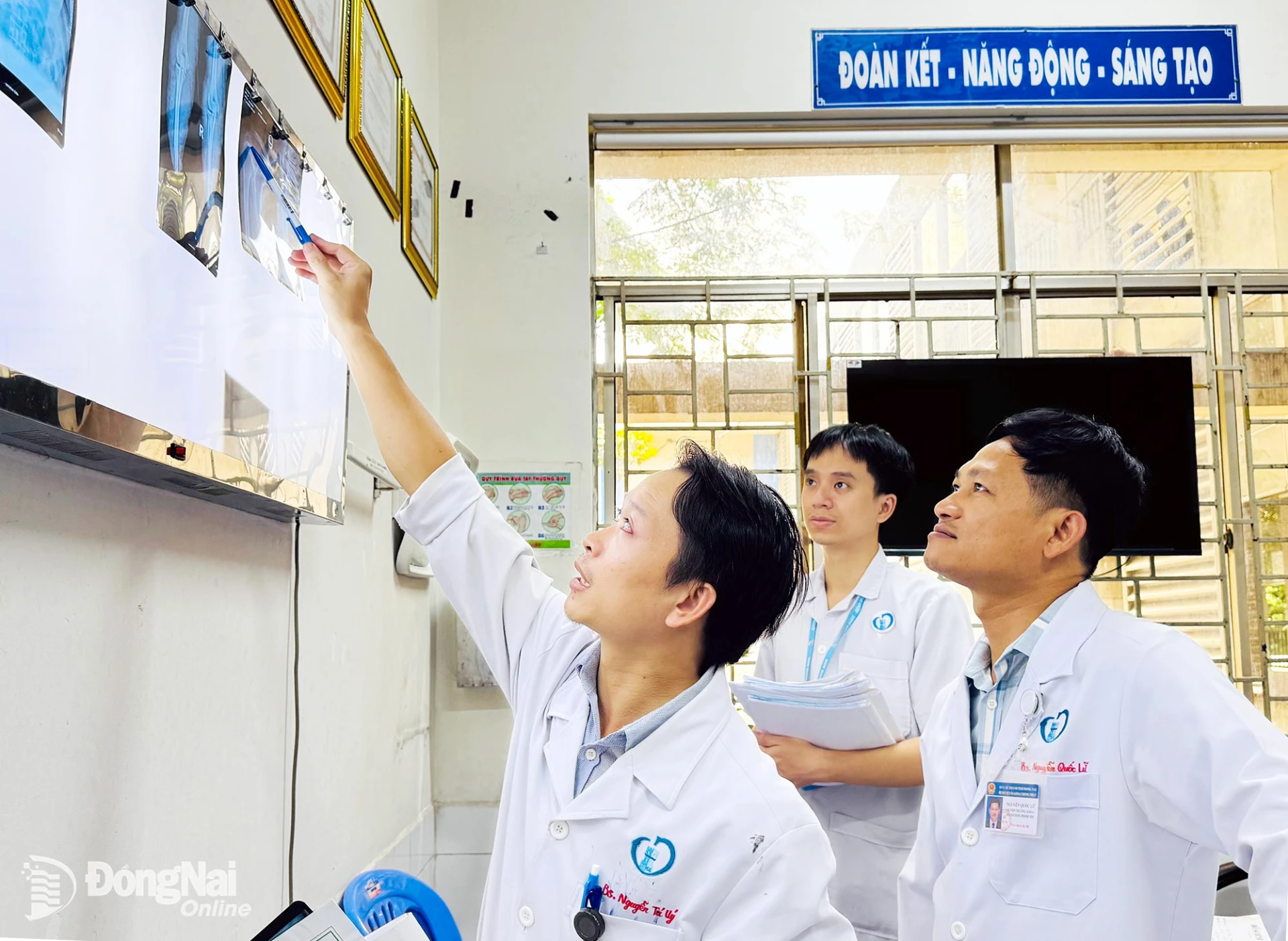 |
| Doctors from the Department of Trauma Orthopedics and Burns at Thong Nhat General Hospital discuss a case before surgery. |
The exceptionally complex surgeries demonstrate the ability of Dong Nai’s hospitals to master advanced techniques, while offering new hope for patients to receive treatment and recover their health locally.
A “race against time” to save patients
In late August, Thong Nhat General Hospital admitted patient T.T., 40, from Tri An Ward, after his right forearm was completely severed in a workplace accident.
T.T. said, "I work at a company that produces egg cartons. While I was cleaning the machine, another worker, unaware that I was there, turned it on. The machine suddenly started and pulled my right arm into the roller system. As I tried to pull my arm out, my forearm was flung free and completely severed." After receiving first aid at a local clinic, T.T. was transferred to Thong Nhat General Hospital. He had lost so much blood that he had slipped into a coma and was unconscious.
Specialist Level I Doctor Nguyen Ta Uy of the Department of Trauma Orthopedics and Burns at Thong Nhat General Hospital said, "This is a rare type of injury, with the hospital receiving only two to three such cases each year. Upon the patient's admission, the hospital activated a "red alert" procedure and mobilized relevant teams to coordinate emergency care and surgery. The case was assessed as extremely severe. The forearm had not only been severed but had also been pulled and crushed by the machine, causing extensive tissue damage in the arm. The blood vessels were severely torn and retracted."
"The damaged section of the blood vessel was too long for direct reconnection. The team had to take two segments of blood vessels from the patient's leg to create a bypass graft and re-establish blood flow to the reattached limb," said Dr. Nguyen Ta Uy.
The difficulties continued after the vascular anastomosis was completed, when the surgical team discovered that the blood vessel had become blocked again. The doctors had to examine the site, undo the connection, and repeat the procedure. In cases involving severe crushing injuries, vascular repair may have to be repeated until blood flow is ensured. Fortunately, blood flow was successfully restored following the intervention. However, another complication emerged. Due to the crushing injury and prolonged ischemia, the patient developed acute kidney failure. Doctors continued to closely monitor him and coordinate care across multiple specialties to manage the complications.
To date, the patient's condition is stable. Doctors continue to debride necrotic tissue and either suture the wounds or perform skin grafts to cover the defects. In the long term, the patient will undergo rehabilitation for the hand, wrist, and fingers. If necessary, tendon and muscle transfer procedures may be performed.
For T.T., saving his forearm carries special significance. "I am the main breadwinner in my family. Besides working as a factory worker, I also do gardening at home. I am so happy that my forearm was reattached. I thank the doctors and medical staff for their timely treatment, which saved me from disability," said T.T.
Elevating specialized surgical care
Thong Nhat General Hospital is not the only medical facility to have recently achieved notable results in surgery. Long Khanh Regional General Hospital has also established a reputation in the field.
About half a month ago, the hospital admitted patient A.T., 48, from Thong Nhat Commune, in traumatic shock after his left lower leg was severed by a falling bundle of construction steel. Doctors immediately carried out intensive resuscitation while preparing two surgical teams to perform emergency surgery to reattach the lower leg.
After more than three hours of surgery, with the participation of two teams and the transfusion of four units of packed red blood cells and two units of fresh frozen plasma, the severed limb was successfully reattached, and the patient is showing signs of good recovery.
The two cases above underscore the critical role of time, surgeons' expertise, equipment and machinery systems, and coordination among specialties in providing emergency care for severe trauma at hospitals in the city.
Specialist Level II Doctor Nguyen Tuong Quang, Director of Thong Nhat General Hospital, said, "In the near future, the hospital will refine surgical techniques for complex pelvic fractures, microsurgery for lymphedema, lymphatic vessel repair, and the reattachment of severed limbs. Notably, the hospital plans to implement toe-to-finger transfer techniques to restore hand function for patients with severe finger injuries."
In terms of surgery, every successful operation is not only a professional achievement but also an opportunity to help patients retain mobility, return to their families, and continue their lives, especially those who are the pillars and main breadwinners of their families. The reattachment of arms and legs after serious accidents therefore not only reconnects a part of the body but also restores hope for patients.
"For a severed limb to have a chance to 'survive,' in addition to vascular repair techniques, the patient must receive emergency care, resuscitation, and surgery within the appropriate timeframe. The coordination among specialties – emergency medicine, anesthesiology and resuscitation, trauma and orthopedics, and other related fields – is therefore of critical importance."
Specialist Level II Doctor Nguyen Tuong Quang
By Hanh Dung – Translated by Minh Hong, Thu Ha


Thông tin bạn đọc
Đóng Lưu thông tin