
With support from relevant authorities, farmers across Dong Nai City have increasingly adopted science and technology in agricultural production in recent years.
These efforts are helping improve product quality and add value to agricultural produce before it reaches domestic and export markets.
Changing mindsets, bringing technology into production
Resolution No. 05-NQ/TU, dated May 1, 2026, issued by the Dong Nai City Party Committee's Executive Board to launch a special 500-day-and-night campaign under the theme “Solidarity – Discipline – Efficiency – Breakthrough: Building a Civilized and Modern Dong Nai,” sets out tasks to unlock resources, generate momentum for growth and promote socioeconomic development. As part of these efforts, the city is prioritizing support for businesses, cooperatives and household enterprises to upgrade their technology, increase productivity, improve quality and strengthen competitiveness. It is also promoting the private sector, the digital economy and the green economy.
 |
| Thanh Binh Clean Agricultural Production and Consumption Linkage Cooperative in Bau Ham Commune has invested in a processing facility and machinery for the advanced processing of agricultural produce. |
Farmers in Dong Nai are gradually changing their production methods and adopting scientific and technological advances to improve economic efficiency.
One example is Ly Minh Hung, Director of Thanh Binh Clean Agricultural Production and Consumption Linkage Cooperative in Bau Ham Commune, who has invested billions of dong in a nearly 500-square-meter processing facility equipped with cutting, drying and integrated processing systems to increase the value of various fruits.
Hung said the cooperative had previously relied mainly on manual production and processing methods. However, in response to increasingly demanding market requirements, it has had to modernize its operations and invest in technology to add value to agricultural products and bring Dong Nai’s fruit to international markets.
Over the past 20 years, the implementation of Resolution No. 06-NQ/HND, dated July 25, 2006, issued by the fourth-term Central Committee of the Vietnam Farmers’ Union on strengthening the union’s science and technology activities to support the industrialization and modernization of agriculture and rural areas, has also helped promote the adoption of technical advances among farmers. Farmers’ Union organizations at all levels have focused on improving productivity, product quality and incomes by supporting their members in applying new techniques.
One notable initiative has been the establishment of 32 clubs focusing on agricultural science and technology, successful farming and business, and smart cultivation. Their activities center on sharing technical procedures, maintaining production logs, managing product quality and improving agricultural marketing and distribution. As a result, various models suited to local production conditions have been introduced, including high-quality, low-emission rice cultivation, safe vegetable production, biosecure livestock farming and fruit growing in accordance with VietGAP standards. These initiatives have given farmers greater access to new knowledge, opportunities to exchange experience and stronger connections with scientists and businesses.
In Tan Trieu Ward, Truong Ngoc Nhan, Chairman of the ward’s Farmers’ Union, said the organization had served as a bridge between farmers and specialized agencies, helping farmers apply improved techniques in crop cultivation, livestock production, safe farming and environmental protection. Notable initiatives include encouraging members to use indigenous microorganism (IMO) preparations, collecting pesticide containers and moving toward organic farming. These practices help reduce production costs and limit environmental impacts.
In addition, the city’s Farmers’ Union has organized study visits for 22 delegations of officials, union members and farmers, with nearly 900 participants in total, to learn about high-tech agricultural models and production linkages tied to the marketing of agricultural products.
Strengthening partnerships for modern agriculture
Cao Tien Sy, Member of the Dong Nai City Party Committee, Vice Chairman of the Vietnam Fatherland Front Committee of Dong Nai City, Chairman of the city’s Farmers’ Union, said the 20 years of implementing Resolution No. 06 had brought positive results in science and technology, innovation and digital transformation across the union’s organizations. Officials and members have gradually improved their awareness and capacity to apply technology, while production methods have increasingly shifted toward technical advances, digital technologies and quality standards. The union has also strengthened its role in connecting farmers with scientists, businesses, cooperatives and credit institutions.
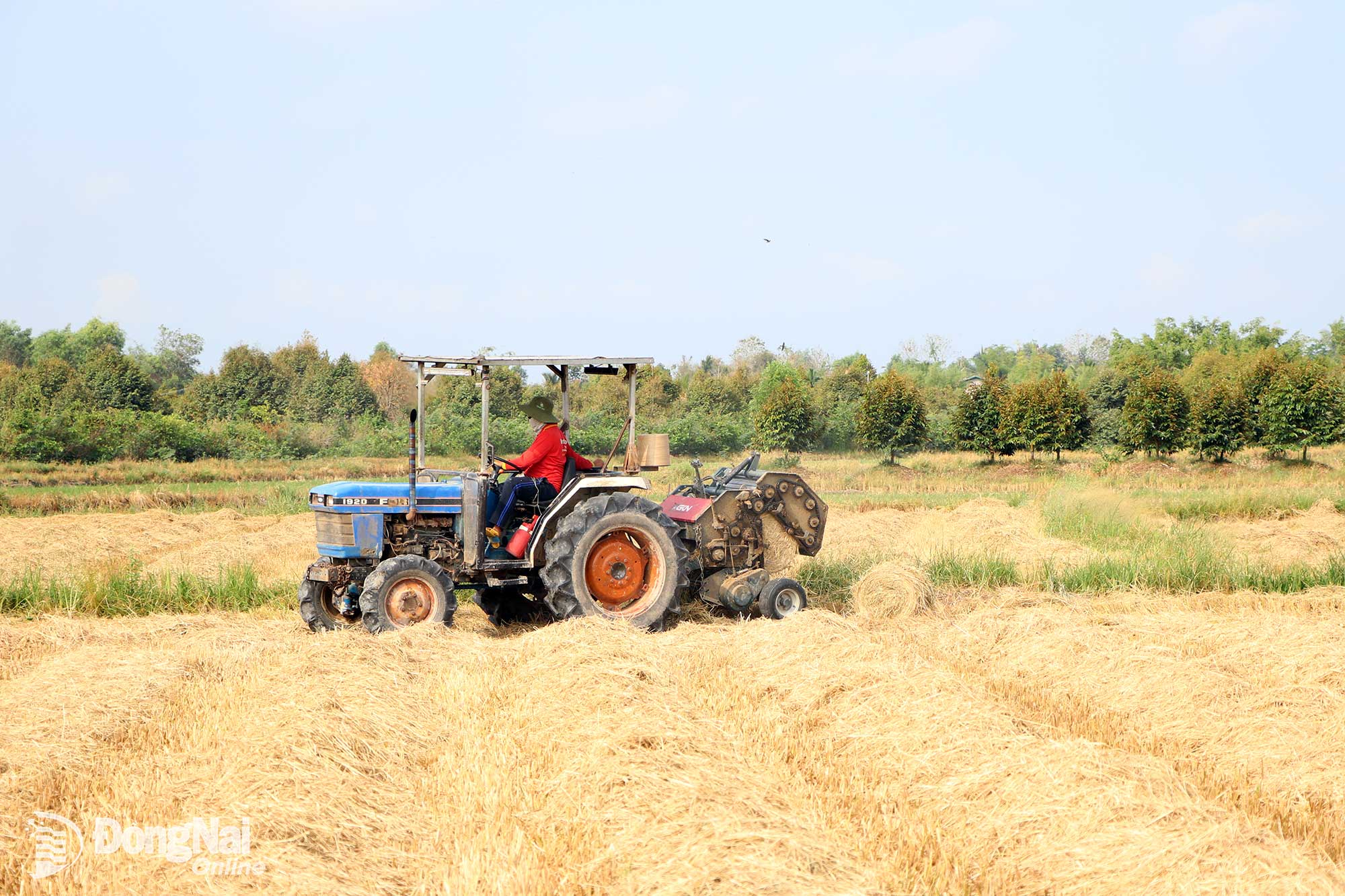 |
| Farmers in Phu Vinh Commune use mechanized equipment in agricultural production. Photo: To Tam |
Going forward, the city’s Farmers’ Union will expand hands-on training based on a “learning by doing” approach and promote farmer-to-farmer knowledge sharing. Effective smart-farming clubs, digital transformation groups, occupational branches and professional farming groups will serve as models for exchanging experience and disseminating good practices. Priority will also be given to the transfer of technologies involving improved seed varieties, water-saving irrigation, integrated pest management, mechanization, unmanned aerial vehicles (drones), automation and biotechnology. Technology adoption will be linked with access to funding, compliance with quality standards and reliable market outlets. Particular emphasis will be placed on strengthening the “four-party” partnership among the government, scientists, businesses and farmers.
Nguyen Van Vien, Deputy Director of the Department of Science and Technology, said the Central Committee of the Vietnam Farmers’ Union should provide guidance on a “reverse commissioning” mechanism driven by the needs of farmers and cooperatives to ensure that science and technology deliver practical results. He also called for policies to create initial markets for new technologies, circular agriculture processes and innovative products. Other priorities include helping farmers secure intellectual property protection for their innovations and integrating the Vietnam Farmers app with databases covering planting-area codes, product traceability and e-commerce platforms.
Over the past 20 years of implementing Resolution No. 06, Farmers’ Union organizations across Dong Nai have conducted nearly 18,000 training sessions, technology-transfer activities, on-farm seminars and demonstration programs, attracting close to 800,000 attendances by officials, union members and farmers. Estimates indicate that many of these models have reduced input costs by 10–20%, cut seed or pesticide use by 15–30%, increased yields by 5–15%, and raised product value by 10–25% compared with traditional farming methods.
Nguyen Van Thang, Deputy Director of the Department of Agriculture and Environment, said the development of high-tech agriculture must be linked with innovative entrepreneurship and efforts to strengthen the effectiveness of cooperatives. The city should encourage young people to participate in the collective economy and make more targeted and effective use of support funds, with a focus on agricultural value chains. He also emphasized the need to apply technology to breeding and the development of specialty crops and livestock in which the locality has a competitive advantage. Other priorities include expanding biotechnology applications, scaling up production while conserving genetic resources, and developing distinctive local crop varieties.
By To Tam – Translated by Mai Nga, Minho


Thông tin bạn đọc
Đóng Lưu thông tin