
With favorable soil and climatic conditions, Dak O commune sees agriculture as a key driver of its local economy, with pepper as one of its main crops. After years of price volatility and a shrinking cultivation area, farmers are once again investing in their pepper gardens.
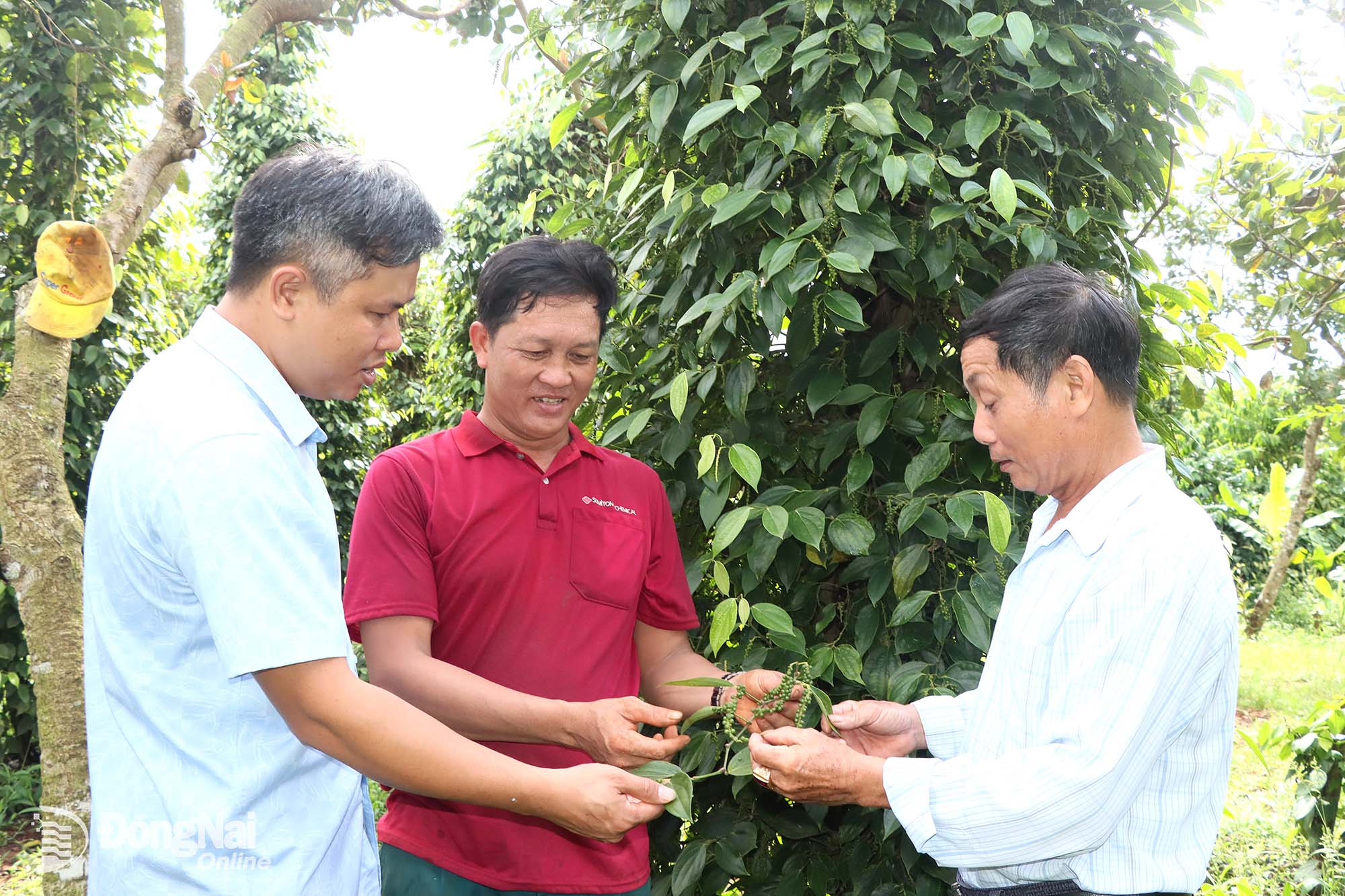 |
| Tran Van Dien (center) is encouraged by high pepper prices as his family continues to invest in its pepper garden. Photo: Quang Minh |
Cooperatives and local authorities are playing a growing role in linking producers with markets, helping farmers develop product brands and reach more buyers. Such efforts are helping increase the value of Dak O pepper while improving growers' incomes.
Reviving pepper gardens
As a border commune whose economy depends largely on agriculture, Dak O once relied on pepper as a mainstay crop that helped many local households become more prosperous. Established in 2019, the Dak O Organic Agriculture Cooperative has 154 members cultivating a combined 800 hectares, including 214 hectares planted with pepper.
Tran Van Khanh, Chairman of the cooperative's Board of Directors and Director, said it initially focused on producing clean pepper in accordance with VietGAP standards before moving toward organic farming practices. The cooperative also partnered with Nedspice Processing Vietnam Limited to secure an outlet for its produce. At its peak, it supplied around 500–600 tonnes of pepper to the market annually, generating substantial income for its members.
Dak O commune plans to establish six more cooperatives and develop six products under the One Commune, One Product (OCOP) program, each targeting a rating of at least three stars. Pepper products are among those being developed.
Phung Hiep Quoc, Secretary of the Dak O commune Party Committee.
However, pepper prices plunged from 2021 to 2023, falling at one point to around VND40,000 per kilogram. As returns dwindled, many households cut back on investment, leaving some gardens neglected. Pepper plants died, yields fell, and some land was switched to other crops, significantly shrinking the commune's pepper-growing area.
As prices recovered, farmers began to see greater incentives to invest in their gardens again. Tran Van Dien, a farmer in Bu Bung Hamlet, has grown pepper on seven hectares since 2005, mainly cultivating the Vinh Linh variety. He recalls that in 2016, his family harvested 17 tonnes of dried pepper and sold it for more than VND190,000 per kilogram, earning a substantial income. In 2025, with cashew and coffee also intercropped on the farm, the family harvested eight tonnes of dried pepper, which sold for VND150,000 per kilogram.
Dien continues to adopt more environmentally friendly farming practices. His family clears weeds five to six times a year without using herbicides, relying mainly on properly composted cow manure and organic fertilizers. These practices help maintain the pepper garden while reducing reliance on chemical weed control.
Lam Xuan Quang, Head of the commune's Economic Division, said more than 200 hectares of pepper remained under cultivation in Dak O. With buying prices above VND150,000 per kilogram, farmers are becoming more optimistic and increasingly willing to reinvest in their gardens and expand production.
Khanh added that the cooperative continued to work with businesses to help farmers obtain agricultural inputs on credit, provide technical guidance and encourage the production of clean pepper using organic farming practices. The initiative aims to improve product quality and make the pepper more competitive in the market.
Besides the Dak O Organic Agriculture Cooperative, other cooperatives, including the Phuong Nghia Agroforestry and Services Cooperative, the Dak O Agroforestry Services Cooperative and the Binh Phuoc Organic Agriculture Cooperative, are also helping members develop pepper production.
Strengthening value chains for sustainable growth
Building on the area's abundant supply of quality pepper, local businesses and individuals have developed product brands and expanded market links to add value to the crop.
Vo Thi Hien, a Dak O resident, is one example. She has developed the Co Hai Clean Pepper brand through a family-run business that purchases and markets around 10 tonnes of dried pepper from local farmers each year. Besides promoting the brand in domestic and overseas markets, she connects growers with buyers, helping them reach a wider customer base.
Dak O's experience shows that increasing the value of pepper depends on close cooperation among farmers, cooperatives and businesses. Strengthening such links is also a priority for the Dong Nai City Cooperative Alliance, particularly in supporting agricultural cooperatives that have established raw material production areas.
Nguyen Thanh Hien, Vice Chairwoman in charge of the Dong Nai City Cooperative Alliance, said the city had 953 cooperatives and people's credit funds, including 560 agricultural cooperatives. Many have adopted new technologies and mechanized production and processing to increase the value of their products. However, a significant number have suspended operations or ceased operating and are awaiting formal dissolution.
In the coming period, the city's Cooperative Alliance will advise the municipal People's Committee and the Steering Committee for Collective Economy and Cooperative Development on implementing support policies adopted by central and local authorities. It will also coordinate programs to help cooperatives gain access to credit, new technologies, market information and trade promotion activities. The measures aim to ease existing difficulties and improve cooperative performance.
Phung Hiep Quoc, Secretary of the Dak O commune Party Committee and Chairman of the commune People's Council, said the commune's Party Committee had adopted a resolution for 2025–2030 focusing on high-tech and organic agriculture linked to market demand, including pepper production. Under the resolution, the commune will prioritize the application of scientific and technological advances to improve productivity and product quality while making better use of local soil and climate conditions. The goal is to put pepper production on a more sustainable footing.
By Q.Minh – Translated by M.Nguyet, Minho


Thông tin bạn đọc
Đóng Lưu thông tin