
Ta Lai Commune is a remote locality in the Eastern part of Dong Nai City and part of the buffer zone of Cat Tien National Park. It has been stepping up efforts to achieve comprehensive new-style rural development, gradually shifting from movement-based approaches to sustainable rural economic development and improved living standards.
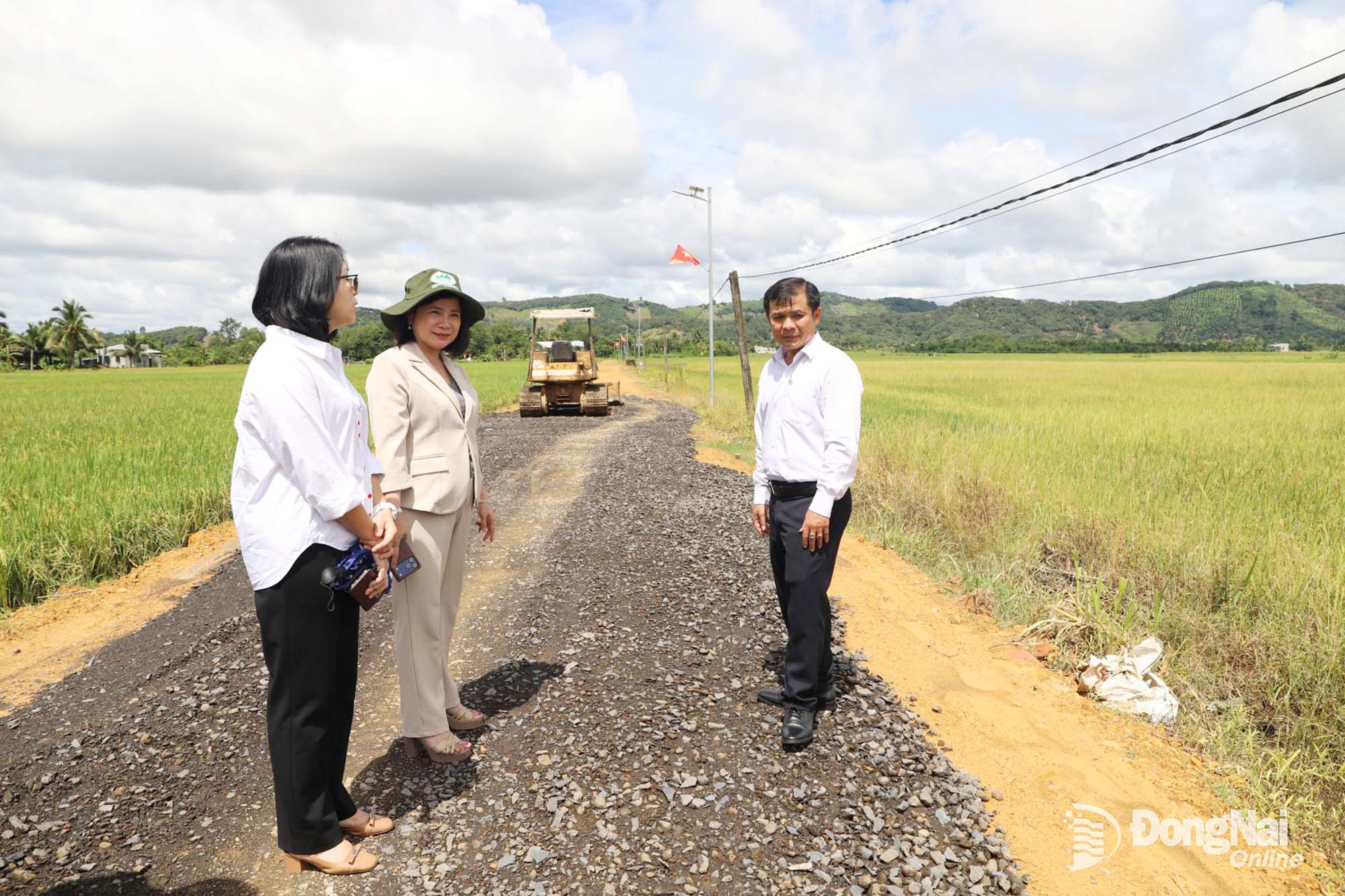 |
| The Vam Ho dam road leading to a more than 4-hectare rice field in Ta Lai Commune is being upgraded. |
Rural infrastructure has been prioritized, providing a foundation for the commune to better tap into its land resources for agricultural production and ecotourism, with the goal of becoming a “green destination” of the city.
A remote commune takes on a new look
Ta Lai commune boasts a diverse mix of 16 ethnic minority groups, including the Choro, Chau Ma, S’tieng, Tay, Nung, Khmer and Hoa. It was formed through the merger of the former Phu Lap, Phu Thinh and Ta Lai communes.
Following the merger, the commune has implemented a range of measures and achieved important results in new-style rural development and sustainable poverty reduction. Rural infrastructure, agricultural production, education, healthcare and public healthcare services have gradually improved, while local cultural facilities have been put into use effectively. The grassroots political system has been strengthened, national defense and security maintained, while social order and safety have remained largely stable.
Communication and public awareness campaigns have also produced positive results, leading to changes in the awareness and actions of local officials and residents. People have increasingly recognized their role as key stakeholders, actively participating in emulation movements, contributing resources, monitoring and working alongside local authorities in implementation. Public support for infrastructure projects funded through social mobilization has been particularly positive, especially rural road projects.
During a working visit to Ta Lai, To Thuy Nga, Head of the New-style Rural Development Division under the the Central Coordination Office for National Target Programs at the Ministry of Agriculture and Environment, said that although Ta Lai is a disadvantaged commune of Dong Nai City, field survey showed that its performance in new-style rural development was better than the national average. After conducting the field inspection and reviewing the report, the delegation found that Ta Lai had met more criteria than initially reported by the local authorities. This provides a basis for the commune to achieve its goal of becoming a new-style rural commune by 2027 and subsequently move toward modern new-style rural development, Nga said.
The rural landscape has also gradually improved with “bright, green, clean and beautiful” roads, helping maintain and enhance the quality of the new-style rural criteria already achieved.
Ta Lai Commune aims to achieve its new-style rural commune status by 2027. So far, the commune has met 32 of 47 criteria, while the remaining indicators are being reviewed and assessed for further improvement.
Particularly, infrastructure serving rural socio-economic development has received due attention, especially roads, irrigation and electricity, better meeting residents’ production and daily needs. Inter-hamlet roads and field roads have been systematically upgraded, providing access to rice fields and orchards.
Recent projects include an internal road to the rice production area in Phu Lap 2 and Phu Lap 4 hamlets; repairs and reinforcement of the Vam Ho dam irrigation canal; the Vam Ho dam road; an internal road in Group 8 of Hamlet 3; and a low-voltage power line in Hamlet 2.
The commune now has 25 roads totaling 25 kilometers in length, with 645 solar-powered lights installed at a cost of VND5 billion through social mobilization. Many rural roads have also been maintained and repaired, while irrigation canals have been newly constructed, dredged and maintained to support agricultural production.
Trinh Van Luan, Secretary of the Ta Lai Commune Party Committee, Chairman of the Commune People's Council, said that following the merger, the commune conducted a comprehensive review of completed and outstanding tasks. It has since maintained the criteria already achieved while developing plans to meet those that remain outstanding. In addition to promoting economic development, the commune has placed strong emphasis on social welfare, Luan said.
Developing green and sustainable agriculture
Following the merger, Ta Lai has gained greater development space and opportunities for inter-regional connectivity, allowing it to capitalize on the distinctive strengths of different areas and focus on agriculture, trade and services, as well as ecotourism and cultural tourism. With agricultural land accounting for more than 70% of its total area, agricultural production remains a key strength of the locality.
With the goal of developing specialized production areas that meet export standards, the commune is focusing on organic-oriented production models for pomelos, durians and rice, combined with value-chain linkages. The approach is intended to improve agricultural product quality, connect farmers with markets and expand export opportunities. The commune has so far established eight durian growing-area codes and one banana growing-area code for export purposes.
Vo Van Thao, a durian farmer in Ta Lai, said his family's durian orchard is cultivated under safe production standards. As a result, the trees produce high yields and quality fruit, while traders and businesses purchase the produce at favorable prices, generating high economic returns for the family.
According to Trinh Van Luan, Secretary of the Ta Lai Commune Party Committee, Chairman of the Commune People's Council, the commune has worked with the Department of Agriculture and Environment and the city's Cooperative Alliance to meet with businesses and companies to survey pomelo, durian and high-yield rice production models. The aim is to provide farmers with guidance on organic farming techniques and encourage them to participate in agricultural value chains, he said.
Pomelo is one of the commune's key crops, covering more than 1,200 hectares. Local authorities are working to develop specialized pomelo growing areas linked to sustainable value chains and meeting export market standards. The commune has signed cooperation agreements with four companies committed to purchasing and distributing locally grown pomelos. It has also partnered with businesses that purchase durians for export, helping secure more sustainable outlets for local agricultural products.
By Binh Nguyen - Translated by Mai Nga, Thu Ha
Thông tin bạn đọc
Đóng Lưu thông tin