
Amid rapid urbanization, farmers in Phuoc Tan Ward have to not only change their production methods but also explore new approaches to adapt to shrinking farmland, shifting market conditions, and increasingly diverse consumer demand.
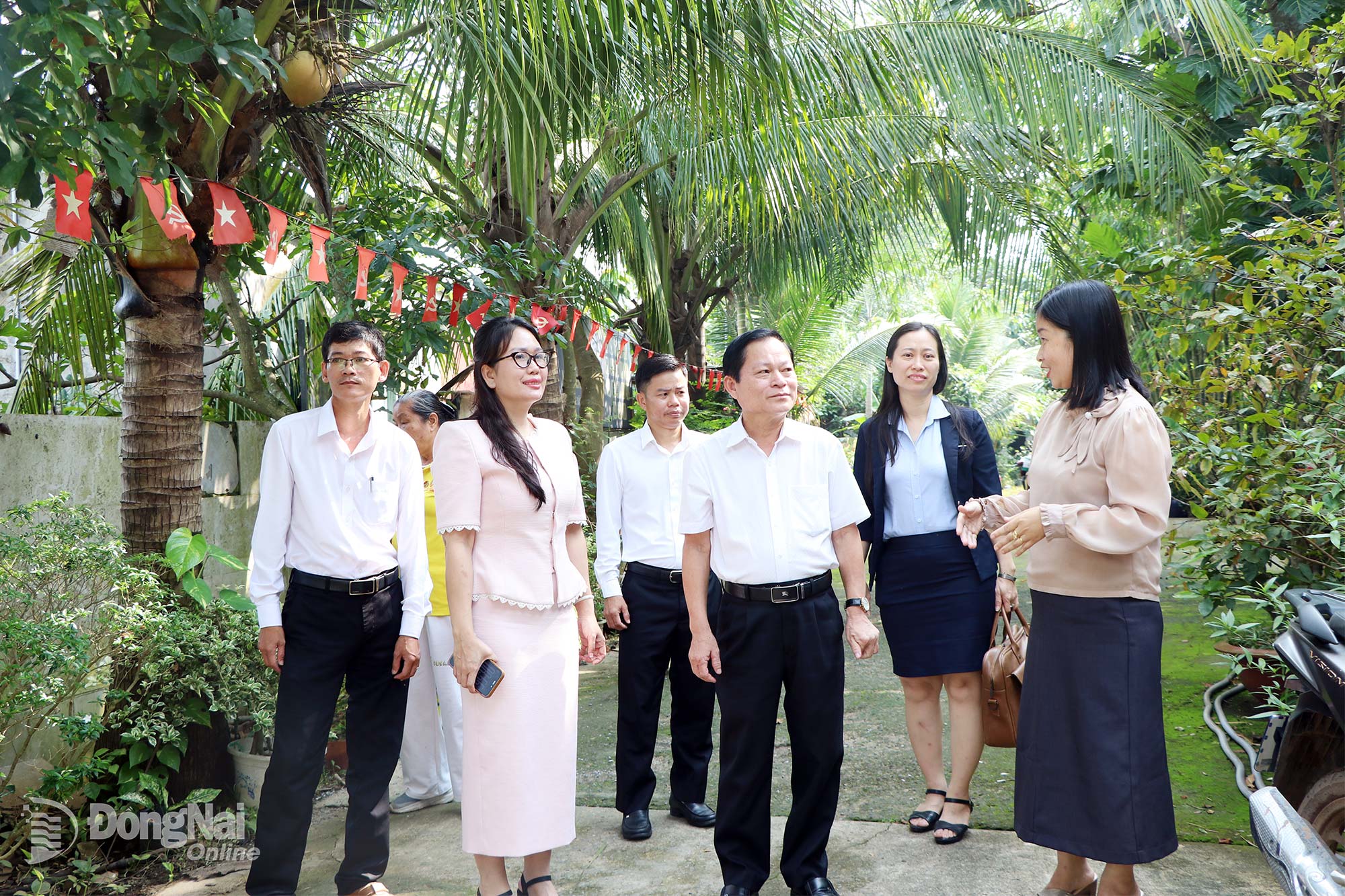 |
| Leaders of the Farmers’ Union and Phuoc Tan Ward join farmers in visiting the Song Buong coffee shop development model. |
Against this backdrop, the Farmers’ Coffee model was launched by the Phuoc Tan Ward Farmers’ Union in connection with the activities of the Club for Good Farmers in Production and Business. The model has created an informal space for farmers to meet, exchange ideas, strengthen connections, and explore development opportunities.
Connecting urban farmers
On the morning of September 15, the Farmers’ Coffee space in Phuoc Tan Ward was filled with everyday conversations closely linked to practical production and business issues. More than 30 farmers and local leaders gathered over coffee to discuss matters of common concern.
There were no formal meetings dominated by reports, the discussions focused on practical issues, including how to establish production linkages, find market outlets for products, cooperate in developing production processes, create more jobs for residents, and support one another in business. Each participant contributed an idea or experience, offering suggestions for jointly identifying development directions suited to the area.
According to Dau Duc Dong, Head of the Phuoc Tan Ward Club for Good Farmers in Production and Business, the club currently has more than 10 members operating in various fields, ranging from crop cultivation and agricultural produce trading to handicrafts and small businesses. This diversity of occupations also provides conditions for members to complement one another in their activities.
A notable feature of Farmers’ Coffee is its informal organizational format. The space is arranged in a friendly and open manner, enabling farmers to confidently discuss issues directly related to their production and business activities, such as sharing experience in accessing loans, applying technology, and promoting products. At the same time, members participating in the model actively encourage and recruit more outstanding production households and invite experts, scientists, and local business leaders to participate as advisors and partners.
Luong Thi Cam Nhung, Chairwoman of the Phuoc Tan Ward Farmers’ Union, said the model was developed in the context of rapid urbanization in the locality. As land available for production shrinks due to projects, farmers must also reconsider their business approaches and can no longer rely solely on traditional production methods.
According to Nhung, the Phuoc Tan Ward Farmers’ Union plans to maintain the activity on a monthly basis. One of the model’s key goals is to strengthen cohesion among members while providing the organization with more opportunities to disseminate policies and better understand the actual thoughts and needs of the people. Through these meetings, the union can better grasp what its members need and the difficulties they face to provide appropriate support.
Opening up development paths for urban farmers
Reality shows that urban farmers are no longer confined to agricultural production on large plots of land. They can trade agricultural products, provide services, develop processed goods, connect with markets, organize experiential activities, or make use of the city’s existing advantages to create new value.
Do Phuoc Dung, Vice Chairman of the Dong Nai Farmers’ Union, said the Phuoc Tan Ward Farmers’ Union’s proactive establishment of the Club for Good Farmers in Production and Business and its selection of Farmers’ Coffee as a meeting space represent an approach consistent with the requirements for renewing the content and methods of union activities in an urban environment.
Accordingly, the value of farmers in the city does not necessarily lie solely in the production land area they have but also in their ability to transition, innovate, develop services, create products, connect with customers, and capitalize on market advantages. Directions such as trading agricultural produce, safe food, processed products, and specialty goods; providing services linked to agriculture, cuisine, and experiences; or developing household economic and small business models suited to the locality can become new development avenues.
Along with that, digital transformation should be regarded as a tool to help farmers improve business efficiency. This can begin with familiar tasks such as building a personal brand, promoting products on social media, selling online, using cashless payments, creating images or videos to introduce items, and managing customers and orders.
To achieve these goals, the club can select several experienced and skilled members to form a core group and guide other members in adopting digital tools. The goal is not to discuss digital transformation at length but to enable each member to apply at least one tool to make their production and business activities more effective.
"The club needs to gradually become an economic connection network. Those with products connect with those who have sales locations; those with raw materials connect with processors; those with experience support beginners. The connections may be small at first, but if they create real value, they will form a foundation for long-term cooperation," said Do Phuoc Dung.
Through this new model, the Phuoc Tan Ward Farmers’ Union aims to develop a way of bringing farmers together that is better suited to urban life. If maintained substantively, Farmers’ Coffee will become a connection space where Phuoc Tan farmers can adapt, innovate, and jointly seek new avenues within the developing urban area itself.
The Farmers’ Coffee model is expected to become a place where farmers can discuss career changes, build personal brands, develop products, and seek cooperation opportunities.
Luong Thi Cam Nhung, Chairwoman of the Phuoc Tan Ward Farmers’ Union
By To Tam – Translated by Minh Hong, Thu Ha
Thông tin bạn đọc
Đóng Lưu thông tin