
Higher rubber latex prices are bringing better returns to growers, encouraging farmers in Northern Dong Nai to invest more in plantation care and improve yields. This will also create favorable conditions to strengthen production linkages, expand financial and technical support, and increase the value of rubber.
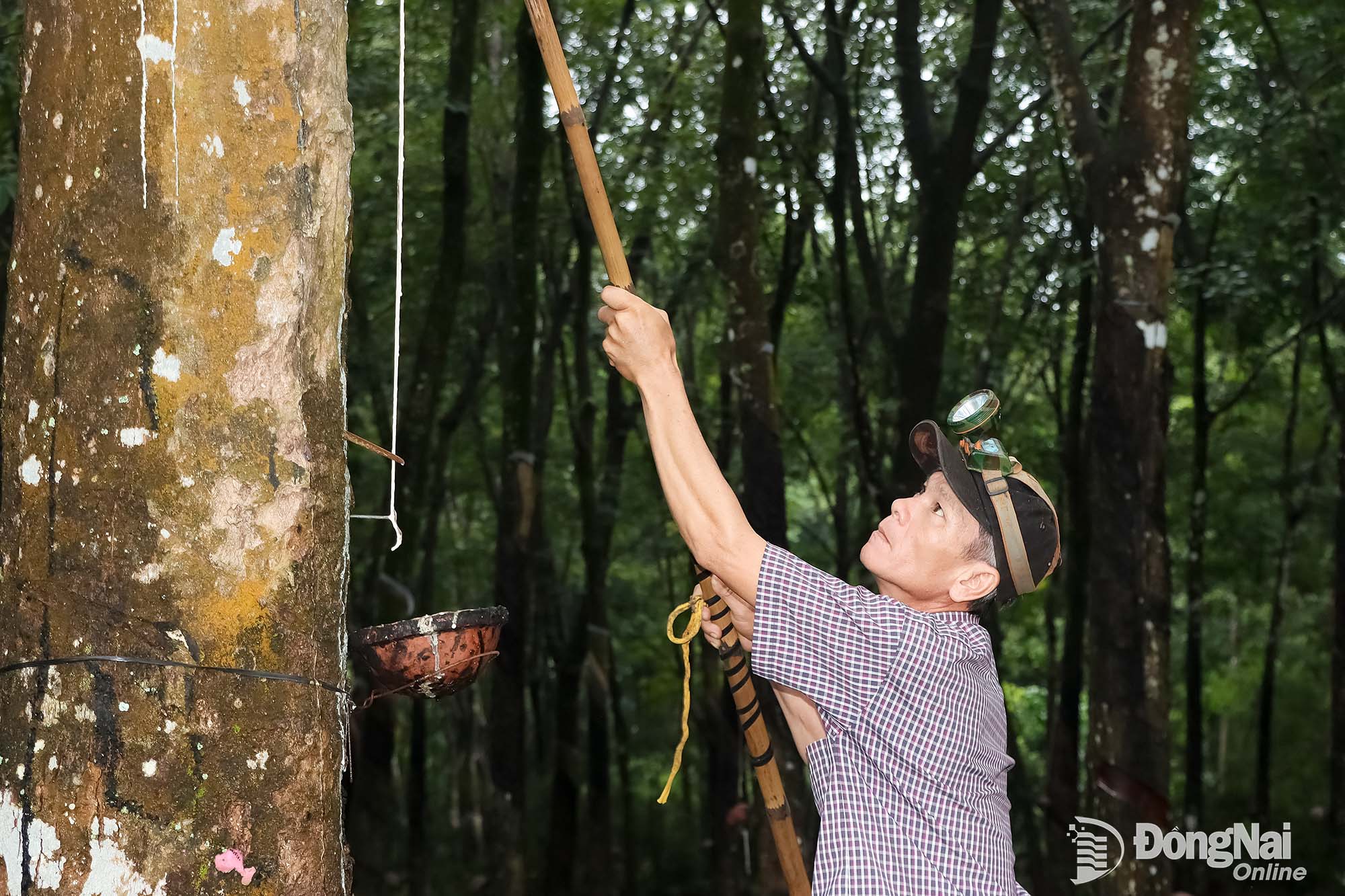 |
| Rubber growers are upbeat as latex prices rise. In the photo: Nguyen Van Tu of Quarter 2, Dong Xoai Ward, taps rubber trees early in the morning. |
Investing in higher yields
Northern Dong Nai is a major rubber-growing area. Many plantations are now in stable production, while sustained high latex prices are encouraging growers to invest more in plantation care and improve yields.
Pham Ngoc Danh’s family, from Hung Long Quarter, Chon Thanh Ward, has been growing rubber for many years. The family currently has 19 hectares of rubber trees in their 10th year of tapping. Rising latex prices have given them more resources and incentive to invest in the plantation. Danh said his family’s rubber trees were planted with PB 260 and RRIV 515 varieties, which are widely grown and capable of good growth and latex yields under suitable conditions. As it is now the rainy season, the latex tests at around 32-35 degrees, with the average price at about VND530 per degree.
With latex prices remaining high, Danh’s family is focusing on fertilizing the trees and controlling pests and diseases. Proper care has helped the plantation maintain a relatively high yield.
The family employs six workers to tap its 19 hectares of rubber trees. On average, the plantation produces about 900 kilograms of field latex a day, generating more than VND15 million in daily revenue.
For rubber growers, the Dong Nai Farmers’ Association (DNFA) and farmers’ associations in communes and wards are working with specialized agencies to provide training and technical guidance, while helping farmers improve cultivation efficiency and access financial support. They are also encouraging farmers to take a more proactive approach to production and adapt to changing conditions and market developments to improve economic efficiency.
Nguyen Van Giang, Vice Chairman of the DNFA
To Van Phu of Thanh Tam Quarter, Chon Thanh ward, is a rubber tapper for Danh’s family. He said: “I am assigned 700 trees. I start tapping at around midnight and finish at about 5 a.m., then return at 8:30 a.m. to collect the latex. Under the contract, the plantation owner and worker split the proceeds at a 60-40 ratio.
“When latex prices are high, workers are also happy because they earn more. If I tap the trees consistently, I can earn an average of around VND900,000 a day, which is higher than the income from many other manual jobs.”
Higher latex prices are also providing a boost to purchasing activity. Nguyen Chau of Minh Long 7 Quarter, Minh Hung Ward, has been involved in rubber latex purchasing for about 20 years. His family currently buys liquid latex from more than 50 households each day, totaling around five tonnes.
According to Chau, his purchasing facility sets its daily buying price based on the price announced by the company it supplies to. Workers go directly to farmers’ plantations to collect the latex, check its latex content, and pay farmers based on the applicable price.
“Higher latex prices have had a positive impact on trading activity. Some farmers weigh their latex and take payment immediately, while others wait until the end of the month to collect their money. Therefore, purchasing facilities need to offer reasonable prices to retain existing suppliers and attract new ones,” Chau said.
Building a foundation for sustainable development
Dong Nai has considerable room to develop its agricultural economy. According to the Department of Agriculture and Environment, the city has established more than 400 concentrated production areas, including large areas devoted to several perennial crops. Rubber plantations cover about 280,000 hectares. With favorable climatic and soil conditions, many communes and wards in the northern part of the city, including Chon Thanh, Minh Hung, Dong Phu, Tan Loi and Nha Bich, have large rubber-growing areas. Nha Bich Commune alone has more than 8,800 hectares of rubber, accounting for 95% of the commune’s total perennial-crop area. This provides a strong foundation for developing concentrated production areas, strengthening production linkages and increasing the value of rubber.
Under Plan No. 03, dated January 7, 2026, on the development of fruit trees and key industrial crops in the commune for the 2025-2030 period, the Nha Bich commune People’s Committee identified the concentrated and sustainable development of fruit trees and key industrial crops, including rubber, and higher added value as key priorities. The commune plans to strengthen linkages in concentrated production areas, comprehensively apply scientific and technological advances in production, and establish and organize production linkages along value chains. It will also implement measures to support the development of cooperatives in both breadth and depth, with a focus on establishing and expanding cooperatives and cooperative groups among local residents.
Alongside the locality's development orientation, financial support for farmers is being rolled out to create more favorable conditions for local residents to invest in production.
Nguyen Van Giang, Vice Chairman of the DNFA, said the Farmers’ Support Fund currently has about VND332 billion in outstanding loans across the city, supporting nearly 1,100 loan projects and more than 5,400 member households and farmers in their production and business activities. Of this amount, 93 loan projects have supported rubber cultivation, plantation renovation and care, with more than VND10 billion disbursed to 353 households.
Rising latex prices are opening up new opportunities for rubber growers, particularly in Northern Dong Nai. Rubber plantations are expected to receive continued investment for better care, helping local residents earn additional income and creating more jobs for laborers, while latex purchasing activity is also becoming more vibrant.
To make the most of market opportunities, higher yields and better-quality plantations need to go hand in hand with better-organized production, stronger linkages and greater access to financing and technical support. These efforts will help the rubber sector build on its strengths, increase the value of its products and make a stronger contribution to Dong Nai’s agricultural economy.
By Q. Minh – Translated by M.Nguyet, Minho
Thông tin bạn đọc
Đóng Lưu thông tin