
Politburo Resolution No. 16-NQ/TW dated July 21, 2026, on building and developing Dong Nai City through 2035, with a vision to 2065, identifies the development of the Long Thanh Airport City and its surrounding areas as one of the new driving forces for Dong Nai City's growth. In implementing this orientation, alongside accelerating construction projects, infrastructure development, and the formation of new service, production, and business activities, requirements for ensuring fire prevention and fighting, as well as search and rescue, are becoming increasingly stringent.
In line with the goals of the special 500-day-and-night emulation campaign, "Solidarity - Discipline - Efficiency - Breakthrough, building a civilized and modern Dong Nai," fire prevention and fighting solutions in the Long Thanh Airport area and its surroundings are being implemented with a focus on proactive prevention at the grassroots level and enhanced response capabilities in the event of an incident.
Increasingly stringent requirements for fire prevention and fighting
Along with Long Thanh Airport, the urban landscape and economic and service activities in surrounding areas are also expanding. Numerous residential areas, infrastructure projects, and production, business, and service facilities are gradually taking shape, leading to population growth and increased demand for travel and daily activities. According to the master plan, the area to the west of the airport alone covers more than 6,300 hectares, with a projected population of approximately 400,000 to 450,000 by 2045. This scale of development requires proactive planning for safety conditions, with fire prevention and fighting implemented in a synchronized manner from the outset of the development of new residential areas and facilities.
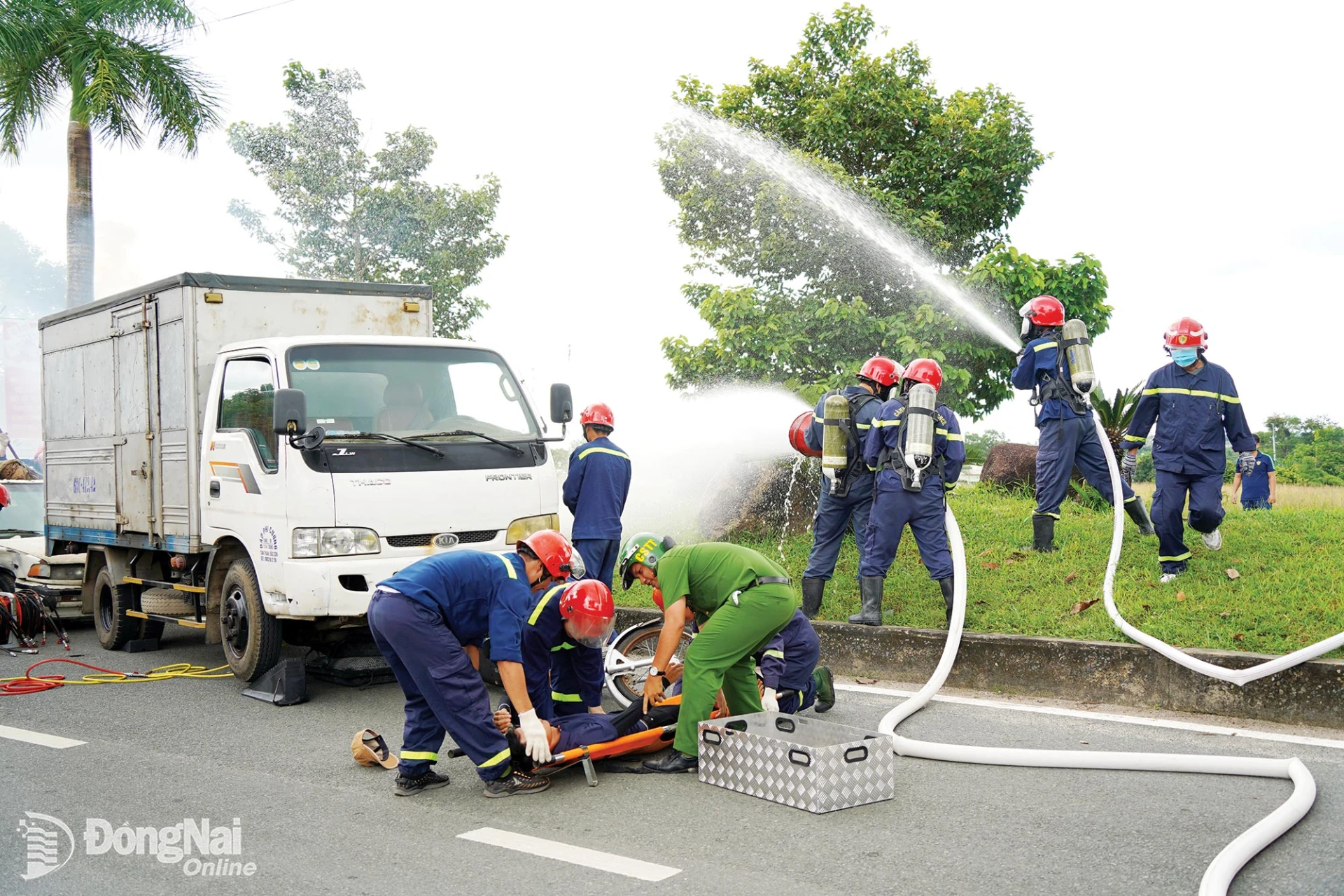 |
| Forces take part in a firefighting and search and rescue drill simulating a vehicle accident in Long Thanh Ward. |
The rapid increase in population, business establishments, boarding houses, warehouses, construction projects, and various service sectors is placing greater demands on fire safety. In densely populated areas in particular, if electrical systems and fire safety equipment are not regularly inspected, escape routes are obstructed, or residents and workers lack the skills to handle initial incidents, a possible fire can quickly escalate into a complex situation.
The firefighting and search and rescue drill held in Long Thanh Ward on July 31 demonstrated the need for proactive response in the airport area. The simulated scenario involved complex traffic conditions, a multi-vehicle collision, trapped individuals, and a fire caused by leaking fuel. Under the scenario, police, firefighting and search and rescue forces, medical teams, and on-site units practiced procedures for approaching the scene, rescuing victims, containing the fire, and providing first aid before transporting victims for emergency care. The drill helped test concerted plans in practice while enabling the forces to identify issues requiring further adjustment to shorten response times when an incident occurs.
Vu Duc Anh, a resident of Long Thanh Ward, commented that as the airport area develops further, the number of people and vehicles and the volume of business activities will increase accordingly. Residents need to take the initiative in prevention through small actions such as inspecting electrical systems, keeping on-site firefighting equipment ready, maintaining clear escape routes, and avoiding complacency when using sources of fire or heat.
The larger the scale of development, the greater the requirements for prevention and response capabilities must be. This is also why fire prevention and fighting work in the Long Thanh Airport area is not limited to inspections and public awareness campaigns, but is being incorporated into requirements for developing plans, forces, and concerted mechanisms suited to the characteristics of an emerging airport urban area.
Vu Dinh Nam, a worker at a business in Long Thanh Industrial Park, said that being proactive in fire prevention and fighting also means protecting one's own safety, as well as that of colleagues and the business. In a production environment, even a small incident, if not detected and handled promptly, can affect the entire area. Therefore, workers need to master fire reporting procedures and the use of initial firefighting equipment, and know how to escape when an incident occurs.
Building a proactive fire prevention approach for the airport city
At the firefighting and search and rescue drill held in Long Thanh Ward on July 31, Senior Colonel Tran Anh Son, Deputy Director of the Dong Nai City Public Security Department, emphasized that the synchronized implementation of fire prevention and fighting and search and rescue solutions is of great significance to Long Thanh Ward, an area located within the airport city that is taking shape and developing rapidly. In addition to developing response plans for complex situations, it’s necessary to carry out fire prevention and fighting work at the grassroots level, strengthening the responsibility of local authorities, facility owners, businesses, and the public, thereby reducing the risk of fire and explosion and limiting damage when incidents occur.
According to Lieutenant Colonel Mai Anh Giang, Head of the Firefighting and Search and Rescue Team of Area 3, which is responsible for Long Thanh Ward, the airport area is characterized by rapid urbanization, with an increasing number of construction projects, business establishments, residential areas, and production activities. Therefore, firefighting forces regularly survey the area, monitor the situation of facilities at risk of fire and explosion, and instruct facility owners on how to address existing fire safety deficiencies. At the same time, the force focuses on raising public awareness and training residents and workers in initial incident-handling skills, escape techniques, and the use of on-site firefighting equipment.
One of the key solutions is to strengthen prevention from the stage of developing facilities and projects. Production and business establishments, boarding houses, warehouses, and crowded places need to be guided in fully implementing fire safety conditions and regularly inspecting electrical systems, sources of fire and heat, firefighting equipment, and escape routes. Identified deficiencies must be addressed within specific timeframes to avoid a situation in which action is taken only after an incident occurs. At the same time, it is necessary to enhance on-site firefighting and search and rescue capabilities, especially in residential areas, businesses, and areas with high concentrations of workers. Building and consolidating grassroots firefighting and civil guard forces, and organizing drills for each type of risk, will help residents and employees avoid panic in the first few minutes when an incident occurs. This is also a crucial period for preventing a fire from spreading, saving lives, and protecting property.
As Long Thanh Ward gradually becomes an important part of the airport city, the requirement is not only to have sufficient forces and equipment when fires occur but also to establish a multi-layered prevention and response network involving the government, specialized forces, businesses, and the public. This is also a way to concretize the spirit of "Solidarity - Discipline - Efficiency - Breakthrough, building a civilized and modern Dong Nai" during the 500-day-and-night special emulation campaign, creating a safe foundation for the Long Thanh Airport area to develop rapidly and sustainably.
For areas with numerous roads, transport infrastructure, and vehicles connecting to the airport, the ability to access the scene and coordinate rescue efforts must also be taken into consideration. Plans must clearly define access routes, water sources, vehicle assembly points, evacuation areas, and the concerted mechanism between firefighting forces and the police, medical services, local authorities, and related units. These elements need to be tested through drills and exercises so that any shortcomings can be promptly addressed.
By Le Duy – Translated by Minh Hong, Thu Ha



Thông tin bạn đọc
Đóng Lưu thông tin