
Long Thanh International Airport is entering the stage of preparations for commercial operations, creating strong momentum for Dong Nai’s economic development in the new phase. This major project is expected not only to support aviation operations but also to drive the development of aviation-related industries in Dong Nai.
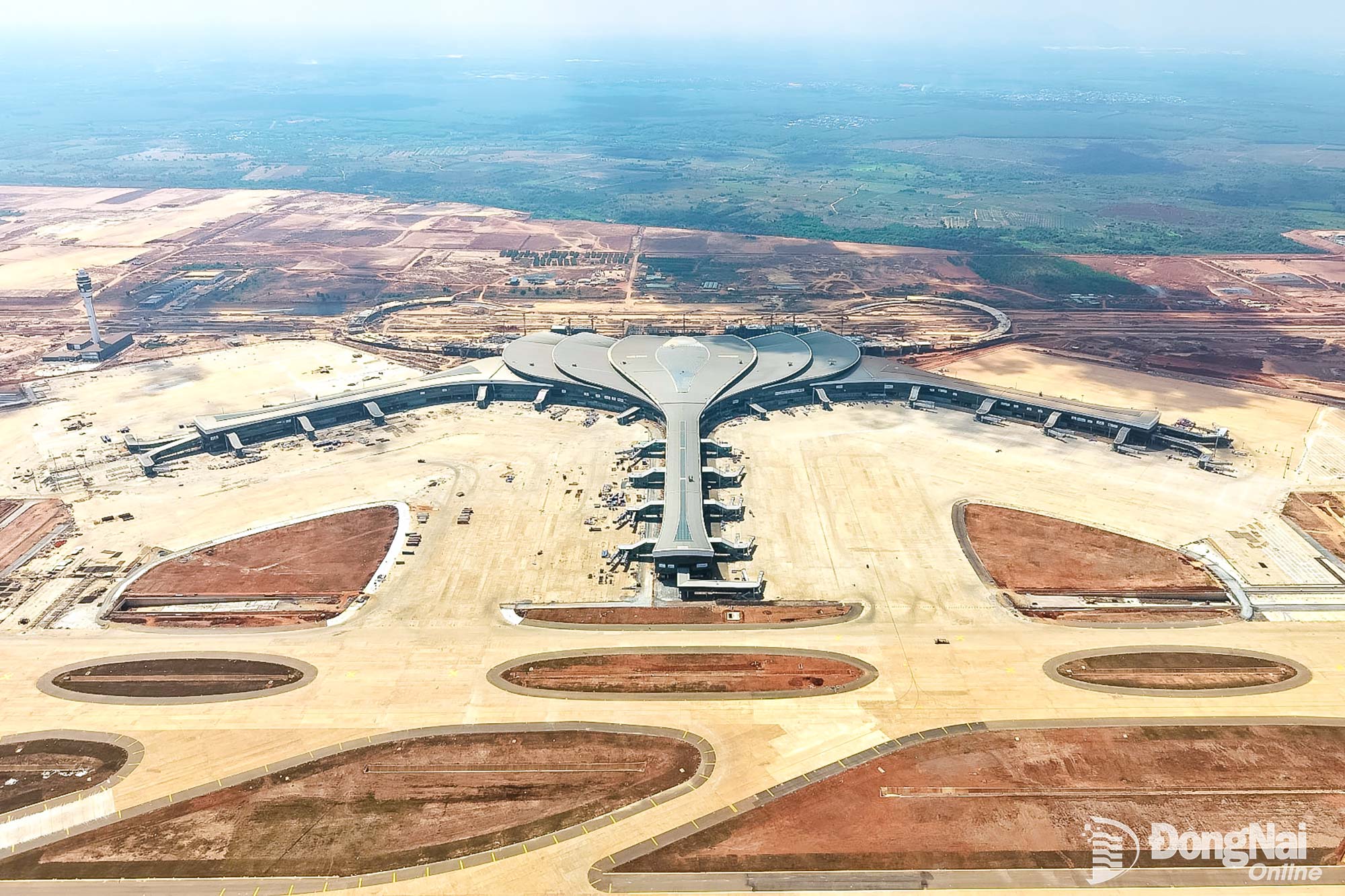 |
| Long Thanh International Airport is creating strong momentum for Dong Nai to develop an aviation industry and services ecosystem. |
Recently, Politburo Resolution No. 16-NQ/TW, dated July 21, 2026, on building and developing Dong Nai City through 2035, with a vision to 2065, identified aviation economy, aviation industry, aerospace industry and high-tech industries as part of the city’s long-term development orientation. A number of related projects and planning schemes are already being implemented, laying the initial groundwork for this direction.
Establishing major development orientations
One of the notable points of Resolution No. 16 is the orientation to develop the city under a polycentric model, with the Long Thanh area organized as an airport city associated with Long Thanh Airport.
Under Resolution No. 16, by 2035 the city aims to develop into a polycentric, green and smart city meeting international standards in aviation industry, aviation economy and high-tech industries. By 2045, Dong Nai aims to become a modern aviation hub in the Asia-Pacific region, with a vision toward 2065 of becoming a globally connected, multifunctional city.
Under this orientation, Long Thanh is identified as the city’s key international airport, an international transit hub and the core of the aviation economic space. The resolution calls for the integrated development of services, logistics, industry and urban areas associated with the airport, while studying appropriate mechanisms and policies to effectively capitalize on the advantages of Long Thanh Airport.
For the aviation industry, Resolution No. 16 takes a broader approach than passenger transportation alone. Areas such as aircraft maintenance and repair, component manufacturing and supply, supporting industries, aviation engineering services and related high-tech sectors are incorporated into the development space of the airport city.
The resolution also mentions studying new functional areas such as an aviation industrial park, a concentrated digital technology park, an innovation zone and functional areas serving aviation activities. These are strategic-level orientations, while the development of specific projects must go through planning, investor selection and implementation in accordance with regulations.
According to Associate Professor, Doctor Nguyen Hoang Phuong, Deputy Head of the Faculty of Socio-Economics and Environment at the Ho Chi Minh National Academy of Politics Region II, Dong Nai should prioritize spearhead sectors such as aviation, semiconductors, artificial intelligence (AI) and automation, while modernizing its industrial parks toward ecological and smart models linked to innovation. In addition to the momentum generated by Long Thanh Airport, Dong Nai is also seeking to reposition its economy toward a modern and smart industrial city model. The core issue is to shift from outsourcing industries toward high-tech industries with greater added value.
Developing the aviation industry
Following the central government’s orientations, Dong Nai is reorganizing its industrial space, with the Long Thanh area playing an important role. According to Pham Viet Phuong, Deputy Head in charge of the Dong Nai Industrial Parks and Economic Zones Authority, the city is focusing on developing three groups of spearhead industrial products: aviation industry; semiconductors, chips and AI; and automation equipment and information technology. The selection of these sectors is closely linked to the connectivity advantages provided by Long Thanh Airport and the interregional transport network.
In the long term, Resolution No. 16 places the aviation and aerospace industries among the sectors associated with the goal of improving the quality of Dong Nai’s economic growth. Therefore, the requirements for local industry will change toward increasing the share of sectors with higher levels of technology, engineering and added value.
Speaking at the Forum on Building Ecological and Smart Industrial Parks — Drivers for Investment Attraction and Green Economic Development in the Southeast Region, held in Dong Nai on July 28, Pham Viet Phuong said that Dong Nai’s industrial orientation in the new phase is to select high-tech industries while developing supporting industries, deep processing, logistics and models of ecological industrial parks. The Southern region, where Long Thanh Airport is located, is being oriented toward expanding services, logistics, high-tech industries and airport-related activities. Meanwhile, the northern industrial space is being expanded toward attracting manufacturing industries suited to available land resources and infrastructure conditions.
In practice, alongside the construction progress of Long Thanh Airport, a number of related projects outside the airport site have also been implemented or are under development. These include the Long Thanh Concentrated Digital Technology Park in the An Phuoc and Binh An areas. Covering approximately 119 hectares under the planning scheme, the park is expected to attract digital technology activities, research and development, and related high-tech industries. The city has completed planning-related steps and is promoting infrastructure investment in the area.
In aviation engineering, maintenance, repair, and overhaul (MRO) centers operated by Vietjet and Vietnam Airlines at Long Thanh Airport will provide aircraft maintenance and repair services. The presence of MRO facilities in the airport area will add direct production and service activities supporting the aviation industry.
At the same time, Dong Nai is urgently completing its connectivity infrastructure, particularly routes leading to the airport gateway, including the radial expressways and direct connecting routes such as Roads 769 and 773. These projects will connect the Long Thanh area with urban centers, industrial parks and the interregional transport network.
According to experts, Long Thanh Airport provides the conditions for Dong Nai to develop an ecosystem of aviation-related industries and services. However, it is important to create opportunities for Vietnamese businesses to participate more deeply in the aviation supply chain. To do so, businesses must meet high requirements in engineering, quality, safety, production management and human resources. Therefore, alongside attracting major projects, developing supporting-industry businesses and training technical workers will determine the extent to which Dong Nai can participate in this value chain.
By Vuong The - Translated by Mai Nga, Thu Ha



Thông tin bạn đọc
Đóng Lưu thông tin