
Dong Nai is home to more than 2.65 million religious followers out of its total population of nearly 5 million. In implementing social welfare activities through community resources, the Vietnam Fatherland Front (VFF) and its member organizations at all levels have proactively engaged religious organizations in these efforts.
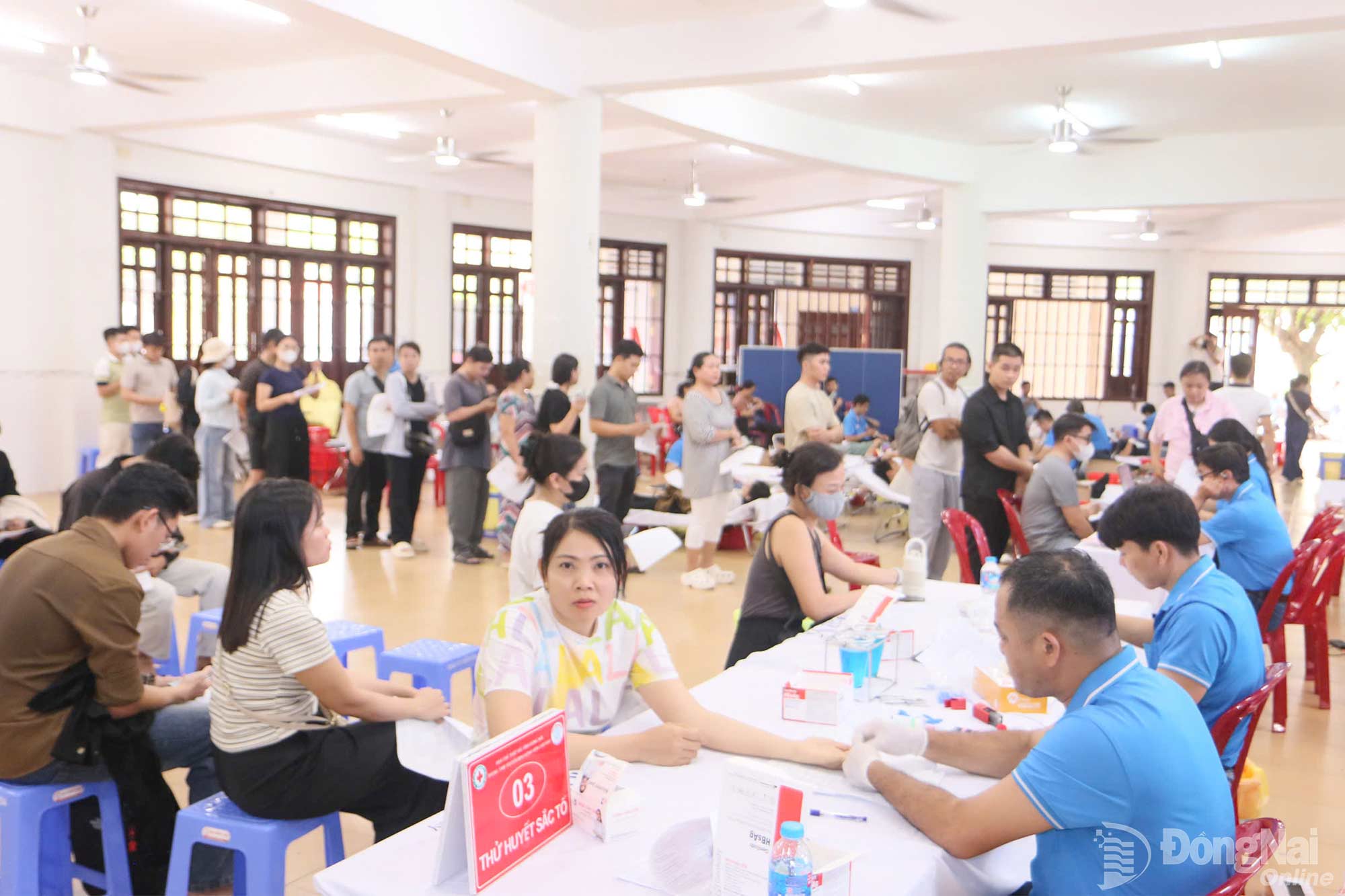 |
| Parishioners of Bien Hoa Parish in Tran Bien Ward participate in a voluntary blood donation drive. |
This has contributed to effectively mobilizing and diversifying social resources for social welfare work, while strengthening the close relationship among the Party, the government, and religious organizations, religious dignitaries, clergy, and followers for the city's development.
Mobilizing resources of religious organizations
Dong Nai has a rich and diverse religious life, featuring 24 organizations from 10 different religions, as well as a variety of belief establishments and other forms of religious practice. In recent years, religious organizations have actively participated in social welfare activities, education and healthcare development, the building of cultural life, and the maintenance of local security and order.
Among these activities, contributions to social welfare most clearly demonstrate the spirit and social responsibility of religious organizations, religious dignitaries, clergy, and followers. During the 2021–2025 period, religious organizations in the area contributed more than 2.5 trillion VND to social welfare activities. Since the beginning of 2026, religious organizations have contributed more than 428 billion VND to social welfare work through various models. Many models, including charity kitchens, Zero-VND markets, charity clothing closets, free clean water, and parish-led blood donation drives, have been maintained, generating positive social impacts.
For many years, Giac Quang Pagoda in Loc Hung Commune has coordinated with local authorities to maintain a charity kitchen serving people in difficult circumstances. Venerable Thich Buu Hoa, Deputy Chief Secretary of the Dong Nai City Executive Board of the Vietnam Buddhist Sangha and abbot of Giac Quang Pagoda, said the kitchen operates two days a week. Each time, the pagoda prepares 400 free meals for the community. Over the years, with the support and facilitation of local authorities, the kitchen has been able to reach people in need, while meal distribution at the pagoda gate has been conducted in an orderly manner.
According to Priest Nguyen Minh Chanh, Vice Chairman of the Committee for Solidarity of Vietnamese Catholics in Dong Nai City and Parish Priest of An Khuong Parish in Tan Hung Commune, every parish has maintained forms of assistance for people in difficult circumstances for many years. Notably, an initiative that has been effectively implemented and regularly maintained is the provision by each parish of a clean water system that supplies free water for people’s daily needs, regardless of religion.
Nguyen Tan Phu, Vice Chairman of the Dong Nai City VFF Committee, said religious organizations have established 183 educational institutions, with average annual support funding for educational activities exceeding 95 billion VND. In addition, there are 74 healthcare facilities belonging to religious organizations, with average annual support funding for medical activities exceeding 20 billion VND. There are also 44 social protection establishments caring for and educating more than 2,600 social assistance beneficiaries. These activities are not only materially significant but also help nurture the spirit of mutual affection and community responsibility and strengthen cohesion among all walks of life.
Through coordination with religious organizations in implementing social welfare models, a crucial principle has become evident: When the VFF’s movements are linked to the practical interests of the community and aligned with the moral values of each religion, the potential for participation and sustainability is greater. Therefore, in building and replicating religious models that accompany the community, the VFF at all levels will focus on areas in which religion has strengths, such as social welfare, the environment, learning promotion, care for vulnerable groups, crime prevention, and the building of civilized residential areas.
Nguyen Tan Phu, Vice Chairman of the City VFF Committee
Aiming for sustainable social welfare programs
The results achieved through the participation of religious organizations alongside the VFF and its member organizations, as well as communes and wards in implementing social welfare work in recent years, are considered very positive. These social welfare models have continued to be maintained and expanded by the relevant parties.
According to Nguyen Thi Quy, Chairwoman of the Minh Duc Commune VFF Committee, in 2025, the Commune VFF Committee and Tu Nghiem Pagoda coordinated to operate a kitchen for people in difficult circumstances and provide gifts to poor people and other cases in need of assistance. During the implementation process, after initially establishing ties with one religious institution, the commune’s VFF Committee has since engaged all six religious institutions in the area in social welfare work. As a result, many community assistance activities have been carried out, including one community water well for 19 ethnic minority households at a cost of 30 million VND and the distribution of more than 1,500 gifts to local people.
In addition, these religious institutions also coordinate with local authorities to disseminate information and encourage followers to properly implement the Party's guidelines and orientations and the State's policies and laws to promote the spirit of mutual affection in daily life. These activities continue to be maintained by the Commune VFF Committee and the religious organizations.
According to Nguyen Tan Phu, Vice Chairman of the City VFF Committee, Dong Nai is promoting the role of religious organizations, religious dignitaries, clergy, and followers in building united, safe, prosperous, and joyful residential areas. This direction is highly consistent with Program 4 of the 11th National Congress of the VFF for the 2026–2031 term, on promoting the people's mastery role and their spirit of self-management and on building united, safe, prosperous, and joyful residential areas.
According to Nguyen Tan Phu, the VFF recognizes the contributions of religions as a sustainable social resource. Rather than mobilizing religious contributions only for individual drives or campaigns, it is necessary to develop long-term coordination programs. To achieve this goal, the VFF is developing a coordination mechanism with religious organizations, shifting from case-by-case coordination to program-based coordination. Each program clearly defines its goals, content, focal points, responsibilities, and methods for evaluating results. The VFF proactively connects the social resources of religious organizations with local social welfare programs while ensuring the principles of openness, transparency, and compliance with the law. Attention is also paid to identifying exemplary religious dignitaries and clergy, promoting their role, and commending them.
By Van Truyen – Translated by Minh Hong, Thu Ha
Thông tin bạn đọc
Đóng Lưu thông tin