
Originally built as an irrigation project, the Ta Lai spillway, also known as Vam Ho dam in Ta Lai Commune, is gradually emerging as a popular destination for recreation and experiences among local residents and tourists. It is expected to become a key destination as Ta Lai seeks to develop community-based tourism.
Located in the buffer zone of Cat Tien National Park, Ta Lai is an agricultural commune endowed with pristine landscapes and home to ethnic minority communities, including the Chau Ma, S’tieng, and Tay, that continue to preserve their traditional customs. These advantages give the commune significant potential to develop tourism into a spearhead economic sector.
From an irrigation project to a weekend getaway
During the September 2 National Day holiday period, the Ta Lai spillway becomes busier than usual. Every day, hundreds of people visit the dam to enjoy its cool, clear blue water and the charming scenery of rivers, clouds, and sky in the peaceful countryside. There are no large-scale tourism projects, while tourism services have yet to receive systematic investment. The area's appeal comes, first and foremost, from its natural and idyllic beauty.
 |
| The Ta Lai field, located in Ta Lai Commune, is a popular photo spot. Photo: Thuy Tien |
Nguyen Thi Ngoc Yen, who lives and works in Bien Hoa Ward, traveled with her husband to Ta Lai during this year's September 2 holiday and chose the Ta Lai spillway as a check-in spot on the country's special day. Wearing matching family outfits and carrying the national flag, Yen, her husband, and their two young children took photos beside the spillway. "My first impression is that the scenery here is stunning. I took photos and shared them on Facebook, hoping that many people will learn about this place and come here, contributing to the development of local tourism. I realize that Ta Lai has a lot of potential. If its potential is properly developed, it will attract many visitors," said Yen.
The Ta Lai spillway was built to provide irrigation for approximately 52 hectares of fields in Hamlet 4, Ta Lai Commune, with the structure stretching about 1.32 km. During the rainy season, water flowing over the dam creates a waterfall effect. Notably, the spillway is set amid a rich agricultural landscape, near more than 80 hectares of rice fields nestled between the mountains and the Dong Nai River, creating a characteristic countryside scene in Ta Lai. Over time, the irrigation structure has not only helped ensure water for production but also created a unique landscape that attracts many visitors.
Awakening tourism "materials"
Beyond Vam Ho dam, Ta Lai Commune holds considerable potential for tourism development. Located in the southern buffer zone of Cat Tien National Park, the commune boasts a diverse landscape encompassing forests, the Dong Nai River, rice fields, and orchards. Ta Lai has a population of more than 34,000, with ethnic groups such as the Chau Ma, S’tieng, Choro, Tay, Nung, and Hoa accounting for about 12%. The community continues to preserve many traditional cultural values, including brocade weaving, basketry, and festivals such as the New Rice Celebration and Long Tong. Ta Lai is also home to the Ta Lai Prison Break site, a provincial-level monument of value for historical tourism and traditional education. These are valuable "materials" for developing in-depth tourism products rather than relying solely on natural scenery.
 |
| The Ta Lai spillway attracts many visitors for recreation. |
According to Nguyen Anh Tuan, Deputy Head of the Culture and Social Affairs Division of the Ta Lai Commune People's Committee, following the administrative boundary merger and the implementation of the two-level local government model, greater attention and investment have been given to tourism development. Tourism development has also benefited from support from the culture, sports, and tourism sectors, as well as the Dong Nai Museum, through initiatives such as classes on gong culture and brocade weaving. Tourism businesses have also become involved. Specifically, Oxalis Adventure Co., Ltd. currently operates several tours in Cat Tien National Park, including three trekking tours to Ta Lai that incorporate local cultural experiences. The company has set the goal of developing Ta Lai into one of the world's best tourism villages by 2030.
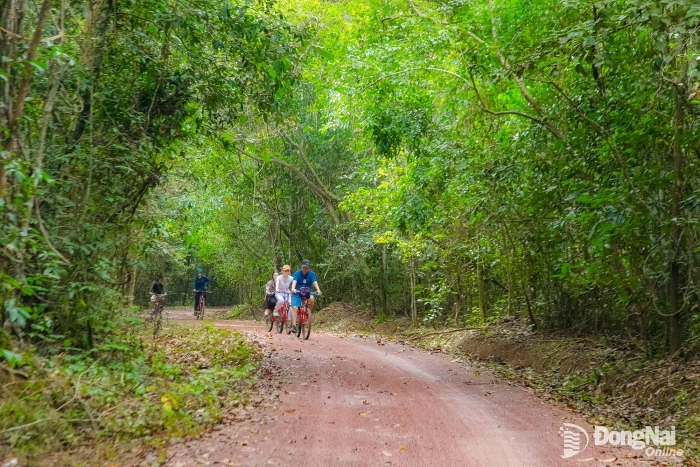
Potential tourism activities being developed by Ta Lai Commune include cycling on forest trails connecting the commune center with Cat Tien Forest or passing through sites such as Suoi Da and Vam Ho dam; kayaking on the section of the river running through Ta Lai to watch the sunset and observe riverside flora; and camping in rice field areas or near streams and waterfalls. Other forms of tourism include community-based and cultural tourism that leverages the traditional culture of the Chau Ma, S'tieng, and Tay peoples; agricultural experiential tourism; and environmental education tourism.
The landscape is merely the "shell" of the Ta Lai tourism story; its "soul" lies in the community. Visitors can learn about the culture of the Chau Ma, S’tieng, and Tay peoples, experience traditional crafts, enjoy local cuisine, participate in agricultural activities, and learn about the natural environment. These are also the tourism product lines that Ta Lai Commune is focusing on developing.
Nguyen Anh Tuan added that tourism currently does not yet play a leading role in the local economic structure. However, under its development orientation for the coming period, the locality has identified agriculture and tourism as two spearhead sectors. Therefore, the human resources challenge is being addressed alongside tourism product development. The locality aims to attract young people to return while also coordinating with partners to enable children from ethnic minority communities to attend specialized tourism training courses before returning to work in and operate local tourism models.
By Hai Yen – Translated by Minh Hong, Minho


Thông tin bạn đọc
Đóng Lưu thông tin