
From Long Thanh International Airport, highways, ring roads and railways to the space along the Dong Nai River, a series of major infrastructure projects are gradually shaping Dong Nai's urban structure. For these "pieces" to form a cohesive, modern urban entity, the city must organize its space under long-term planning, ensure synchronized infrastructure connectivity and place citizens at the center of the development process.
These are also among the major orientations set out for Dong Nai in Politburo Resolution No. 16-NQ/TW, dated July 21, 2026, on the construction and development of Dong Nai City through 2035, with a vision toward 2065 (referred to as Resolution 16).
Projects reshaping Dong Nai
Dong Nai was once known as the country's industrial "capital." As it enters a new stage of development, industry remains an important foundation, while strategic infrastructure projects are giving the city a new look. These include the airport, which enhances the city's status and creates a new growth pole; the transport network, which strengthens connectivity and expands development space; and the Dong Nai River, which creates identity, landscape and modern living spaces.
 |
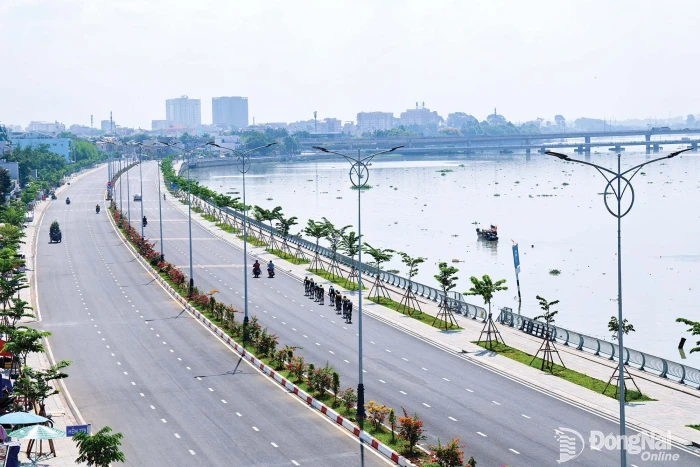
| A corner of the urban area in Tran Bien Ward. Photo: Cong Nghia |
The most prominent among these projects is Long Thanh Airport. Under the guidelines set out in Resolution 16, the airport is not merely a transport project but must become the nucleus of an aviation ecosystem linked with logistics, high-tech industry, commerce, services and urban development.
This approach provides a basis for Dong Nai to potentially develop Vietnam's first airport city model. According to the master plan, upon completion of all phases, Long Thanh Airport will have the capacity to serve approximately 100 million passengers annually. Such a scale places demands on aviation infrastructure and entails the formation of corresponding urban spaces, services and infrastructure in the surrounding area.
According to architect Khuong Van Muoi, former Vice Chairman of the Vietnam Association of Architects, an airport city is an urban area with comprehensive functions serving aviation activities, meeting residents' needs and connecting with domestic and international markets. This ecosystem encompasses aviation logistics, industry, commerce, services, education, healthcare and many other urban functions.
Along with investment in the airport, investment is being made to develop and complete the transport network connecting Dong Nai with economic centers in the region. In addition to the Bien Hoa - Vung Tau Expressway, Ho Chi Minh City’s Ring Road 3 and roads connecting to the airport, which have been or are being developed, urban railway lines will soon be added to complete the multidimensional transport network.
Deputy Secretary of the Dong Nai City Party Committee Vo Tan Duc said transport infrastructure projects connecting Long Thanh Airport with Ho Chi Minh City, seaports, international border gates, industrial parks, urban areas and many other localities in the region will form the "backbone" of Dong Nai's future spatial development.
Within this structure, the Dong Nai River constitutes an important spatial axis. Resolution 16 calls for the river system and natural ecosystem to serve as the primary landscape axis, with the Dong Nai River playing a central role in ecology, culture, landscape and urban development.
This is a key direction for creating a distinctive identity for Dong Nai City. Architect Khuong Van Muoi also noted that the Dong Nai River is large in scale and has a wide riverbed, providing ample room for the development of urban, cultural, sports and tourism activities. Investment is currently being made in road and embankment projects along the river. Once completed, they will contribute to improving connectivity, preventing erosion and creating more public space for residents.
Under the city's guidelines, strategic projects such as the airport, highways, railways, seaports and the urban system along the Dong Nai River will be connected under a unified plan to create new development poles and corridors. The city will then gradually shift from the structure of a traditional industrial city toward a polycentric, multi-nodal and multi-layered urban structure.
Toward an open, polycentric urban structure
For a developing city like Dong Nai, investment in large-scale, strategic projects is essential. However, these projects can only become truly effective when incorporated into a unified spatial structure. Conversely, without connectivity and spatial organization in accordance with planning, individual projects will struggle to maximize their catalytic role or help shape the city's identity.
 |
| Bien Hoa 2 Industrial Park, one of the first industrial parks established in Dong Nai. |
Resolution 16 requires comprehensive city planning with a long-term vision, with space organized in an open, polycentric, multi-nodal and multi-layered direction. This approach differs from the mindset of developing urban areas through individual projects or in specific areas.
Accordingly, development associated with Long Thanh Airport is not confined within the project's boundaries but extends along corridors connecting it with Nhon Trach, Bien Hoa, Ho Chi Minh City, the seaport system and other economic centers. This means that the Long Thanh airport urban area is positioned in relation to neighboring urban areas, including Ho Chi Minh City.
Urban spatial organization needs to be linked with the development of public transport, with housing, schools, hospitals, services and public spaces appropriately arranged around transport hubs and corridors. This approach is consistent with the direction of reducing emissions and moving toward the net-zero goal in Dong Nai City's transport sector. When road infrastructure and public transport develop in a synchronized manner, residents will have more choices and make greater use of public transport, thereby reducing traffic pressure, lowering emissions and improving the quality of the urban environment.
Regarding the direction for utilizing space along the Dong Nai River, Member of the City Party Committee’s Standing Board and Vice Chairman of the City People's Committee Nguyen Tuan Anh said Dong Nai will control project development while combining urban renewal with the preservation and promotion of landscape values. For projects currently being implemented or about to be implemented, such as Nguyen Huu Canh Boulevard and the extension of the Ben Thanh - Suoi Tien metro line to the administrative center of Dong Nai City and Long Thanh Airport, the city will link infrastructure investment with urban spatial renewal. Through this approach, it will gradually establish a sustainable development space, truly making the Dong Nai River the primary landscape axis.
Politburo Resolution 16 on the construction and development of Dong Nai City through 2035, with a vision toward 2065, sets the goal of developing Dong Nai into an airport city and a riverside urban area that is polycentric, green and smart, with an important role in the Southeast region and the country as a whole. The city will develop in a polycentric, multi-nodal and multi-layered direction, with open space organized around the river system and natural ecosystem as the primary landscape axis and with the Dong Nai River playing a central role in ecology, culture, landscape and urban development.
A city's structure is shaped by its major projects and the quality of life it offers for its residents. For this reason, Resolution 16 identifies people as the center, subject, resource, goal and beneficiary of development. Today's construction projects and works must contribute to enabling residents to travel more conveniently, access essential services more easily and enjoy more public space and a higher-quality living environment.
The projects currently being implemented or about to be implemented can be regarded as important building blocks in shaping Dong Nai's future urban structure. As infrastructure becomes interconnected, urban space expands and development centers gradually take shape, the major guidelines of Resolution 16 are also being progressively realized. This provides a solid foundation for Dong Nai to create a new, modern, green and more livable development space for its residents.
By Hoang Loc – Translated by Minh Hong, Thu Ha
Thông tin bạn đọc
Đóng Lưu thông tin