
Dong Nai is prioritizing administrative reform in tandem with local digital transformation efforts. The city is focusing on accelerating the digitization of records and archival documents, completing digital infrastructure, and strengthening data connectivity and sharing among government agencies.
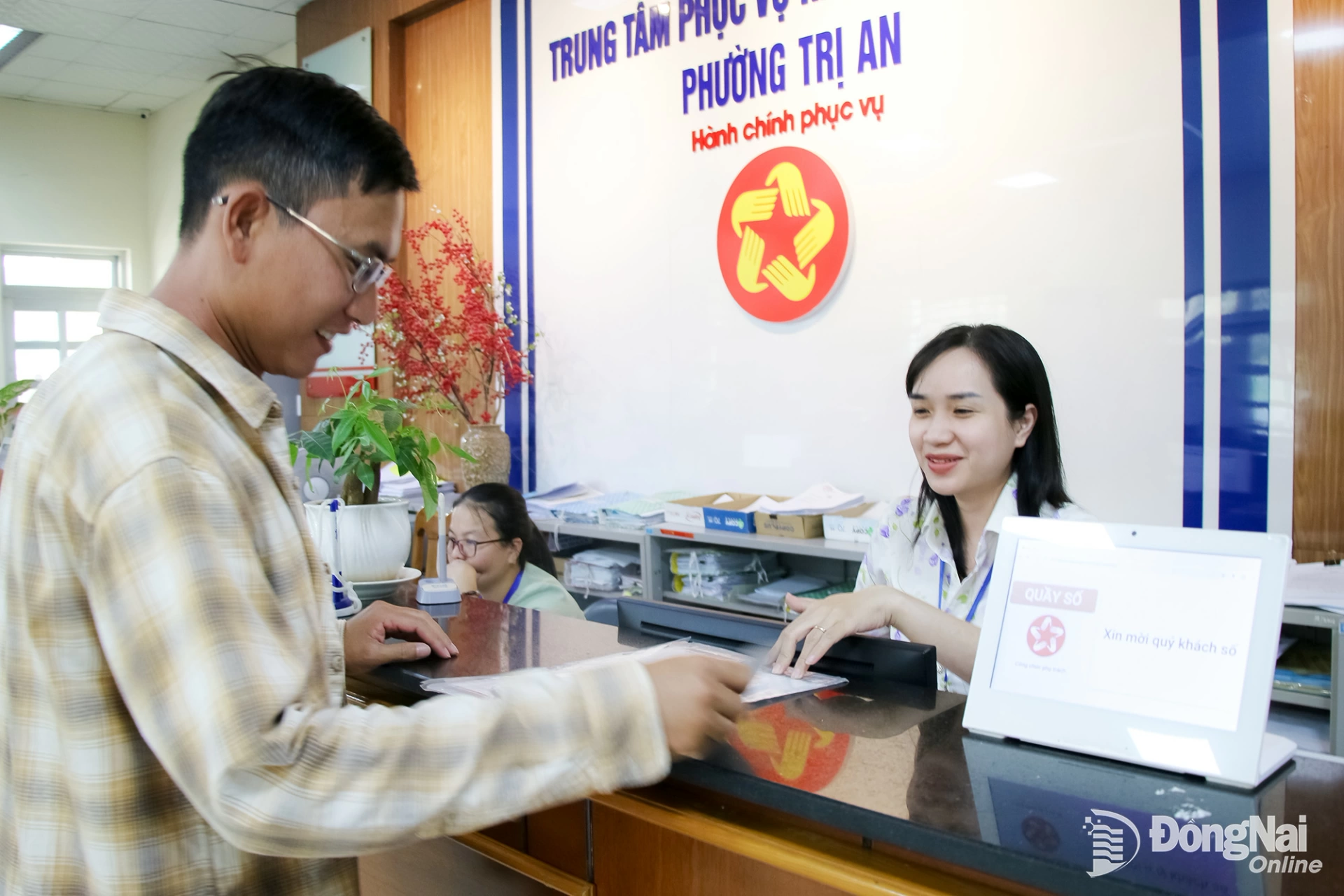 |
| Staff at the Tri An Ward Public Administrative Service Center assist residents in completing administrative procedures online. |
Localities across the city are also stepping up the application of information technology in management, operations, and the processing of administrative procedures, with the aim of building a modern, transparent, and efficient administrative system.
Accelerating document organization and digitization
Recently, departments, sectors, and localities have carried out tasks under Decision No. 2996/QD-UBND issued by the People's Committee of Dong Nai Province (now Dong Nai City) in 2025, approving the Project for Management and Professional Processing of Records and Documents already inventoried by agencies and organizations prior to organizational restructuring (referred to as Project 2996), and Decision No. 1687/QD-UBND issued by the People's Committee of Dong Nai Province (now Dong Nai City) in 2026, approving the Project on Digitization of documents and archival records of agencies and units in Dong Nai for the 2026-2030 period (referred to as Project 1687).
According to the Department of Home Affairs, as of mid-August 2026, the total funding approved by the City People's Committee and the Department of Finance for units and localities to implement Project 2996 had reached nearly 424 billion VND.
In terms of implementation progress, units and localities in the group with less than 200 linear meters of documents (a linear meter of documents is 1 meter of documents placed upright, side by side on a shelf, or in a cabinet) or implementation costs of under 1 billion VND (Group I set to be completed before August 31, 2026) had organized more than 1,216 linear meters of documents.
For the group of units with less than 1,000 linear meters of documents (Group II set to be completed before September 30, 2026), units and localities had organized 3,972 linear meters of documents. For the group of units with more than 1,000 linear meters of documents (Group III scheduled for completion before October 31, 2026), five units had received funding approval of more than 204.3 billion VND from competent authorities. Among them, the Department of Agriculture and Environment had organized 676.6 linear meters of documents, reaching nearly 46% of its assigned plan.
According to the Department of Science and Technology, the city currently has three data centers/server rooms, including one data center/server room undergoing procedures for information system security level approval, and 120 videoconferencing systems in place.
Regarding Project 1687, as of mid-August 2026, 84 of 135 agencies and units had established councils to review, evaluate, and select documents for digitization, while 112 of 135 agencies and units had issued plans to implement the project...
At a meeting with agencies, units, and localities in mid-August 2026 to hear reports on the organization and digitization of archival records and documents of agencies and units in the city, Member of the City Party Committee and Vice Chairwoman of the City People's Committee Nguyen Thi Hoang requested that departments, sectors, and localities continue implementing the aforementioned projects to ensure progress in accordance with the specific completion timelines set for each group based on document volume.
The Department of Home Affairs was requested to closely monitor the implementation progress of the aforementioned projects, promptly identify any remaining difficulties and obstacles faced by agencies, units, and localities, report them to the City People's Committee for solutions, and ensure that document organization and digitization proceed according to the set plan.
Improving data-based governance efficiency
Administrative reform is a continuous, ongoing process. The ultimate goal of administrative reform efforts is to increase citizen satisfaction, create a favorable environment for businesses, and better serve local development. In this process, digital transformation and efforts to improve the quality of services for citizens and businesses are always identified by the city as an important driving force for socio-economic development and for improving the city's administrative reform index.
At a seminar on solutions to improve the effectiveness of using the Satisfaction Index of Public Administrative Services (SIPAS) and the Public Administration Reform Index (PAR Index) at the local level, organized by the Ministry of Home Affairs in coordination with the Dong Nai City People's Committee in June 2026, Deputy Minister of Home Affairs Nguyen Van Hoi emphasized that the highest goal of administrative reform is to increase the satisfaction of citizens and businesses while modernizing administrative and governance systems at both the central and local levels. One of the current requirements for localities, including Dong Nai, is to continue promoting digital transformation in conjunction with improving specialized databases, thereby contributing to improvements in the administrative reform index and the level of satisfaction among citizens and businesses...
Currently, the city has put its Intelligent Operations Center (IOC) into operation, contributing to real-time monitoring, management, and operational activities. In addition, according to the Department of Science and Technology, 100% of administrative documents, excluding classified documents, are now processed entirely in an electronic environment and digitally signed. A shared cloud computing system has been deployed across all city-level agencies and 95 communes and wards, facilitating the interconnection of an average of 185,000 documents per month. The city-level Local Government Service Platform (LGSP) operates effectively, handling more than 1.5 million transactions per month.
Furthermore, Dong Nai is reviewing a plan to deploy groups of proactive public services across the city, aimed at shifting public service delivery from a passive model, in which citizens approach government agencies, to a proactive model, in which authorities actively reach out to citizens and businesses. At the same time, the city is maximizing the use of available digital data, including VNeID and population, land, social insurance, and business databases, to support citizens, increase transparency, and accelerate the development of digital government.
By Hai Quan – Translated by Minh Hong, Thu Ha




Thông tin bạn đọc
Đóng Lưu thông tin