
Personnel work is decisive for the survival and leadership capacity of the Party, as well as for the effectiveness and efficiency of the State apparatus.
With this objective in mind, the city has identified improving the quality of personnel work as one of its key breakthroughs, aimed at effectively serving the local political mission and fulfilling its role as a vital growth pole for the entire country.
High goals, high requirements
The documents of the 1st Congress of the Dong Nai Provincial (now municipal) Party Committee for the 2025-2030 term established the core task of building a contingent of cadres and Party members, especially leaders and managers at all levels, who possess political mettle and the courage to think, speak, act, take responsibility, innovate, and confront difficulties and challenges, and have a strong desire to contribute to the common good. In translating the resolution into action, the city's leadership has focused personnel work on three main components: organization, personnel, and job requirements.
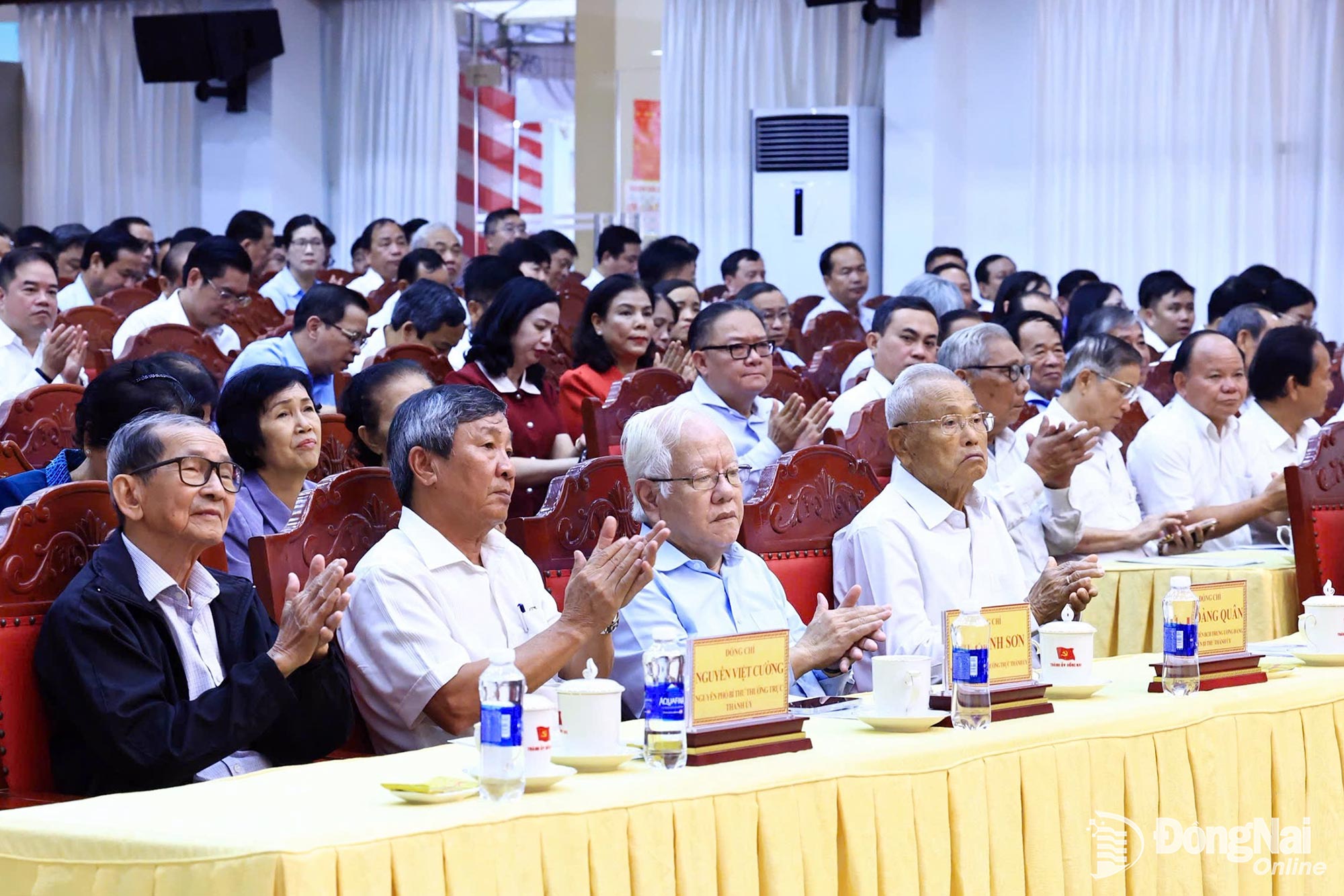 |
| Former and incumbent leaders of agencies and units in Dong Nai City attend a conference to study and implement the Politburo's Resolution No. 16-NQ/TW. |
Between January 1, 2025, and September 2026, Dong Nai has reviewed, amended, and supplemented 70 documents related to various stages of personnel work. Thai Bao, Deputy Secretary of the Dong Nai City Party Committee and Head of the City Party Committee's Organization Commission, said personnel work receives special attention from the City Party Committee’s Standing Board. Dong Nai's development goals are set high, and the requirements for personnel work are therefore also very high. The Standing Board has issued two regulations on standards for city-level leaders and managers, as well as standards for commune-level leaders, managers, and civil servants.
For city-level leaders and managers, officials appointed to or nominated for higher positions must have been assessed by the competent authority as having successfully completed their tasks or better for three consecutive years up to the time of the proposal.
For commune-level leaders, managers, and civil servants, in addition to the general standard framework stipulated by the Central Government, the City Party Committee’s Standing Board has set out additional standards concerning the spirit of public service; understanding of the Party's guidelines, and policies and the State's laws; and communication, conduct, and service to the people and businesses. The city is also developing a framework for professional and occupational competence, a framework for public service execution competence, and a framework for leadership, management, and development competence, with each comprising specific competence groups divided into five levels.
In evaluating leaders and managers, the City Party Committee’s Standing Board has developed and issued 31 sets of criteria for annual evaluation and ranking and 29 sets of criteria for quarterly evaluation. These are tailored to the city's specific characteristics and situation and linked to the results of political task performance, Party building, political system development, and the exemplary responsibility of cadres and Party members.
Personnel planning, transfer, rotation, appointment, and candidate nomination have essentially been carried out in accordance with prescribed authorities, principles, and procedures. Since January 1, 2025, the city has included 683 individuals for personnel planning.
Party committees, Party organizations, agencies, and units have strictly and properly conducted the assessment and classification of the quality of leaders and managers in accordance with the Central Government's regulations and guidelines, following five steps and using the KPI (key performance indicator) scoring method. The evaluation results serve as a basis for personnel arrangement and utilization.
Dedicated to their work
Enhancing the quality of the contingent of cadres from the city to the grassroots level through specific criteria has contributed to improving the effectiveness, efficiency, and operational performance of the two-tier local government apparatus, creating momentum for Dong Nai's innovation and development process.
According to Nguyen Thi Hoang, Member of the City Party Committee and Vice Chairwoman of the City People's Committee, despite having to simultaneously handle a massive workload involving consolidation, organizational restructuring, and the transformation of governance models, the city’s economy has maintained positive growth momentum. In 2025, the gross regional domestic product (GRDP) reached nearly VND678 trillion, up 9.63% year on year. In the first six months of 2026, Dong Nai's GRDP grew by 9.81% compared to the same period in 2025. Domestic investment attraction exceeded VND860 trillion, equivalent to 538% of the 2026 target.
At a working session with Inspection and Supervision Delegation No. 231 of the Politburo and the Party Central Committee’s Secretariat on September 7, 2026, Nguyen Van Ut, Deputy Secretary of the City Party Committee and Chairman of the City People's Committee, said Dong Nai's contingent of leaders and managers are deeply dedicated to their work.
In the first quarter of 2026, Dong Nai was still a province; by the second quarter, it became a city. The entire contingent of leaders, managers, civil servants, and public employees worked day and night to answer the question: How does Dong Nai City differ from the former Dong Nai Province?
Currently, the city is concretizing the Politburo's Resolution No. 16-NQ/TW on the construction and development of Dong Nai City through 2035, with a vision to 2065. Simultaneously, under the Law on Urban Development, passed by the National Assembly on August 24, 2026, the city is moving quickly to develop a special economic zone project based on an airport-city model, with Long Thanh International Airport serving as its core.
The city is also implementing a master plan, accelerating zoning and functional area plans, and effectively carrying out urban development projects, industrial park infrastructure, concentrated digital technology zones, and strategic infrastructure projects in accordance with approved plans.
"Dong Nai City is fully capable of fulfilling its role as an important national growth pole," affirmed Nguyen Van Ut, Deputy Secretary of the City Party Committee and Chairman of the City People's Committee.
Regarding the results Dong Nai has achieved, Politburo Member, Secretary of the Party Central Committee and Chairman of its Commission for Internal Affairs Le Minh Tri acknowledged that Dong Nai's cadre contingent has quickly and effectively carried out many important tasks, meeting the requirements of the city's major and new objectives. Dong Nai has focused all measures on meeting the requirements for double-digit growth and sustainable development.
He suggested that, to continue achieving major goals, especially breakthroughs in science, technology, innovation, and digital transformation, Dong Nai must secure resources; attract, select, and train talent; and consider hiring experts to ensure that tasks are carried out effectively and yield concrete results. Investment in science and technology must be guaranteed, while scientific and technological personnel should receive due attention in terms of personnel planning, training, placement, and utilization.
Thai Bao, Deputy Secretary of the City Party Committee and Head of the City Party Committee's Organization Commission, said the city had recently implemented several effective models and practices in personnel work. A prime example is the establishment of working groups and the assignment of the City Party Committee’s Standing Board members to directly oversee, direct, monitor, inspect, and expedite the implementation of the city's key tasks. This approach enhances the role of the City Party Committee’s Standing Board members; many positive changes have been seen in key tasks in the fields of Party building, socio-economic development, and other areas, helping ensure progress and effectiveness.
Le Minh Tri emphasized that the most important factor remains personnel work. It is necessary to strengthen cadres, those heading the city’s key areas, and the heads must have the capacity to lead overall development. Where cadres do not meet the required standards, they should be promptly supported and coached. However, if there is no improvement after a period of support, personnel adjustments in those areas must be considered.
In implementing the two-tier local government model, the city needs to focus on providing specialized, in-depth professional training for commune-level officials in various fields, thereby helping Dong Nai achieve substantive growth through effective operations at the grassroots level.
By Phuong Hang – Translated by Minh Hong, Thu Ha

Thông tin bạn đọc
Đóng Lưu thông tin