
Following the reorganization, many villages, hamlets, and neighborhoods have expanded in scale, placing greater demands on personnel working directly at the grassroots level.
Against this backdrop, Resolution No. 26/2026/NQ-HDND, dated August 28, 2026, stipulating the number, titles, allowance levels, and support for non-specialized personnel and those participating in activities in villages and residential groups within Dong Nai City (referred to as Resolution 26), was recently adopted by the Dong Nai City People's Council at its 5th session and has received broad support from grassroots officials. The new policy is regarded as practical encouragement for those dedicated to serving their residential areas.
Larger areas, greater responsibilities
Neighborhood 13 in Long Binh Ward was established following the merger of Neighborhood 34 and Neighborhood 35. The new area covers nearly 1,400 hectares, is home to nearly 9,000 residents, and is divided into 48 residential groups. The neighborhood's Party cell also has nearly 300 members. Such a large scale has increased the workload of those working directly in the residential area. Grasping the public situation, conducting outreach and mobilization, organizing Party activities, and resolving emerging issues all require greater attention and more time.
 |
| Officials of Neighborhood 13 in Long Binh Ward prepare materials for public outreach. |
Le Van Chuong, Secretary of the Neighborhood 13 Party Cell and Head of the Long Binh Ward People’s Council’s Delegate Group 6, said, "After the merger, the area is large, and the population is high, so the workload has increased severalfold. Management must be more attentive and persistent. Therefore, I am very encouraged that the new policy has been issued. The generally higher support levels are a practical form of encouragement, helping those working directly at the grassroots level feel more secure and committed to the area".
According to Chuong, those working in the neighborhood must grasp the situation at the grassroots level and understand the issues of concern to residents to coordinate timely solutions. Besides devoting considerable time to local work, Chuong has proactively changed his working methods. Despite his age, he actively applies technology in his work. "Grassroots officials now need enthusiasm and responsibility and must master technology to promptly meet task requirements and serve the people more effectively", emphasized Chuong.
A similar situation has been recorded in Da Kia Commune. Following the reorganization, the commune reduced the number of villages from 24 to eight across an area of nearly 20,000 hectares. At the 5th session of the City People's Council, Ly Trong Nhan, Member of the City Party Committee, Secretary of the Party Committee, and Chairman of the Da Kia Commune People's Council, said that the scale of villages in the commune following the reorganization is larger than before, resulting in increased work pressure on grassroots personnel, particularly those holding the three key positions of Party cell secretary, village head, and head of the Vietnam Fatherland Front working committee. Therefore, the issuance of Resolution 26 provides a practical boost, giving grassroots personnel greater motivation to fulfill their tasks well.
Ly Trong Nhan, Secretary of the Da Kia Commune Party Committee, also believes that villages and residential groups are the units closest to the people. When these units operate stably, firmly grasp the public situation, and promptly resolve issues emerging at the grassroots level, the operations of the commune-level government will be more favorable, contributing to building a city government that is increasingly closer to the people and operates effectively.
Encouraging grassroots officials to feel secure in their work
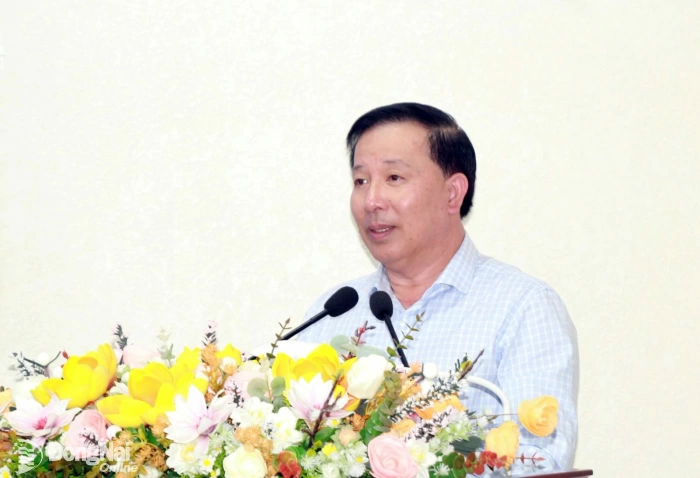
According to Nguyen Huu Dinh, Member of the City Party Committee and Director of the Department of Home Affairs, Resolution 26 was developed to promptly give concrete effect to the provisions of the Law on Organization of Local Government and the Government's Decree No. 185/2026/ND-CP, dated May 26, 2026, concerning the organization and operation of villages and residential groups, as well as the regimes and policies applicable to non-specialized personnel working in these units. The resolution also replaces Resolution No. 39/2025/NQ-HDND, dated December 10, 2025, of the People's Council of Dong Nai Province (now City). Through these provisions, the resolution helps remove mechanism-related obstacles, safeguard legitimate rights and interests, and encourage grassroots officials to feel secure in carrying out their duties.
Under Resolution 26, the three non-specialized positions in villages and residential groups are Party cell secretary, village head or residential group leader, and head of the Vietnam Fatherland Front working committee. For villages with 700 households or more, residential groups with 1,000 households or more, and certain specific areas, the allowance is 2.67 times the statutory base salary per person per month. For the remaining villages and residential groups, the allowance is 2.17 times the statutory base salary per person per month. Individuals holding these positions receive support covering 100% of their health insurance premiums.
Deputy Party cell secretaries, deputy village heads, deputy residential group leaders, and deputy heads of the Vietnam Fatherland Front working committee receive support equivalent to 1.4 times the statutory base salary per person per month, along with support covering 100% of their health insurance premiums.
Youth Union chapter secretaries and heads of the Women’s Union, Farmers’ Union, and Veterans’ Association chapters receive monthly support equivalent to 0.5 times the statutory base salary. Deputies of these organizations, as well as individuals who directly assist Party cell secretaries in places where the Party cell secretary concurrently serves as village head, residential group leader, or head of the Vietnam Fatherland Front working committee, receive monthly support equivalent to 0.3 times the statutory base salary per person.
Resolution 26 stipulates the number of people participating in activities in villages and residential groups based on the number of households. Specifically, villages with fewer than 1,200 households and residential groups with fewer than 1,650 households are allocated a maximum of three people for the positions of deputy Party cell secretary, deputy village head/deputy residential group leader, and deputy head of the Vietnam Fatherland Front working committee. For villages with 1,200 households or more, residential groups with 1,650 households or more, as well as key villages/residential groups for national defense, border areas, or particularly difficult villages, a maximum of four people may be allocated.
Notably, non-specialized personnel who concurrently hold positions, thereby reducing the headcount by one, are entitled to an additional 50% of the monthly allowance or support for the concurrent position. The number of people participating in activities is also determined by the population scale, with a maximum of three or four people depending on the area. Resolution 26 also encourages and prioritizes people of working age and those with professional qualifications for appointment or selection as non-specialized personnel or participants in village/residential group activities.
The scale of the area has changed, and the way work is organized has changed as well, but the requirement to remain close to the people remains unchanged. For those directly undertaking work in residential areas, the new policy provides not only material support but also recognition of the responsibilities and contributions of the grassroots workforce.
By Ho Thao – Translated by Minh Hong, Minho

Thông tin bạn đọc
Đóng Lưu thông tin