
“You can take a person out of their homeland, but you cannot take their homeland out of them,” the famous Russian poet Rasul Gamzatov once wrote. Perhaps that is why, for nearly 50 years, residents of Hamlet 2, Song Ray Commune, have worked together to build this place into a peaceful countryside bearing the distinctive imprint of a Northern Vietnamese village – from village roads and alleys lined with straight rows of areca palms to rice fields yielding three crops a year and fish ponds in every household's garden.
More importantly, what matters most goes beyond outward appearance. It is also reflected in the local accent, cultural traits, and traditional customs passed down through generations to descendants born and raised in the Southeast region.
From a new economic zone...
Hamlet 2, Song Ray Commune (comprising the former hamlets 9 and 10), covers approximately 8,700 hectares and is home to nearly 1,300 residents. Six ethnic groups live in the hamlet: Tay, Nung, Dao, Hoa, Choro, and Kinh. Most residents migrated from Northern and Central Vietnam to build new lives here.
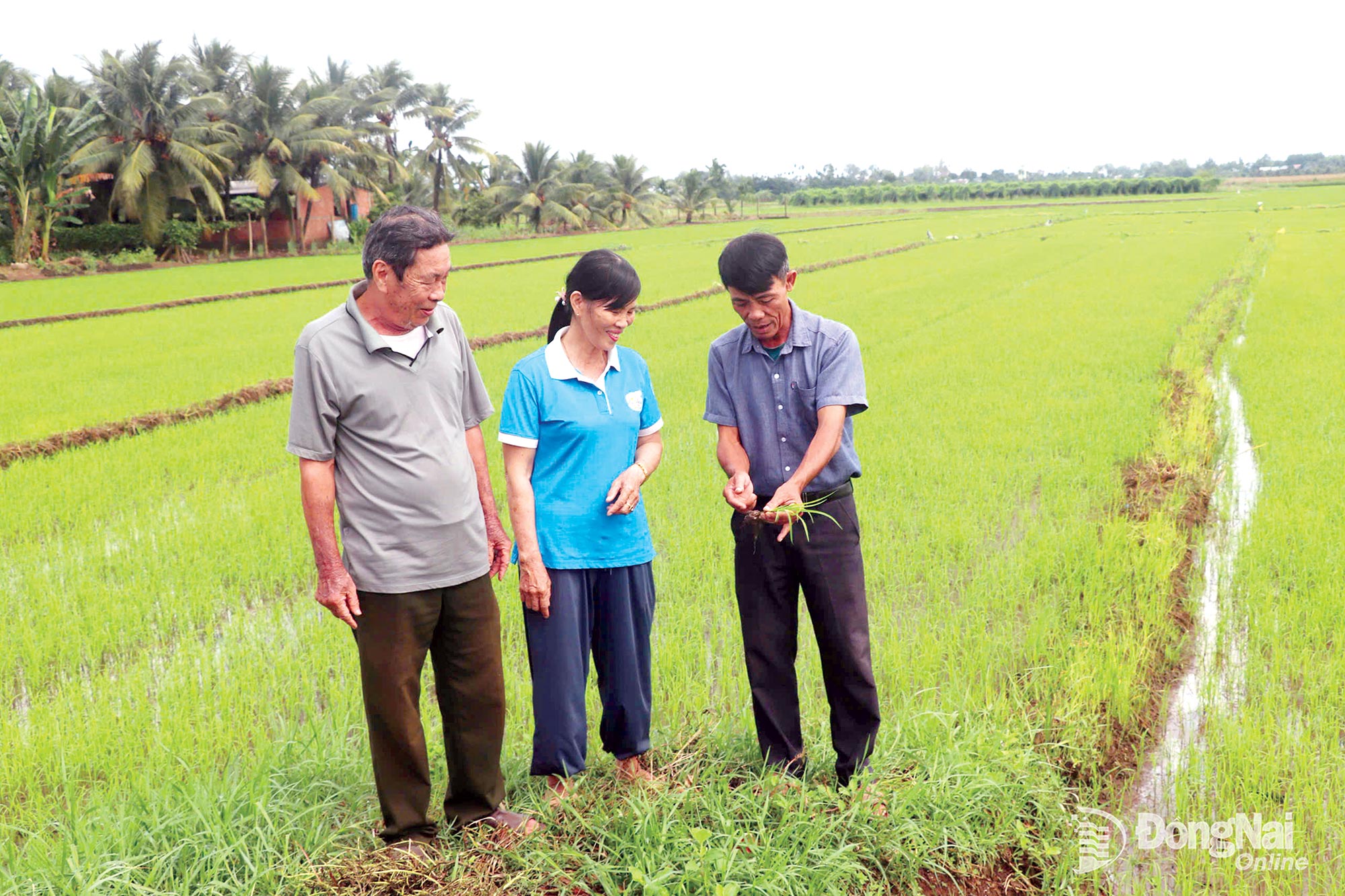 |
| Tran Ma Luong (far right), Head of Hamlet 2 in Song Ray Commune, and local residents visit the fields. |
According to Tran Ma Luong, Head of Hamlet 2, beginning in 1977, many groups of people from the Northern and North-Central provinces arrived in the area to settle under the "new economic zone" policy. They came to make a living and develop the local economy, gradually forming a residential community.
After reclaiming the land, residents gradually stabilized their lives and focused on agricultural production, with wet rice becoming the primary product. Hamlet 2 currently has about 247 hectares devoted to triple-crop rice, while residents have established an organic rice production cooperative group covering nearly 30 hectares. Alongside rice cultivation, some households have shifted to new production models, most notably net-house melon cultivation. Meanwhile, the garden-pond-livestock (VAC) model continues to be maintained.
Even more remarkable are the production figures. From a new economic zone, Hamlet 2 has gradually developed a living space with its own distinct identity. It was once the first model residential area in the former Cam My District. To create that appearance, residents joined local authorities in investing in roads, street lighting, greenery, and environmental sanitation. To this day, local residents consider maintaining the model residential area a regular task. Hamlet 2 holds a weekly "Green Saturday" activity, during which residents clean village roads and alleys. Within the model residential area itself, sanitation activities are carried out even more frequently.
Walking along paths lined with straight rows of areca palms, looking out over expansive rice fields, and passing through alleys bordered by green hedges, gardens, and fish ponds, visitors can feel the familiar "breath" of a Northern Vietnamese village.
The fields serve not only as production areas but also as a playground for residents, especially young people, during the dry season. Notably, in previous years, the rice fields of Hamlet 2 hosted a kite-flying festival that drew many artisans from the Southern provinces and attracted large crowds of onlookers.
From a new economic zone, the residents of Hamlet 2, Song Ray Commune, have built a new homeland. What gives this homeland its vitality is not only the rice harvests but also the way each person carries a piece of their old home with them, helping to enrich the place where they now live.
Preserving the "soul of the countryside" in a new land
A notable feature of Hamlet 2 is that although its residents come from many different regions, they continue striving to preserve the customs and traditions of their native homes. This convergence has created a diverse cultural life in which each community maintains its own identity while integrating into the common life.
For those whose roots are in the former Hai Duong Province (now part of Hai Phong City), the phao dat (clay cracker – a folk game) holds special memories. After moving to this new land, although the game is no longer played on the same scale as it was back home, those who cherish it continue to make efforts to keep it alive.
For the Tay and Nung people, the sound of the tinh lute and then singing serves as a link to the culture of their homeland. The locality maintains these activities during holidays and festivals, providing opportunities for community members to meet and interact. Kinh people also participate alongside ethnic minorities, thereby fostering shared cultural activities within the community.
The locality always pays attention to organizing activities aimed at promoting cultural values and enriching people's spiritual lives, particularly those of ethnic minorities, including then singing and tinh lute exchanges, gong performance exchanges, and kite-flying festivals. Additionally, the locality maintains and develops the then singing club for the Tay and Nung people, while raising awareness among younger generations about the preservation and promotion of traditional ethnic cultural values.
Dang Thi Xuyen, Vice Chairwoman of the Song Ray Commune People's Committee
Cultural life in Hamlet 2 is also enriched by activities organized by unions, associations, and various clubs. Table tennis, volleyball, folk dance, qigong, and musical performances are maintained at varying levels.
The tradition of valuing education is also sustained through learning-promotion activities organized by family clans. The Vu-Vo clan is a prime example. Vu Hong Quang said, "Every year, the clan organizes visits and gives gifts to the elderly and encourages students to study hard and live well; when a family faces unexpected difficulties, the clan joins hands to support them. Bringing the members of the Vu-Vo clan together helps those far from home feel as though they are living in their own ancestral homeland. When these activities are organized as a routine, it is easier to educate the younger generation to maintain these beautiful traditional cultural features."
Over nearly half a century, those traditional values have remained deeply rooted and have been preserved and passed down through generations by the residents of Hamlet 2, Song Ray Commune, thereby further enriching the colorful cultural tapestry of Dong Nai City.
By Hai Yen – Translated by Minh Hong, Minho
Thông tin bạn đọc
Đóng Lưu thông tin