
Families are where love is nurtured, character is shaped and cherished cultural values are passed down through generations. Yet amid rapid urbanization and changing lifestyles, building prosperous, progressive and happy families in Dong Nai is becoming increasingly challenging.
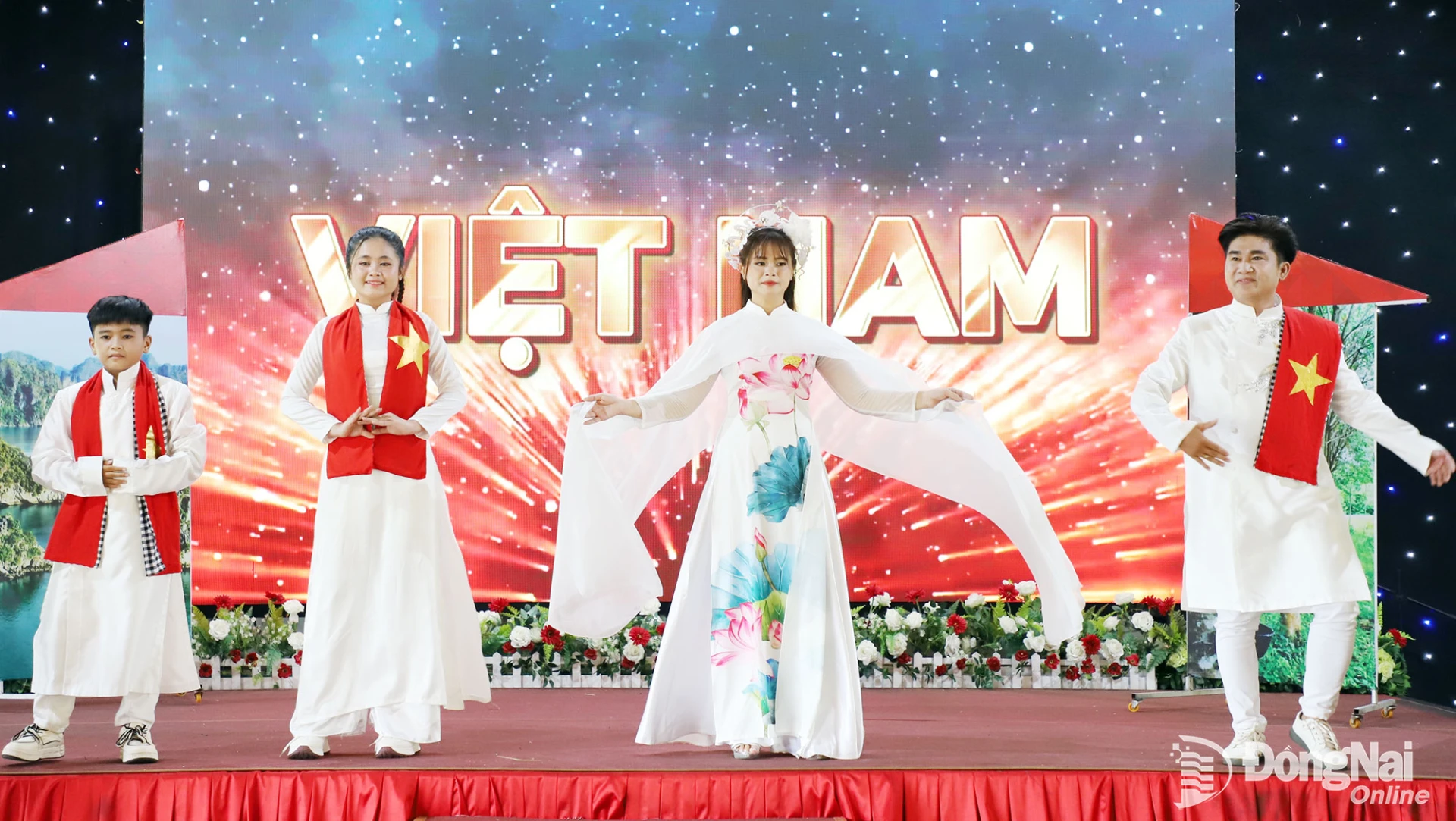 |
| A family recognized for its contributions to building a cultural household in Binh Long ward represents the locality at the 2026 Dong Nai City Family Festival. |
Ensuring happy and harmonious family life is not solely the responsibility of individual households. It requires the active involvement of every family member, along with support from the wider community. This collective effort helps create a safe, humane living environment while safeguarding the values that make each family a foundation of society.
Keeping family values alive amid industrialization
Dong Nai's rapid industrial development has attracted a large workforce, many of whom live in rented accommodation. The resulting residential patterns present particular challenges to efforts to build prosperous, progressive and happy families.
Nguyen Van Dien, Vice Chairman of the Minh Hung ward People's Committee, said that many workers in the northern part of the city are employed at rubber plantations. Their families often face financial hardship and cramped living conditions, while long working hours leave parents with little time to care for their children. These circumstances make it harder to maintain family routines and pass on traditional cultural values.
“During holidays and Tet, some families living in rented accommodation are unable to maintain traditional practices such as gathering for family reunions, decorating their homes or paying respects at ancestral altars. As a result, children have fewer opportunities to learn about and carry on family customs and traditions. With parents also having limited time to spend with them, children may become overly dependent on mobile phones and video games or become involved in unhealthy relationships, increasing their exposure to risks such as violence and abuse,” Dien said.
Dien said that building happy families requires greater attention to individual households, particularly those of workers living in rented accommodation. Local authorities, mass organizations and residential neighborhood groups should work closely with landlords to understand workers' circumstances and concerns, identify households facing difficulties or potential risks, link them to appropriate support services and take timely measures to protect family members.
Dinh Xuan Hien, Deputy Head of the Culture and Social Affairs Division of Ho Nai ward, said the presence of numerous industrial parks in the area has brought challenges for working families. Faced with financial pressures and demanding work schedules, many couples have to send their children to their hometowns to live with their grandparents. The separation makes it harder for parents to provide daily care, guide their children's development and maintain close family ties.
“I hope trade unions and industrial parks authority will continue to develop support policies and improve workers' incomes and working conditions, enabling them to spend more time with their families,” Hien said.
Families across Dong Nai face different circumstances and challenges, whether they belong to ethnic minority communities, follow religious traditions or live in urban or rural areas. Social changes affect how families maintain their traditions, care for their children and fulfill their role in education. Family-related programs and communication efforts therefore need to be tailored to the specific circumstances and needs of each community.
Le Thi Ngoc Loan, Director of the DoCST:
In recent years, Dong Nai has implemented central and municipal authorities’ policies on family development in a coordinated manner. Public awareness campaigns have been conducted regularly through diverse channels, helping authorities, agencies and residents gain a better understanding of the family's role in social development. Family support and domestic violence prevention models have also been strengthened and expanded. These efforts have raised public awareness and improved compliance with the law while helping preserve and promote traditional family values. They have also contributed to building prosperous, progressive and happy families and developing a civilized, modern and livable city.
Dr. Pham Thi Thuy, lecturer at the Ho Chi Minh National Academy of Politics, Region II:
The family is the first environment in which an individual's character is formed and developed. Preventing domestic violence requires equipping family members with communication and conflict-resolution skills. Signs of tension or instability in family relationships should also be identified early so that counseling and timely intervention can prevent conflicts from escalating into violence.
Grassroots support for stronger families
Practical experience shows that grassroots support and timely intervention can help families overcome difficulties and encourage healthier relationships among family members. Le Thi Hien, Head of the Women's Union Branch in Binh Tien Hamlet, Xuan Phu commune, said she had once wondered whether she had done enough to build a happy family of her own before encouraging other women to do the same. Her concern reflects the challenges faced by many grassroots workers, who must balance their responsibility for supporting families in the community with the demands of their own family lives.
Hien also shared her experience in supporting teenagers in Binh Tien Hamlet who had developed unhealthy habits. Instead of reprimanding those who frequently played video games or stayed out late, the local Women's Union branch worked with the police to encourage them to take part in community activities, such as public clean-up campaigns and sports programs. These activities have helped many teenagers make positive changes, follow family routines more responsibly and develop clearer goals for their studies.
The proportion of households meeting cultural standards in Dong Nai increased from approximately 59% in 2000 to more than 98% in 2025, surpassing the target of 95% set by the former Provincial Party Committee, now the City Party Committee. The results reflect the growing reach of the cultural family movement, which has helped preserve traditional values, promote civilized lifestyles and foster a healthy cultural environment in local communities.
At a dialogue held on October 23 by the DoCST, bringing together local government leaders, experts and grassroots family affairs workers, Bui Thi Hanh, Vice Chairwoman of the Dong Nai Women's Union, stressed the need to expand support networks for women who are difficult to reach through existing channels, particularly female workers and those living in apartment complexes and remote areas.
She added that the Women's Union would continue coordinating with relevant agencies to explore the establishment of local Women's Union organizations in industrial parks and non-state enterprises. The initiative aims to better understand workers' concerns and aspirations and provide timely support for their well-being.
Vu Thanh Ngu, Deputy Director of the DoCST, said the two-tier local government model had created new requirements for family-related work at the grassroots level. Issues involving staff assignments, professional duties, personnel, funding and coordination among agencies need to be addressed through timely guidance and practical solutions.
He also stressed the need to sustain and improve the effectiveness of family support and domestic violence prevention models, ensuring that they continue to deliver practical benefits to local communities.
“Going forward, the culture sector will prioritize the implementation of Resolution No. 80-NQ/TW on the development of Vietnamese culture, the Strategy for the Development of Vietnamese Families to 2030 and the Law on Prevention and control of domestic violence. Key priorities include promoting skills for building happy families, strengthening child protection, improving the quality of the cultural family movement, expanding community-based support models and enhancing coordination among relevant agencies. Digital transformation must also be closely integrated with social welfare, education, healthcare and support for vulnerable groups,” Ngu said.
By My Ny – Translated by M.Nguyet, Thu Ha

Thông tin bạn đọc
Đóng Lưu thông tin