
The green transition is reshaping workforce demand and recruitment standards among businesses. Employers now need more than workers with solid vocational skills. The labor market increasingly requires “green skills,” including the ability to use resources efficiently, conserve energy, control waste and adapt to new technologies.
From a business perspective, Bui Thi Ninh, deputy director of the Vietnam Chamber of Commerce and Industry’s Ho Chi Minh City Branch (VCCI-HCM), said market demands were undergoing significant changes, including growing demand for new skills such as green skills. Therefore, further developing the green skills framework in vocational education and training (VET) has become increasingly urgent, helping prepare a workforce capable of meeting businesses’ needs.
Businesses paying greater attention to green skills
Sharing this view, Nguyen Le Nhat Thanh, Deputy Head of the Employers and Women Entrepreneurs Office at VCCI-HCM, identified several key factors driving businesses’ interest in green skills. These include requirements from customers, importers and international supply chains; the need to save energy and materials, reduce costs and boost productivity; and the need to comply with environmental standards, manage emissions data, ensure traceability and adopt new technologies.
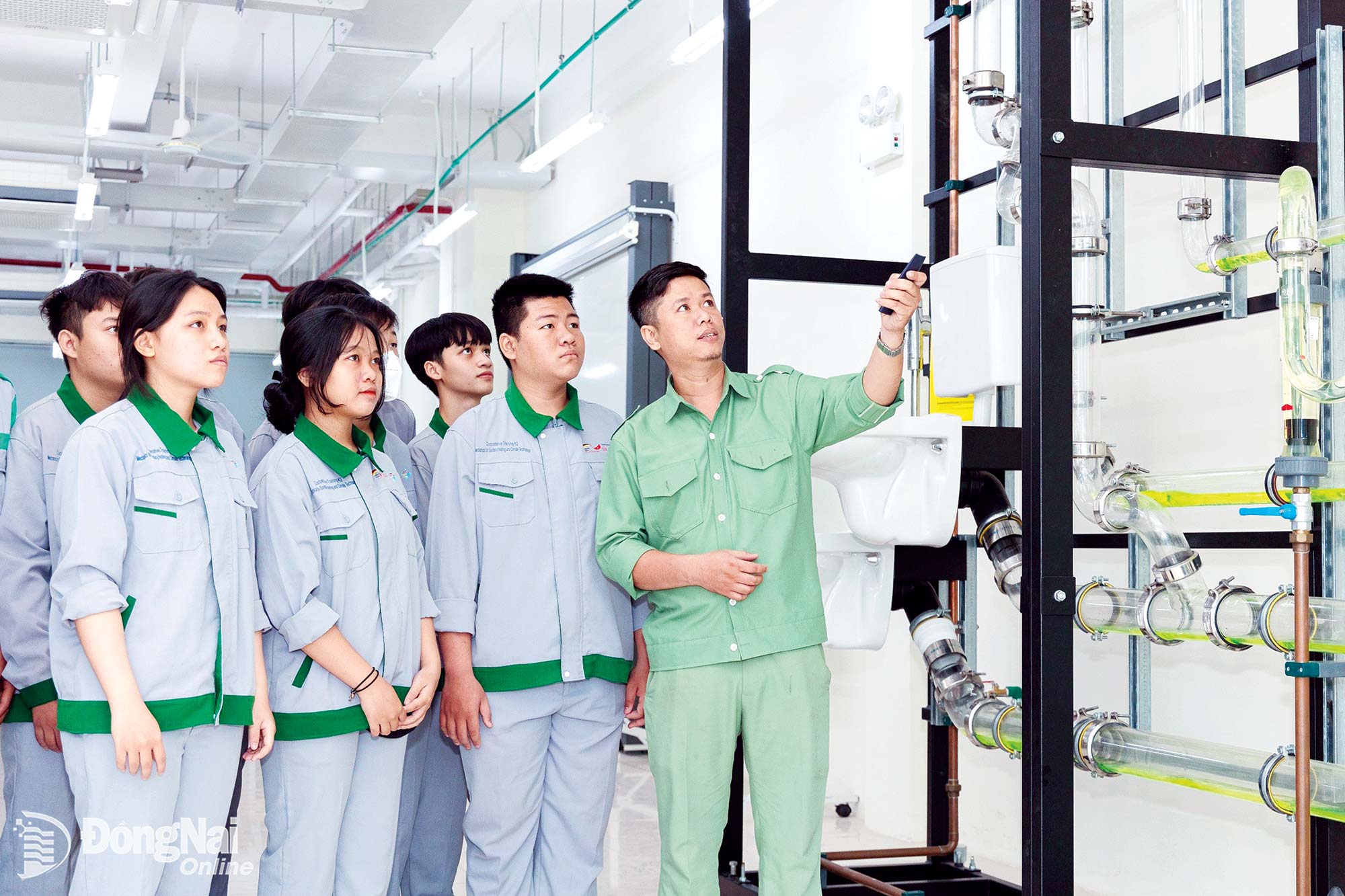 |
| Green skills training helps meet the changing demands of the labor market. In the photo: Students at the Vocational College of Machinery and Irrigation (Ho Nai Ward) are equipped with green skills. |
According to Thanh, workforce demand is changing in three main ways. First, new jobs and positions are emerging in areas such as environmental, social and governance (ESG), greenhouse gas inventories, energy management and renewable energy technology. Second, existing occupations in logistics, manufacturing, procurement, accounting and quality management need to incorporate additional responsibilities related to green requirements. Third, businesses need to upgrade the skills of their existing workforce and provide retraining to help employees adapt to new technologies and standards.
Green skills are therefore not exclusive to people working in renewable energy or environmental protection. They are increasingly relevant across all sectors. Manufacturing workers need to know how to use raw materials efficiently and minimize waste; quality management personnel must understand relevant environmental standards; and logistics workers need to consider resource efficiency in their operations. The scope and content of green skills vary depending on the industry and job position. Accordingly, there can be no single green skills framework or training curriculum that applies universally to all occupations.
Thanh said the skills required by businesses could be divided into three groups. Foundational skills include environmental awareness, systems thinking, a sense of responsibility and efficient resource use. Occupation-specific technical skills cover equipment operation, waste management, emissions measurement and cleaner production. Skills supporting the transition include digital literacy, data analysis, problem-solving, collaboration and innovation.
Green skills should therefore be incorporated into existing occupations and learning outcome standards. Training programs should allocate more time to practical work using real-world business challenges, data and processes, while also developing short courses to help workers upgrade their skills and retrain.
Modernizing training to meet practical needs
Nguyen Van Chuong, PhD, Rector of the Vocational College of Machinery and Irrigation (VCMI), said the green transition had become an inevitable trend, requiring economic development to go hand in hand with environmental protection, efficient resource use, energy conservation and emissions reduction. The labor market consequently needs not only workers with professional knowledge and strong vocational skills, but also green skills, environmental awareness and a responsible approach to work.
At VCMI, the college has gradually incorporated environmental protection, energy conservation and efficient resource use into its training programs. It has also developed practical models for green agriculture, technology applications and resource efficiency.
In addition to applying green practices internally, the college has shared its experience in greening vocational education with more than 40 VET institutions nationwide, helping them assess their current situation, propose solutions and put green criteria into practice. VCMI has been actively expanding its role from adopting and implementing green practices to transferring knowledge and sharing experience in greening vocational education, helping meet the need to train a green workforce and support the green transition.
According to Dr. Chuong, greening VET institutions involves much more than improving campus landscapes or saving electricity and water. It requires a coordinated approach encompassing institutional governance, training curricula, teaching methods, practical activities and cooperation with businesses.
One concrete example is VCMI’s pilot training program in wind power operation and maintenance. Since August 2024, the college has worked with VCCI-HCM and the Confederation of Danish Industry (DI) on a project to strengthen workforce capacity in the renewable energy sector, supporting the development of a green and sustainable economy in Vietnam.
Under the project, the partners surveyed business demand, developed occupational standards and training curricula, and worked with businesses and Denmark’s Mercantec College to improve the capacity of teaching staff. VCMI also partnered with PCC5 (Power Construction Joint Stock Company No. 5) and Phong Dien 1 Wind Power Plant in Binh Thuan Province, now part of Lam Dong Province, to deliver pilot training for students.
In January 2026, the first 18 students completed the course. The program combined theory based on European standards with practical training at businesses, giving students hands-on exposure to operational and maintenance procedures and workplace safety requirements.
Strengthening links between training institutions, businesses and international partners
Although demand for green skills is becoming increasingly evident, several gaps remain. Training curricula have not always kept pace with new technologies and green standards. Environmental knowledge is not consistently translated into practical skills, while teaching staff, equipment and access to real-world data may be limited. In addition, businesses have yet to participate sufficiently in curriculum design and assessment, and information on occupation-specific skills needs is not updated regularly.
To narrow these gaps, VCCI-HCM representatives have proposed establishing mechanisms to regularly update industry-specific green skills requirements; integrating green skills into occupational standards and learning outcomes; and encouraging businesses to jointly design, deliver and assess training programs. At the same time, priority should be given to retraining the existing workforce, supporting small and medium-sized enterprises, piloting sector-specific programs and measuring outcomes based on demonstrated competencies.
A training process closely aligned with workplace needs requires businesses to participate from the outset and throughout the entire process. First, stakeholders jointly identify green-related tasks for each job position and determine the competencies required. They then design training programs, organize practical instruction and jointly assess the results. This approach helps prevent training curricula from lagging behind actual production needs while improving graduates’ ability to apply what they have learned in the workplace.
Green skills development requires coordinated action at multiple stages, from identifying market demand and designing curricula to training instructors, organizing practical learning and assessing learners’ competencies. For existing occupations, training institutions need to review their programs and incorporate relevant green content. In emerging fields, businesses and experts must work together to keep technologies, occupational standards and practical training conditions up to date.
International cooperation is also an important way to gain access to experience and effective training methods. The partnership among VCMI, VCCI-HCM, DI, Mercantec College and businesses in wind power operation and maintenance training demonstrates how stakeholders can collaborate throughout the process, from assessing demand and developing curricula to training instructors and organizing practical sessions. Thomas Skov-Hansen, DI’s general manager for partnerships in Southeast Asia, said this provided a solid foundation for implementing further cooperation programs in green skills training.
For such models to be replicated, close coordination among regulatory agencies, training institutions and businesses is essential. Regulatory agencies play a guiding role by promoting standardization and creating favorable conditions for integrating green skills into the VET system. Training institutions organize training based on the competencies required to perform jobs, while businesses provide information on workforce needs, processes and technologies and participate in evaluating training outcomes.
By Hai Yen – Translated by Mai Nga, Minho



Thông tin bạn đọc
Đóng Lưu thông tin