
Poverty reduction efforts in Dong Nai have achieved many positive results in recent years. Now that Dong Nai has become a city, the goal is not simply to reduce the number of poor households, but also to improve living standards and minimize the risk of people falling back into poverty.
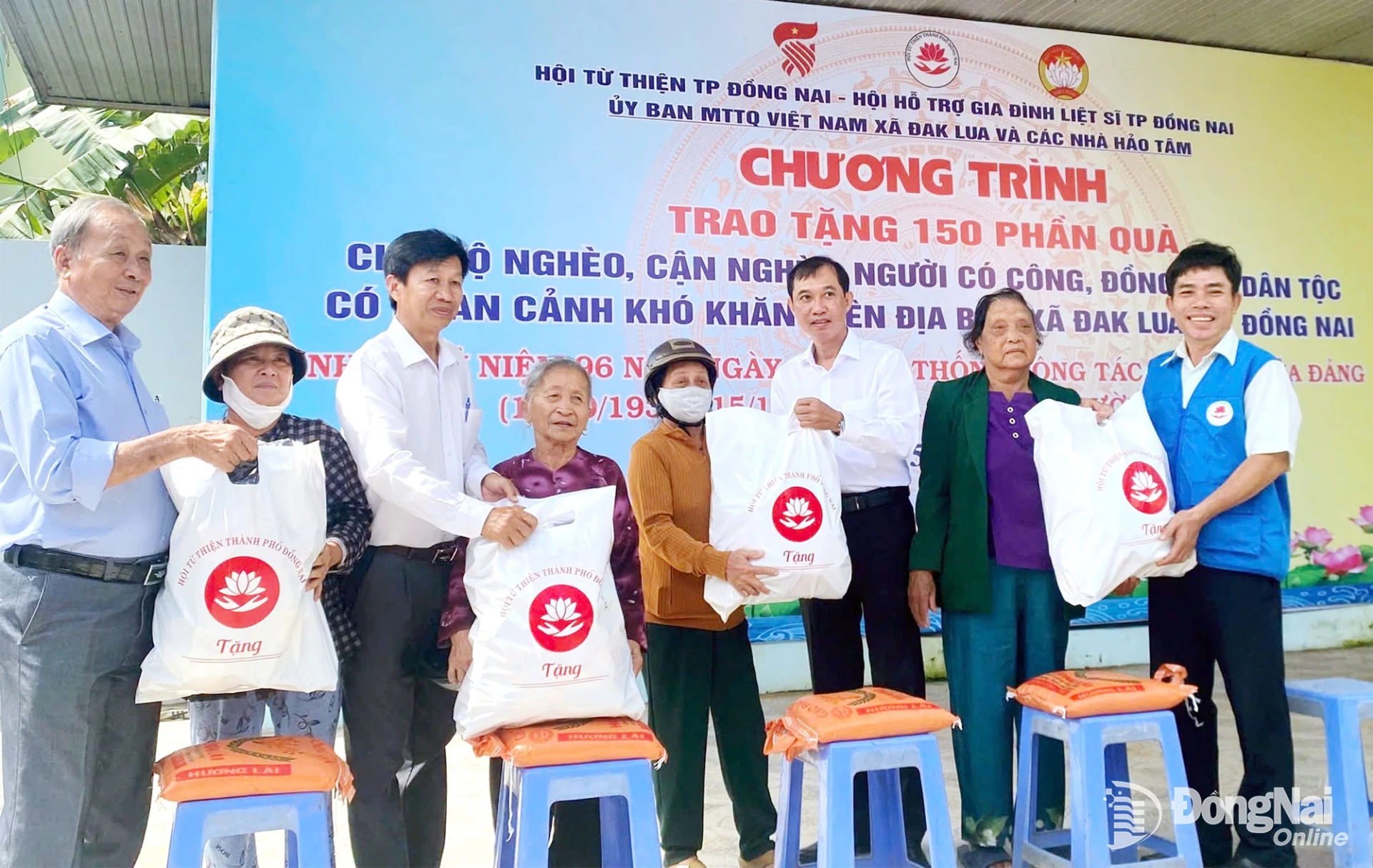 |
| The City Charity Association, in coordination with the City Association for Supporting Martyrs’ Families and the Vietnam Fatherland Front Committee of Dak Lua Commune, presents gifts to poor households and families facing particularly difficult circumstances in the commune. |
A recent oversight review by the City People’s Council’s Committee for Culture and Social Affairs found that, despite the progress achieved, poverty reduction efforts continue to face difficulties in policy implementation and in providing support to residents. This underscores the need for practical solutions to ensure that poverty reduction is effective, substantive and sustainable.
Supporting livelihoods
Le Thi Anh Tuyet, Deputy Director of the Department of Agriculture and Environment, said poverty reduction was an important political task that had consistently received close attention, leadership and direction from the City Party Committee, the City People’s Council and the City People’s Committee. Mechanisms and policies had been translated into concrete measures to facilitate implementation.
At the beginning of the 2026–2030 period, poverty reduction efforts were incorporated into the National Target Program on New-style Rural Area Development, Sustainable Poverty Reduction and Socio-economic Development in Ethnic Minority and Mountainous Areas under Resolution No. 257/2025/QH15. From August 24, 2026, these efforts were further integrated into the National Target Program on Culture, Society, Rural Development, and Ethnic Minority and Mountainous Areas for the 2026–2030 period.
According to a review conducted through March 2026, the poverty rate in Dong Nai stood at 0.24% under the national poverty standard and 0.11% under the former provincial standard, now the city’s standard. Dong Nai was among the five localities with the fewest poor households nationwide. A total of 27 communes and wards had no households classified as poor under the national standard, while eight communes had no poor households under the local standard. To date, the number of poor households has fallen by 312 under the national standard and by 39 under the city’s standard.
Alongside identifying poor households, the city has focused on helping residents develop production activities, improve their incomes and establish more stable livelihoods. From 2022 to 2025, Dong Nai implemented 135 production development support models and projects involving more than 2,800 households, with nearly VND 116 billion in government funding. In 2026, using funding originally allocated in 2025 whose implementation period had been extended, the city launched four community-based production development projects in four communes. These projects provided VND 3.5 billion to support 107 households in raising cattle and goats.
In addition to livelihood assistance, the city has prioritized housing support and social welfare policies. According to a report by the Department of Agriculture and Environment, as of October 26, 180 houses had been newly built or repaired using VND 10 billion from the Fund for the Poor. More than 28,000 health insurance card subsidies had been provided, totaling over VND 35 billion. Electricity subsidies of VND 65,500 per household per month were provided to more than 4,200 poor households classified under either of the two poverty standards. During the Lunar New Year holiday, poor households received VND 1.2 million each, while near-poor households received VND 1 million each, with total funding of approximately VND 12 billion. These support policies have helped residents reduce essential living expenses and stabilize their lives.
Improving the effectiveness of poverty reduction
Despite these achievements, a recent field survey by the City People’s Council’s Committee for Culture and Social Affairs found that many localities had not yet implemented poverty reduction projects and models under the National Target Program. The implementation and integration of components of the National Target Program on Culture, Society, Rural Development, and Ethnic Minority and Mountainous Areas for 2026–2035 had not been carried out or reviewed in a timely manner. Disbursement for several projects also remained slow, reaching only about 54.4% of the planned amount.
The Dong Nai City People’s Committee has recently launched an emulation movement titled “Dong Nai City Joins Hands to Build New Rural Areas, Achieve Sustainable Poverty Reduction, and Promote Socio-economic Development in Ethnic Minority and Mountainous Areas for 2026–2030.” The movement aims to build modern rural communities that retain their distinctive cultural identities; achieve multidimensional, inclusive and sustainable poverty reduction; and promote comprehensive development in ethnic minority and mountainous areas, improving residents’ material and spiritual well-being.
According to Huynh Ngoc Kim Mai, Head of the City People’s Council’s Board for Culture and Social Affairs, following the reorganization of the administrative apparatus under the two-tier local government model, some localities have struggled to coordinate activities, assign responsibilities and determine poverty rates. Some implementation guidelines have not been issued promptly, while officials responsible for poverty reduction have had to handle multiple duties. Rural vocational training has also received insufficient attention, affecting efforts to help residents change jobs and improve their incomes.
The board’s assessment also found that, among near-poor households, more than 1,000 of the over 2,000 households classified under the national standard and more than 2,000 of the over 4,900 households classified under the city’s standard had deficiencies in the employment indicator. In addition, more than 3,100 households lacked adequate access to telecommunications services. These figures show that assistance for poor and near-poor households must be linked to job creation, livelihood stabilization and improved access to information.
In Long Phuoc Commune, Vice Chairman of the Commune People’s Committee Do Chanh Huy said: “The locality continues to implement social welfare policies, paying particular attention to healthcare and providing regular medication to vulnerable groups. However, many poor households face particularly difficult circumstances, have limited working capacity or have varying levels of awareness, making vocational training and livelihood transitions challenging. In addition, the area has numerous major projects underway, and specialized staff must take on multiple responsibilities, which has somewhat affected the time available for monitoring and implementing poverty reduction programs.”
At a recent oversight meeting on this issue, Dang Minh Nguyet, Member of the Standing Board of the City Party Committee, Standing Vice Chairwoman of the City People’s Council, emphasized that poverty reduction was an important task, particularly now that Dong Nai had become a city. This required social welfare policies to be implemented effectively to improve residents’ living standards and meet the city’s development needs.
She stressed that the entire political system, from the city level to local communities, must take responsibility for achieving poverty reduction targets and contributing to the fulfillment of the city’s socio-economic development goals. She called on the Department of Agriculture and Environment to strengthen its guidance through a hands-on, step-by-step approach, helping grassroots officials master procedures and professional skills so they could implement poverty reduction policies effectively. Departments, agencies and local authorities were also urged to strengthen accountability, coordinate closely and proactively resolve difficulties and obstacles. Meanwhile, the City People’s Council’s Committee for Culture and Social Affairs should pay greater attention to follow-up inspections to verify the implementation of recommendations made after oversight reviews.
Sustainable poverty reduction involves more than simply reducing the number of poor households. It also requires helping residents find jobs, secure stable livelihoods and improve their quality of life. Achieving this goal requires effectively implementing support policies, aligning vocational training with labor market demand and selecting solutions suited to each household's circumstances.
By Ho Thao – Translated by Mai Nga, Minho




Thông tin bạn đọc
Đóng Lưu thông tin