
Politburo Resolution No. 57-NQ/TW, dated February 22, 2024, on breakthroughs in science and technology, innovation and national digital transformation (hereinafter referred to as Resolution No. 57), is gradually helping remove bottlenecks so that more science and technology projects can be applied in practice instead of being shelved after completion.
Vo Hoang Khai, Deputy Director of the Department of Science and Technology, said: “Dong Nai is in great need of the active participation of scientists from educational institutions in addressing issues related to the city’s development in this new phase. The department is proactively advising the municipal Party Committee and People’s Committee on policies suited to local conditions to implement Resolution No. 57 and the 2026 Urban Development Law, thereby creating conditions for scientists to contribute to the city’s development.”
New levers needed for science and technology development
Science and technology, innovation and digital transformation are increasingly indispensable across all areas of life and production. They also determine labor productivity and the pace and quality of economic growth. This also creates more opportunities and motivation for scientists to engage in research and technology transfer. However, these activities are increasingly expected to deliver tangible results and practical applications rather than remain at the theoretical research stage. The Department of Science and Technology is ready to receive transferred technologies when projects in science and technology, innovation and digital transformation demonstrate strong practical feasibility.
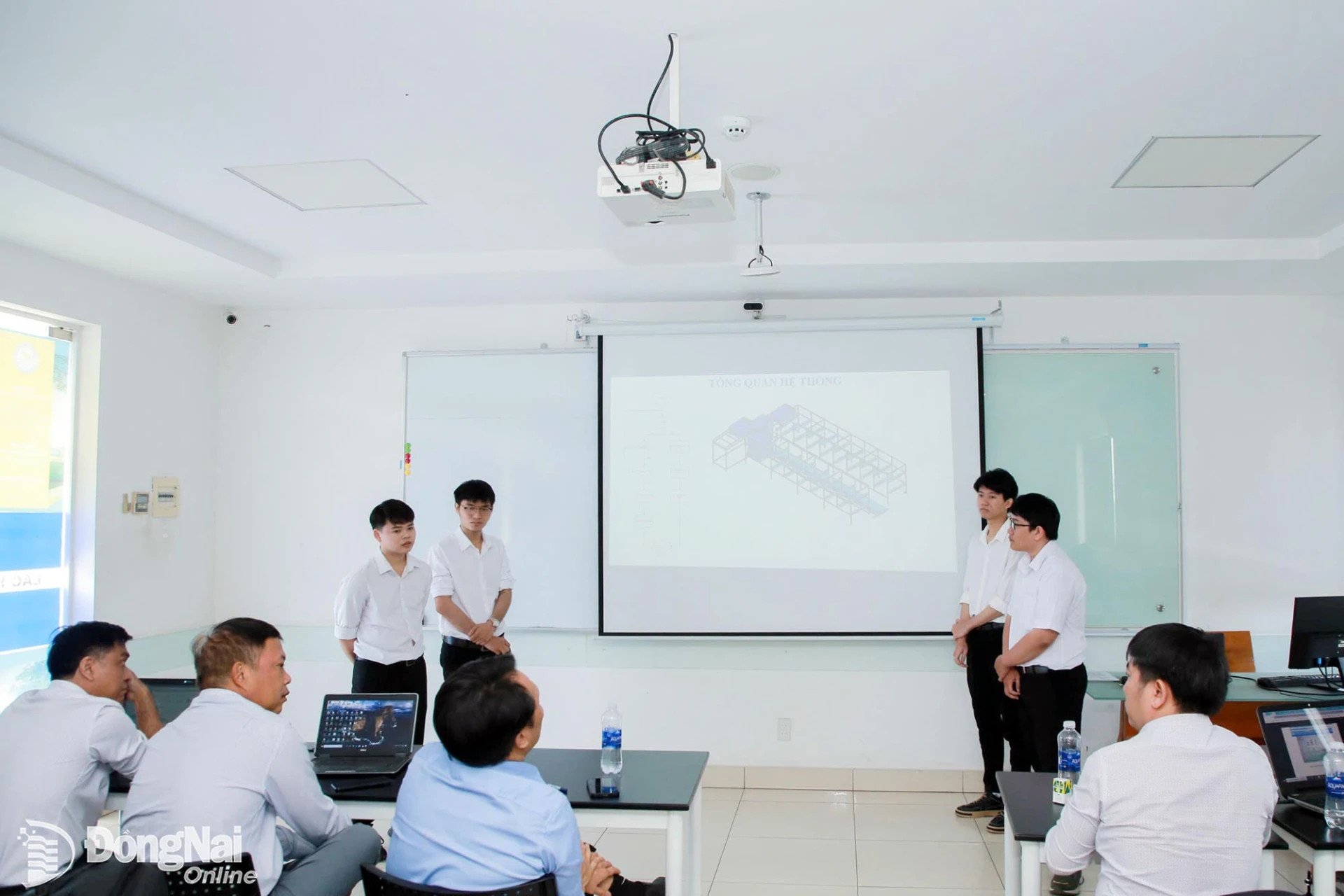 |
| Students at Lac Hong University in Tran Bien Ward present a technology project. |
Dam Van Toan, Head of the Science and Technology Division under the Department of Science and Technology, said the department had received two projects in science and technology, innovation and digital transformation from Lac Hong University in Tran Bien Ward. The first uses robots integrated with artificial intelligence (AI) to answer questions from residents and businesses visiting public administrative service centers to complete administrative procedures. The second is an AI-powered virtual assistant designed to help officials and civil servants handle their work. Both projects have been put into operation at the city’s Public Administration Service Center to support administrative reform.
Assessing their performance, Toan said the two projects had operated relatively reliably and provided useful services to officials, civil servants and residents. The AI-powered robot can take over some of the tasks normally performed by officials and civil servants, answering residents’ questions about regulations and administrative procedures. Meanwhile, the AI virtual assistant can operate 24 hours a day to help officials and civil servants with relevant tasks. Equipped with deep-learning capabilities, the robots and virtual assistants are expected to become increasingly useful to officials, civil servants and residents.
AI robots are also being adopted more widely at one-stop shop divisions in communes and wards across the city, where they can take over some duties involving direct interaction with residents. In addition, more officials and civil servants are proactively learning how to use AI tools to speed up basic administrative procedures, look up information, suggest solutions and draft documents.
Vu Thi Thanh Ha, a resident of Tan Trieu Ward who visited the city’s Public Administration Service Center to complete administrative procedures, said: “Previously, the center provided computers for residents to look up information about administrative reform themselves, but I was not familiar with how to use them. Now the center has AI robots that answer residents’ questions. The interaction is quite simple, much like talking to another person, without complicated operations. I find it very convenient and useful.”
Science and technology projects need stronger support
Dong Nai is currently home to four universities and four university campuses. However, scientific research, technology transfer and the practical application of science and technology projects vary considerably among these institutions, with overall results remaining modest. Beyond differences in research capacity, educational institutions also lack the resources needed to complete the entire life cycle of projects, from research and testing to practical application and, ultimately, commercialization.
 |
| Dong Nai University in Tam Hiep Ward. |
According to the Department of Science and Technology, although the city has a relatively large number of higher education institutions, only a few have research projects that qualify for state funding to carry out assigned tasks. In fact, two universities were previously allocated funding for scientific research projects but were unable to complete them. Ultimately, the individual researchers and the institutions responsible for the projects had to repay the state budget the funding they had received in earlier years.
Regrettably, the researchers leading both projects had solid research capabilities but lacked financial management skills, leaving them unable to complete the required financial settlement procedures in accordance with regulations.
In addition to state-funded science and technology assignments, startup and innovation activities by educational institutions, lecturers and students also face considerable difficulties due to a lack of capital. Dr. Nguyen Van Tan, Deputy Rector of Lac Hong University, said the university specialized in robot technology and had transferred and commercialized a number of products for businesses. The university hoped the city authorities would provide funding to establish an applied robotics research and development center. However, the proposal was not feasible because the university is privately owned.
Meanwhile, Huynh Thi Thuy Loan, Deputy Head of the Science and Technology Division at Dong Nai Technology University in Trang Dai Ward, said students’ startup and innovation drives continued to face funding difficulties, with the success rate of student startups generally remaining very low. Many students had startup projects but did not know where to seek financial support. To encourage students’ participation in scientific research and innovation, she said, an organization was needed to act as a sponsor and provide financial assistance for feasible projects.
Dam Van Toan, Head of the Science and Technology Division at the Department of Science and Technology: Students with startup and innovation projects can approach the department
“Resolution No. 57 issued by the Politburo has expanded opportunities for science and technology, innovation and digital transformation activities. Accordingly, students with projects that are feasible for practical application can approach the Department of Science and Technology to present their proposals. We are ready to advise the department’s leadership on establishing an appraisal council. If a project is considered feasible, students may receive financial support covering 30–40% of the implementation costs.”
Meanwhile, Dr. Nguyen Van Toan, Dean of the Faculty of Mechanical and Electrical Engineering at Lac Hong University, said the university’s lecturers and students had successfully transferred automation technologies to many foreign-invested companies in Dong Nai City and Ho Chi Minh City. However, these projects required substantial capital, while access to startup funds remained difficult. He therefore hoped the city’s Innovation Center would provide a platform where researchers with science and technology and innovation projects could find potential users for their products, as well as financial sponsors to support commercialization.
By Cong Nghia - Translated by Mai Nga, Thu Ha



Thông tin bạn đọc
Đóng Lưu thông tin