
In the past, officials, Party members, civil servants and public employees were generally assessed at the end of each year. Under new regulations and guidance from the central authorities, however, leadership and management officials across the political system are now evaluated quarterly.
Key performance indicators (KPIs) provide a measurable basis for evaluating officials, civil servants and public employees in terms of work outputs, quality and timeliness, replacing broad, subjective assessments. This approach strengthens accountability and promotes results-based management, helping improve the effectiveness and efficiency of public administration.
Toward fairness and efficiency
Ta Quang Truong, Secretary of the Party Committee and Chairman of the People's Council of Xuan Hoa commune, said the commune Party Committee’s Standing Committee had directed agencies and units to align their emulation targets with Resolution No. 05-NQ/TU of the City Party Committee (CPC)’s Executive Board, which launched a special 500-day-and-night campaign under the theme “Unity – Discipline – Efficiency – Breakthrough, building a civilized and modern Dong Nai.” Priorities include administrative reform, digital transformation, better processing of administrative procedures, land management, construction order, site clearance, transport infrastructure and efforts to renovate advanced new-style rural areas.
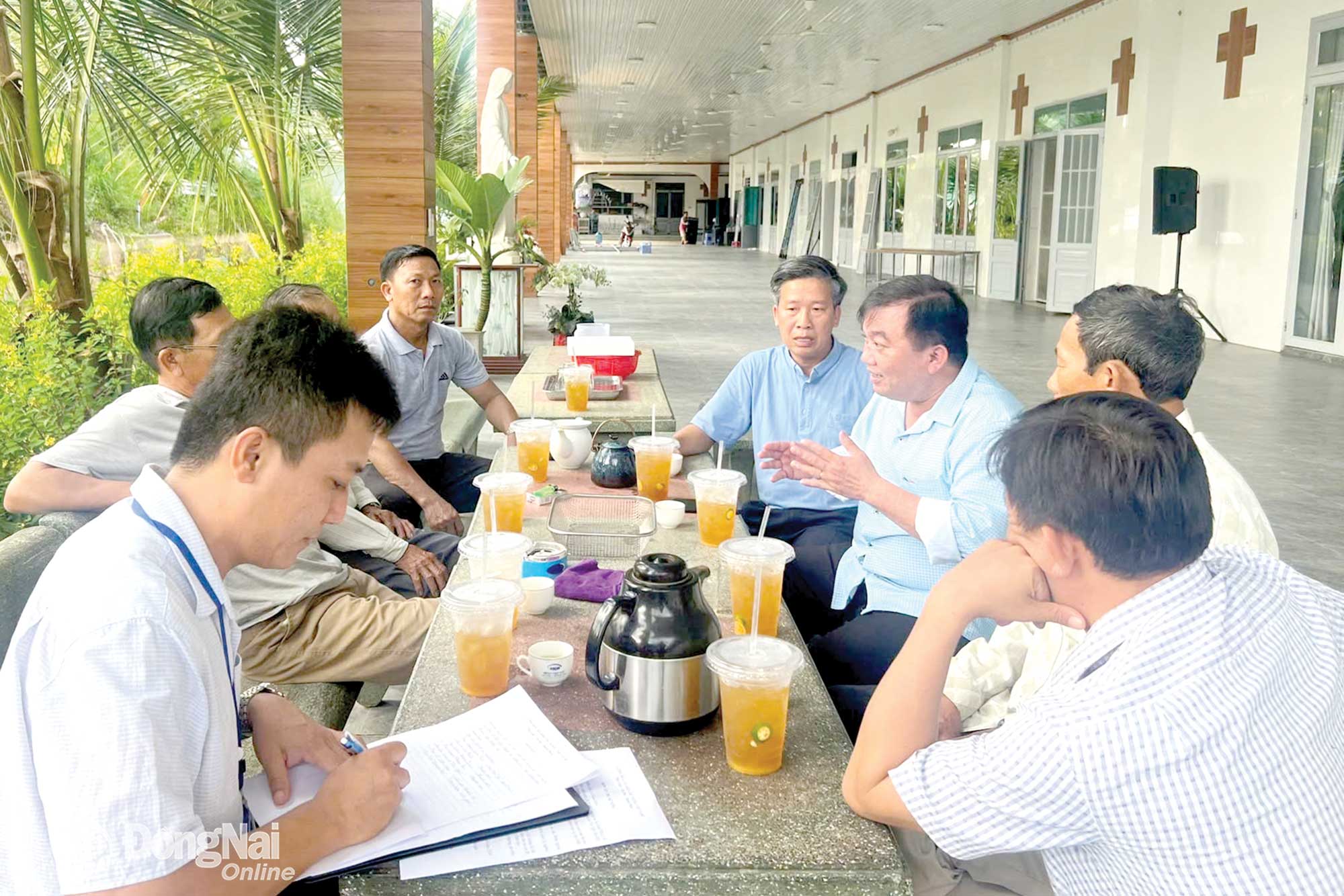 |
| Officials from Xuan Hoa commune visit Tan Ngai Parish to provide guidance on land and construction regulations. |
The Xuan Hoa commune Party Committee’s Standing Committee requires Party cell and Party committee secretaries, along with heads of agencies and units, to directly review and approve monthly KPI plans submitted by officials, civil servants and public employees under their supervision. Vague or merely formal targets, as well as assignments that fall short of requirements, are not to be approved. In Xuan Hoa, officials and civil servants are assessed monthly rather than quarterly. The approach has helped strengthen their sense of responsibility and responsiveness, with officials making themselves available outside regular working hours, including at night and on days off, when work demands or residents' needs require it.
Dao Duc Quy, Deputy Director responsible for the Xuan Hoa commune Public Administration Service Center, said the center had been opening on Sunday mornings since July 2026 to receive and process administrative requests. The arrangement reflects the needs of factory workers, other wage earners, farmers and people who regularly work away from home and cannot visit the center during normal office hours. Quy shared that although weekends are usually reserved for family and personal matters, officials remain on duty on Sunday mornings to help residents complete administrative procedures.
Meanwhile, Phan Quang Tuan, Secretary of the Party Committee and Chairman of the People's Council of Trang Dai ward, said leadership and management officials in the ward were evaluated against KPIs every quarter. The system places greater emphasis on assigned tasks and measurable outputs, including the quantity, timeliness and quality of work, rather than general assessments.
Avoiding one-size-fits-all approach
Tuan said KPI plans must be drawn up before tasks are carried out, not retrospectively to justify completed work. Any new assignments or adjustments required during an assessment period must be documented and confirmed by the relevant unit. At the end of the period, results should be assessed against the original plan and any properly recorded changes. Not all tasks should be weighted equally. Some are routine duties governed by established procedures, while others are new or complex assignments requiring coordination among multiple agencies and carrying greater legal responsibilities. Further work is needed to standardize lists of work outputs and define clear criteria for assigning different weights to tasks, including the basis for each weighting and the authority responsible for approving it.
Tuan stressed that the number of work outputs does not necessarily reflect performance effectiveness. For example, two officials may each complete 10 reports, but one may handle routine reports using standard templates, while the other produces fewer reports but must investigate complex cases, coordinate with several departments and help leaders resolve problems. Similarly, two officials may each process 100 applications on time, but the quality of their work may differ. One may resolve cases correctly at the first attempt, while the other leaves many applications requiring additional documents or corrections. KPIs should therefore take into account the quantity, timeliness and quality of work, as well as the results achieved. Evaluation criteria must be tailored to different job positions rather than applying the same formula to everyone.
A report by the CPC's Organization Commission on organizational and Party-building work in the first nine months of 2026 outlined the implementation of Guidance No. 07-HD/TU, issued by the CPC’s Standing Committee on June 19, 2026. The guidance provides for quarterly assessments of leadership and management officials at all levels across the city's political system. In the first quarter of 2026, 874 officials under the management of the CPC’s Standing Committee were assessed. Of these, 190 ( or 21.73%) were rated as having completed their duties with distinction, 682 (78.03%) as having completed them well, and two (0.24%) as having completed them satisfactorily.
Among 8,953 officials overseen by the Standing Committees of commune- and ward-level Party Committees and equivalent bodies, 1,243 (or 13.88%) were rated as having completed their duties with distinction, 7,667 (85.65%) as having completed them well, 40 (0.45%) as having completed them satisfactorily, and three (0.02%) as having failed to meet their duties.
In the second quarter of 2026, 522 officials fell under the management of the CPC’s Standing Board. Of these, 501 were subject to performance evaluation. Among those assessed, 45 (8.98%) were rated as having completed their duties with distinction, 433 (86.43%) as having completed them well, and 23 (4.59%) as having completed them satisfactorily.
Among 7,122 officials overseen by the Standing Committees of commune- and ward-level Party Committees and equivalent bodies, 834 (11.71%) were rated as having completed their duties with distinction, 6,252 (87.78%) as having completed them well, and 36 (0.51%) as having completed them satisfactorily.
In his closing remarks at the fourth plenum of the 14th Party Central Committee, To Lam, Party General Secretary and State President, stressed that performance evaluation results should be used to select and screen officials. Their integrity, political resolve, competence and credibility must be demonstrated through their work. Assessments should also take into account the difficulty of assigned tasks, the conditions under which they are performed and their long-term value.
At the fifth meeting of the CPC’s Executive Board on October 2, city leaders outlined key priorities for the final three months of 2026, calling on the entire political system to focus on fulfilling the year's targets. City leaders stressed that officials must be evaluated based on their work outputs, timeliness, quality and effectiveness. KPI criteria should be tailored to each job position, with no superficial scoring or one-size-fits-all assessments. In accordance with regulations, officials who fail to meet requirements, delay work or evade responsibility should be reassigned or replaced. At the same time, those who demonstrate initiative and creativity in the public interest should be protected and encouraged.
The message from General Secretary and State President To Lam, together with the practical demands of personnel management, underscores a fundamental principle: capable officials who deliver results and are willing to take on difficult assignments must be recognized and given opportunities to advance. If officials are assessed and rated every year but those who perform well continue to receive virtually the same treatment as those who fall short, KPIs will fail to realize their full potential. Above all, evaluations must be fair and transparent, not used to favor personal connections or penalize those who lack the support of influential individuals. Fair, transparent and objective performance evaluations are essential to motivating officials and public employees and improving the performance of agencies and units.
By P. Hang – Translated by M. Nguyet, Thu Ha




Thông tin bạn đọc
Đóng Lưu thông tin