
From clay, fire and the skilled hands of artisans, stories of Dong Nai have transcended the traditional craft village to come vividly to life in ceramic works imbued with a distinctly Vietnamese identity.
Not only has the renowned Bien Hoa ceramic tradition affirmed its status as a cultural heritage of the Southeastern region, but it has also become an artistic bridge connecting and promoting the cultural values of Thang Long–Hanoi.
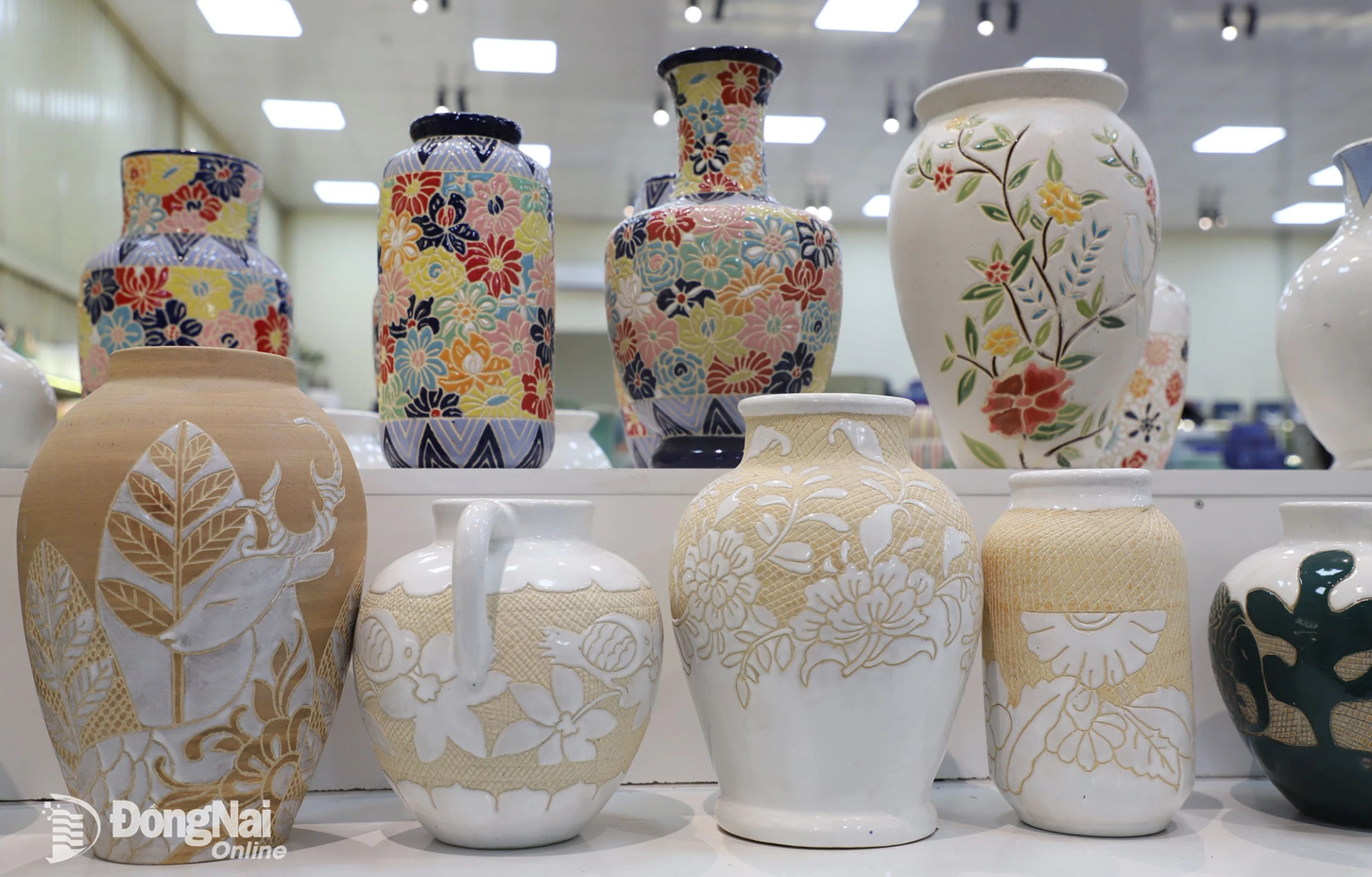 |
| Bien Hoa ceramic handicrafts reach domestic and international markets, including Hanoi. |
When clay and fire tell stories of culture
Although Hanoi and Dong Nai are geographically far apart, the currents of history have forged early links between the two through art and culture. One of these special connections has been created through clay, fire and the hands of ceramic artisans. In 2010, as the country celebrated the 1,000th anniversary of Thang Long–Hanoi, the Ceramic Road along the Red River was created as a unique community art space. Ceramics from different regions converged in Hanoi, telling diverse stories about the country, its people and Vietnamese culture.
According to artist Mai Van Nhon, Chairman of the Dong Nai City Vietnam–ASEAN Friendship Association, in 2010, when Hanoi invited Dong Nai to participate in creating the Ceramic Mosaic Mural along the Red River, he had the honor of working with artisans and lecturers from the Faculty of Ceramics and Sculpture at the Dong Nai College of Decorative Arts to create a 50-meter-long section of the mural. The work was carried out in coordination with colleagues from northern Vietnam, adding another “slice” of Dong Nai culture to the capital’s artistic landscape.
“At the time, I was still a civil servant, so completing a large-scale artwork within a tight timeframe was a challenge. We divided the work into several sections, produced them in Dong Nai, then transported them to Hanoi for assembly and completion. This gave Bien Hoa ceramics an opportunity to join the cultural flow of Thang Long–Hanoi and become part of a shared story about Vietnam and its people,” Nhon said.
What makes Dong Nai’s section of the ceramic mural special is not its size, but the story told through the language of clay and fire. On the Bien Hoa ceramic surface, a dynamic and creative Dong Nai comes to life through iconic images such as Tran Bien Temple of Literature, industrial parks, rubber trees and local specialty fruits. A particularly evocative highlight is the image of military poet Huynh Van Nghe, accompanied by two lines of poetry: “From the day I carried my sword to open new frontiers/A thousand years of longing for Thang Long.” From Southern Vietnam, the poem looks toward Thang Long–Hanoi, extending a thread of historical memory and expressing the people of Dong Nai’s attachment to the nation’s roots.
Following the milestone of the 1,000th anniversary of Thang Long–Hanoi, artist Mai Van Nhon continued to pursue this creative direction. From ceramic mosaic panels, he broadened his means of expression, turning Bien Hoa ceramics into a medium for telling stories about Vietnamese culture, history, land and people. In 2011, at an art exhibition themed “Dong Nai’s Spirit – A Millennium of Thang Long–Hanoi,” his work Mother of Cu Lao won first prize. Rather than using grand symbolic imagery, the work depicts a Southern Vietnamese mother with a gentle face, a warm smile and eyes filled with love.
Also in Hanoi, Mai Van Nhon’s ceramic mosaic portraits of 21 APEC Economic Leaders in 2017 were selected as gifts for leaders of the APEC economies. In August 2024, his work, Soul of the Old Quarter, was selected by the Vietnam Fine Arts Association for display at the Regional Fine Arts Exhibition VII. The painting depicts renowned artist Bui Xuan Phai, an iconic figure embodying a deep love for Hanoi’s Old Quarter. Combining ceramics, acrylic and oil paint, the work evokes nostalgia for the past and a desire to preserve heritage amid the currents of modern life.
Seventy-two years after the Liberation of the Capital (October 10, 1954–2026), the cultural flow of Thang Long–Hanoi continues to converge and spread far and wide. On each smooth piece of Bien Hoa ceramic, covered with its distinctive bronze-green glaze, stories of love for the homeland and country, and the cultural bridge linking Northern and Southern Vietnam, continue to be written. Bien Hoa ceramics are no longer merely clay and fire; they have become ambassadors carrying the heartbeat of Dong Nai and blending it with the thousand-year cultural heritage of Thang Long–Hanoi.
Promoting and spreading Bien Hoa ceramics
Beyond artistic works displayed in Hanoi’s cultural spaces, Bien Hoa ceramics continue their journey through products that are closely connected to everyday life. Artists and artisans are constantly exploring new designs, functions and forms of expression so that craft products can retain their traditional handmade identity while meeting the needs and tastes of contemporary society.
In Bien Hoa Ward, artisan Hoang Ngoc Hien, owner of Hien Nam Pottery Workshop, has devoted considerable effort to preserving the craft while seeking new directions for its products. Using techniques ranging from shaping and incised carving to relief work and glaze treatment, Hien and his fellow artisans create a wide range of products for interior and exterior decoration, gardens, household use and handicrafts.
According to artisan Hoang Ngoc Hien, ceramics are not inanimate objects. Through the hands of artisans, clay is shaped and fired, then carries the imprint of the people who created it. Each ceramic product, therefore, has its own story. Bringing Bien Hoa ceramics to Hanoi is not simply a matter of expanding the market, he said. It is also a process through which a local cultural value encounters another cultural space, creating new opportunities for exchange.
Following a similar approach, Master Dinh Cong Viet Khoi, a lecturer at the Ceramics and Sculpture Faculty of the Dong Nai College of Decorative Arts, incorporates cultural values into applied art products. Using Bien Hoa ceramics, he has created products such as Thanh Long wine jars and Nam Hue pomelo wine jars. These products have been introduced by the Dong Nai City Investment, Trade and Tourism Promotion Center and the Dong Nai Culture and Cinema Center at trade fairs and exhibitions in Hanoi and other localities across the country.
Beyond creating products with distinct local characteristics, artisan Dinh Cong Viet Khoi also seeks to broaden the visual language of Bien Hoa ceramics through themes drawn from folk culture. Motifs inspired by communal houses and lines reminiscent of Hanoi’s Hang Trong folk paintings have been incorporated into his works, creating an encounter between two cultural spaces through the same medium. According to Khoi, each time Bien Hoa ceramics appear in a new locality, they offer another opportunity for viewers to learn about the ceramic craft and gain a deeper understanding of the cultural values embodied in each product.
After more than a century of formation and development, Bien Hoa ceramics have forged a distinctive identity through a combination of traditional craftsmanship, creative thinking and the dedication of generations of artisans and artists. Amid the rhythms of contemporary life, bringing ceramics closer to the public is also a way to preserve and retell the memories of a land and a traditional craft through new forms of expression. From Dong Nai to Thang Long–Hanoi, stories of history, culture, people and places continue to reach farther afield, adding another color to the diverse tapestry of Vietnamese culture.
By My Ny – Translated by Mai Nga, Minho


Thông tin bạn đọc
Đóng Lưu thông tin