
Dong Nai's banking sector has focused on implementing preferential credit programs to support small and medium-sized enterprises (SMEs), agriculture, social housing and sectors identified as key drivers of growth. It has also accelerated digital transformation and promoted cashless payments.
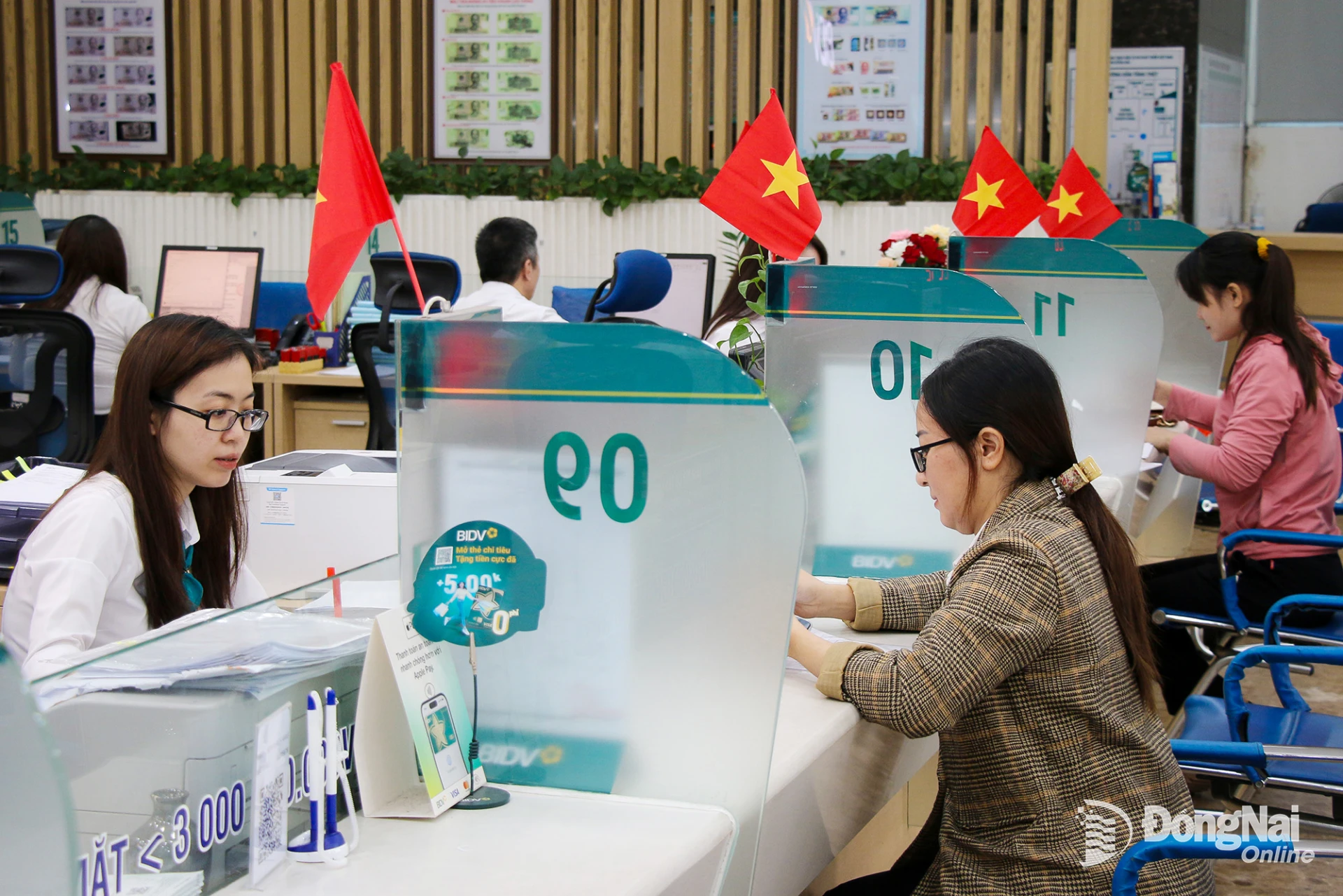 |
| Customers conduct transactions at a commercial bank branch in Tam Hiep ward. |
Bank-business engagement has gradually expanded, helping banks communicate credit policies and better understand businesses' financing needs for production and business activities.
Addressing bottlenecks
With a large number of industrial parks and industrial clusters, Dong Nai has diverse demand for credit and financial products. These include loans for industrial park infrastructure development, production and business activities, and import-export operations. As Dong Nai enters a new stage of development, its development needs are creating substantial demand for capital. At the same time, businesses need to improve investment efficiency and strengthen their capacity to absorb capital.
Removing barriers to credit access will not only help businesses maintain their operations but also lower the costs of moving goods, improve the competitiveness of manufacturers and import-export enterprises, and contribute to the overall development of the local economy.
Speaking at an October 2026 conference on mobilizing financial and banking resources to support growth in the Southeast region during 2026-2030, Phan Dinh Canh, Chairman of the Dong Nai Logistics Association, said logistics plays a vital role in linking production with goods distribution, import-export activities and supply chains.
However, the sector requires substantial capital and a continuous cash flow, while the time required to recover that capital depends on customers' payment schedules. As a result, logistics businesses continue to face several challenges in accessing bank financing.
First, many businesses struggle both to obtain loans and to meet collateral requirements. Second, financing costs are high, and cash flow pressures are significant. Third, credit procedures and loan disbursement processes are not meeting businesses' needs in a timely manner. Fourth, there is a lack of credit products specifically designed for the logistics sector.
At the same conference, held in October 2026, Governor of the State Bank of Vietnam Pham Duc An stressed that the central bank would continue to manage monetary policy flexibly, ensure liquidity in the banking system, contribute to macroeconomic stability and create favorable conditions for credit institutions to support the economy. He noted that the Southeast region makes a significant contribution to national economic growth and therefore deserves particular attention in the implementation of credit policies. Credit institutions should develop lending programs with appropriate interest rates and strengthen their engagement with local businesses and associations to better understand their actual needs.
To ease these difficulties and improve logistics businesses' access to credit, Phan Dinh Canh called on the banking sector to continue taking measures to lower financing costs. He also urged banks to clearly disclose interest rates, fees and lending conditions so that businesses can plan their finances more effectively.
He also proposed developing credit packages tailored to the logistics sector, providing funding for working capital and investment in transport vehicles, warehouses, equipment and digital technologies.
Banks should also expand lending based on businesses' cash flows, service contracts, revenues and payment histories. In addition, they should apply collateral requirements more flexibly in accordance with regulations, rather than relying solely on real estate. Shorter appraisal periods and simpler documentation should also be considered for businesses with transparent financial records, stable contracts and viable business plans.
Dang Van Diem, Chairman of the Dong Nai Business Federation, said that amid mounting pressure from rising input costs, market challenges and the need to upgrade technology, bank credit remained an important source of funding for production and business activities. However, feedback from the business community indicates that several challenges remain, including difficulties in accessing loans, high borrowing costs, stringent credit requirements, time-consuming lending procedures, and a lack of information and appropriate support mechanisms.
Channeling credit into economy
Dong Nai's banking sector is directing credit toward production and business activities, consumer lending and sectors prioritized by the Government. These include agriculture and rural development, exports, SMEs, supporting industries and enterprises applying high technology.
According to the State Bank of Vietnam's Regional Branch 2, as of October 2026, outstanding credit to priority sectors in Dong Nai totaled more than VND459.5 trillion, accounting for over 71% of the local banking system's total outstanding loans.
Of this amount, outstanding loans to SMEs for production and business activities reached approximately VND106 trillion, while credit to export-oriented businesses totaled around VND81 trillion.
To improve the effectiveness of credit programs in priority sectors, banks are stepping up regular consultations and support for businesses, helping them gain better access to financing.
Dang Van Diem added that the Dong Nai Business Federation encouraged businesses to improve financial management, maintain transparent financial records, fulfill their tax obligations, develop viable business plans and use loans for their intended purposes. These steps are essential to strengthening their credit standing and building long-term relationships with banks.
The federation also called on banks to offer more credit packages tailored to SMEs, businesses in supporting industries, enterprises pursuing technological innovation and digital transformation, and those engaged in green production. It also urged banks to facilitate the restructuring of debt repayment schedules, in accordance with regulations, for businesses facing genuine difficulties but still capable of recovery.
Local authorities should also strengthen coordination with banks to organize regular bank-business networking programs, focusing on processing loan applications and addressing businesses' actual financing needs.
By H. Quan – Translated by M.Nguyet, Minho


Thông tin bạn đọc
Đóng Lưu thông tin