
With more than 506,500 hectares of perennial industrial crops and over 104,500 hectares of fruit trees, Dong Nai City has favourable conditions for developing key export crops. As markets impose increasingly stringent requirements, standardising specialised growing areas, ensuring product quality and building sustainable supply chains have become urgent priorities.
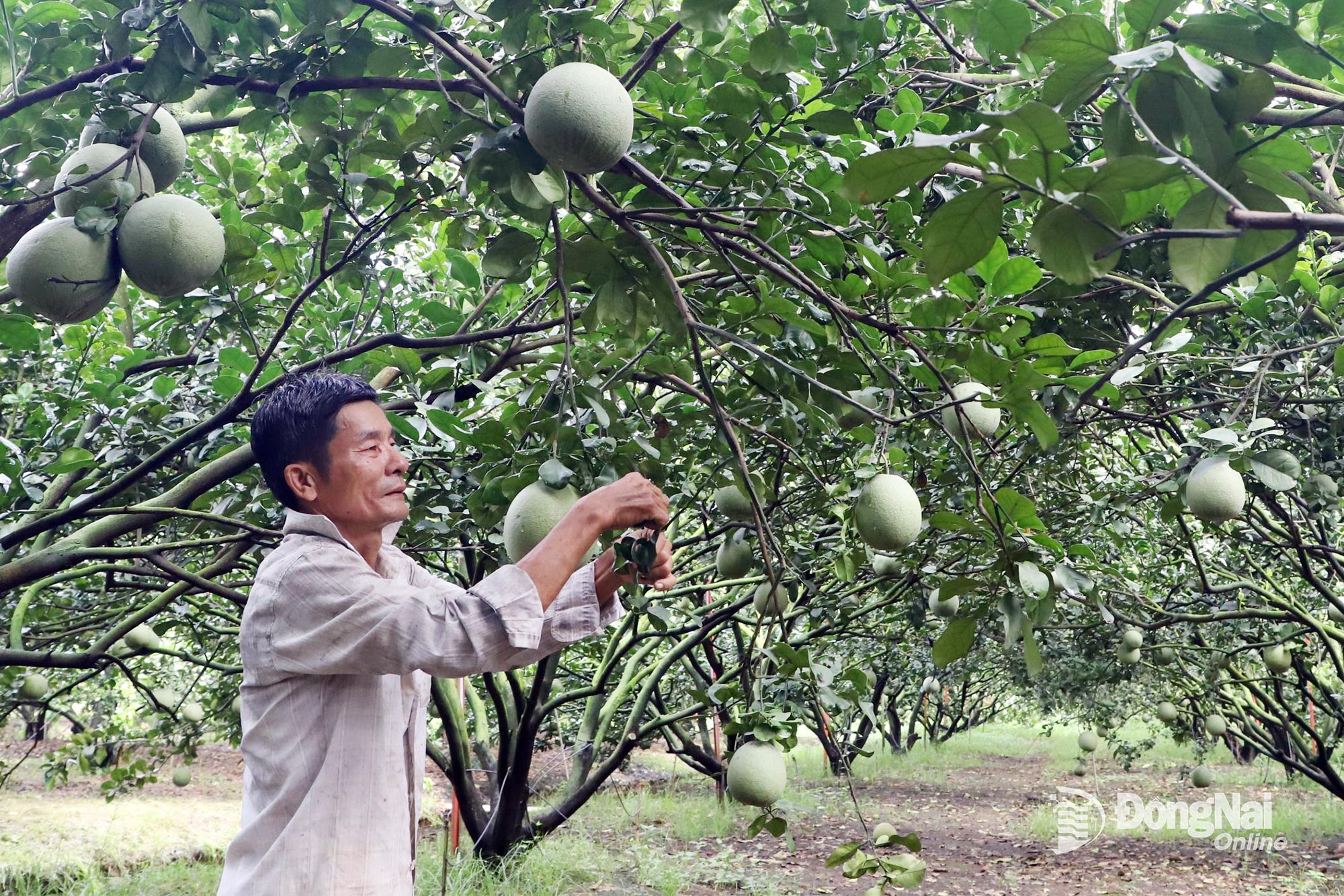 |
| Farmers switch to export-standard farming practices in a specialised pomelo-growing area in Tan Trieu Ward. |
Many localities across Dong Nai have invested in specialised growing areas for industrial crops and fruit trees that meet export standards. However, to keep pace with changing market requirements, farmers need to move beyond fragmented production and adopt an agricultural economic mindset. This means developing stable raw-material zones and exercising strict control over every stage, from production to marketing and export.
No market is easy any more
In recent years, export markets have tightened plant quarantine requirements and limits on chemical and pesticide residues in agricultural products, particularly fresh fruit. Even China, once considered a relatively easy market to enter, has introduced new policies imposing stricter requirements on imported produce.
Liu Xu, Overseas Sales Director at the Guangxi Supply and Marketing Cooperatives Union, representing China Coop, said demand among Chinese consumers for agricultural products, particularly high-quality fruit, was growing rapidly, creating significant opportunities for Vietnamese produce. However, quality must begin at the source, with growing areas cultivated in accordance with established standards and supported by testing systems, traceability and a reliable, consistent supply.
According to Liu, Vietnamese farmers need to standardise cultivation practices and produce sorting in growing areas to ensure quality throughout the supply chain. Testing is becoming increasingly stringent, focusing on pesticide residues, heavy metals, microorganisms and other relevant indicators. Farmers must also address fragmented production information among households to ensure that the origins of agricultural products can be traced and responsibility established when problems arise.
Phan Thi Thu Hien, Director of Post-Entry Plant Quarantine Centre II under the Department of Crop Production and Plant Protection, stressed that countries importing fresh fruit from Vietnam were imposing increasingly stringent requirements. Export operations face scrutiny at multiple levels, from local and central authorities to overseas partners. Farmers must therefore comply strictly with the regulations to secure growing-area codes for export.
China, in particular, has significantly tightened its import requirements since 2019. Rather than simply accepting packaged export consignments, the market now imposes specific requirements on individual fresh-fruit products. Although import conditions vary across markets, growing-area codes and traceability are common requirements. Farmers and businesses must ensure genuine compliance rather than treat these requirements as a formality.
According to Hien, agricultural production must adapt to the new requirements, with a focus on safe farming practices, food safety, chemical residue control and product traceability.
Building sustainable raw-material zones
Dong Nai is one of Vietnam’s leading localities in the area and output of several key crops with export potential, including rubber, cashew, bananas and durian. The city currently has 314 growing-area codes for export, covering more than 22,000 hectares and 83 fresh-fruit packing facilities exporting to major markets such as China, the United States, the European Union, Australia and New Zealand.
To meet market requirements, many specialised growing areas have adopted modern technologies, including smart irrigation and automated fertilisation. Unmanned aerial vehicles (UAVs) and remote sensing are used to detect and manage pests and diseases, while sensors monitor key production indicators and help ensure product traceability.
Daily farming activities are logged electronically, with records covering crop care, the types and quantities of fertilisers and pesticides used, and their application rates. Digitising these records helps monitor production and meet export markets’ requirements for product quality and traceability.
Tran Thanh Tung, Director of Phuoc Son Agricultural Cooperative in Phuoc Son Commune, said the cooperative was working with businesses to adopt advanced technologies and develop a specialised durian-growing area that met export standards. Businesses provide technical support and transfer modern technologies to farmers, helping increase the value of durian products.
According to Tung, practical applications of advanced technology include monitoring crop health and tracking weather changes. Cooperative members introduce beneficial microorganisms into irrigation systems to help reduce plant diseases and create favourable conditions for beneficial microbes to thrive. They also maintain grass cover at an appropriate level to retain soil moisture without allowing grass to compete excessively with crops for nutrients. Beneficial microbes help decompose the grass, turning it into organic fertiliser.
Alongside technology adoption, strengthening production linkages is also essential to establishing growing areas that meet the required standards. Nguyen Dinh Muoi, Deputy General Director of Vina T&T Export-Import Service Trading Co., Ltd., based in Ho Chi Minh City, said the company needed a supply of pomelos that meet export standards and had surveyed pomelo-growing areas in Dong Nai to explore opportunities to collaborate with farmers and establish supply-chain partnerships.
According to Muoi, the company spent three years developing and refining a model for specialised pomelo-growing areas for export in the Mekong Delta. The key to success lies not only in having skilled farmers but also in having a cooperative serve as a central coordinator to connect stakeholders, organise production and establish sustainable supply-chain partnerships.
Standardising specialised growing areas must therefore go hand in hand with stronger links among farmers, cooperatives and businesses. By ensuring controlled production processes, consistent product quality and a stable supply, Dong Nai can strengthen the competitiveness of its agricultural products and meet export requirements over the long term.
Le Minh Hoan, former Vice Chairman of the National Assembly and former Minister of Agriculture and Rural Development, said sustainable supply chains for agricultural exports required the involvement of all stakeholders, including local authorities, businesses, agricultural producers, scientific research institutions and financial organisations. Farmers and businesses, he stressed, need to build partnerships and jointly create value.
By B.Nguyen – Translated by M.Nguyet, Minho
Thông tin bạn đọc
Đóng Lưu thông tin