
As the city's transport infrastructure is rapidly taking shape in a more integrated and modern network, new space for development is opening up, creating the conditions for new growth poles to emerge.
This is also one of important factors for the city to pursue the urban development models outlined in Politburo Resolution No. 16-NQ/TW on the construction and development of Dong Nai City to 2035, with a vision to 2065 (Resolution No. 16), including an airport city, riverfront city, polycentric city and multi-purpose urban area.
Shaping strategic advantages
Under the plan, Long Thanh International Airport is scheduled to begin commercial operations at the end of 2026. Alongside efforts to accelerate construction of the project, Dong Nai is also racing against time to complete planning for an airport city and a free trade zone associated with the airport.
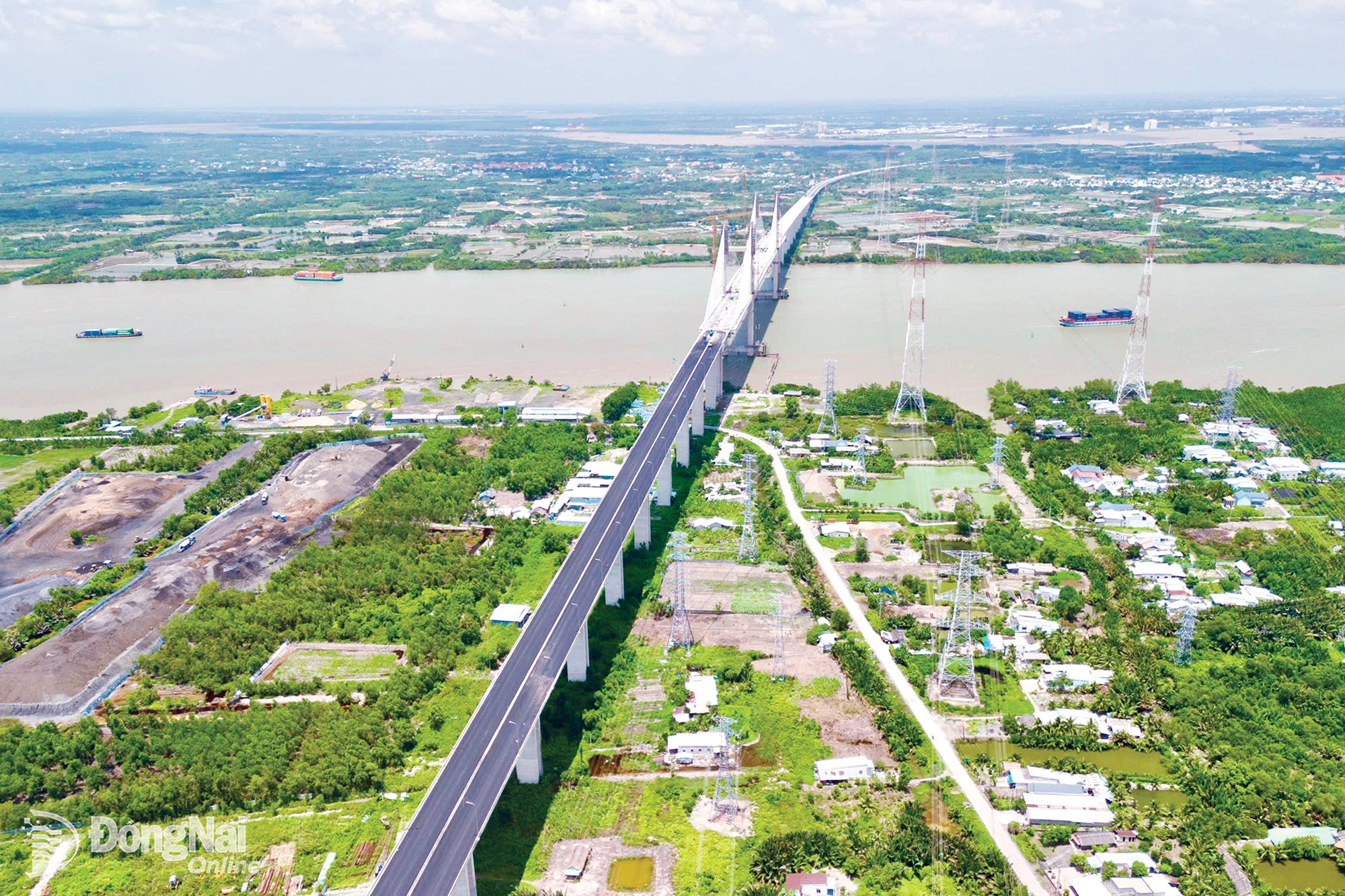 |
| Ben Luc - Long Thanh Expressway is scheduled to be completed and fully opened to traffic in 2026. Photo: Pham Tung |
For Dong Nai, Long Thanh International Airport is more than just a major transport infrastructure project. More importantly, the city aims to turn the airport into a “nucleus” of a new development area and a major driver of growth.
In addition to Long Thanh International Airport, Dong Nai is working with relevant localities and agencies to accelerate the completion of a number of expressways and ring-roads, including the Bien Hoa - Vung Tau Expressway, Dau Giay - Tan Phu Expressway, the Ben Luc - Long Thanh Expressway, the expansion of the Ho Chi Minh City - Long Thanh - Dau Giay Expressway, and Ho Chi Minh City’s Ring Road 3. As the locality with the largest number of expressway projects in the country, Dong Nai views its expressways and ring roads not merely as transport routes, but also as “arteries” that will help expand the city's development space.
Following the Government's approval of the urgent implementation of the project to extend the Ben Thanh - Suoi Tien metro line to Dong Nai City's administrative center and Long Thanh International Airport, the city’s relevant agencies are expediting investment procedures so that construction can begin soon. The project will be the first “piece” of the urban railway network that Dong Nai plans to develop extensively in the coming years.
Huynh Ho Dai Nghia, a public policy expert at the University of Social Sciences and Humanities under Vietnam National University Ho Chi Minh City, said Dong Nai City currently has a combination of advantages that few other localities can match. According to him, at least five groups of major advantages can be identified: its geo-economic position at the heart of the southern region; Long Thanh International Airport; its seaports and logistics system connecting Phuoc An port with Cai Mep - Thi Vai port complex; its network of expressways, ring roads, railways and interregional transport links; and its industrial base, foreign-invested enterprises and workforce built up over decades.
Shifting toward “value-generating infrastructure”
Huynh Ho Dai Nghia noted that although transport infrastructure plays a crucial role in creating Dong Nai's major advantages, these advantages will become real economic resources only when they are backed by appropriate institutions and planning and translated into specific projects.
|
| Ben Luc - Long Thanh Expressway is scheduled to be completed and fully opened to traffic in 2026. Photo: Pham Tung |
He said Dong Nai's first step should be to integrate all strategic infrastructure into a single economic network rather than continue to manage projects individually.
“The airport must be effectively connected with seaports, logistics, railways, expressways, urban areas and industrial parks. When a container, passenger, expert or capital flow passes through Dong Nai, the policy objective should be to retain as much value as possible in the locality. This is the logic behind the shift from ‘transport infrastructure’ to ‘value-generating infrastructure’,” he said.
The Politburo Resolution No. 16 calls for the development of new-generation strategic transport infrastructure, with priority given to interconnected transport infrastructure linking growth-driving regions and development corridors. This network is envisioned as the backbone for organizing the city's development space in a synchronous and modern manner. Priority is also given to developing key transport corridors that provide seamless logistics connections and modern infrastructure linking major transshipment ports.
Resolution No. 16 sets a goal that by 2065, Dong Nai will become a globally connected city with a high quality of life and happiness, ranking among the world's leading airport cities.
According to Assoc. Prof. Dr. Tran Quang Phu, former Vice Rector of the University of Transport and Communications in Ho Chi Minh City, completing the new-generation strategic transport infrastructure system will require Dong Nai to focus not only on projects already underway but also on key infrastructure gaps that are critical to connectivity and can generate wider spillover effects.
Based on regional and city planning orientations, Tran Quang Phu said the city needs to accelerate investment in several key “pieces”, including public transport networks, particularly metro and railway systems; an inland waterway transport and seaport network; and transport projects strengthening regional and urban connectivity.
By P.Tung – Translated by M.Nguyet, Thu Ha


Thông tin bạn đọc
Đóng Lưu thông tin