
Dong Nai City is entering a period of rapid development in transport infrastructure, particularly in the railway sector, with urban rail (metro) and high-speed rail projects now being developed.
This will not only promote public transport but also create an opportunity to restructure the city's urban space through the Transit-Oriented Development (TOD) model.
Reshaping growth poles
At its third session in early July 2026, the first-term Dong Nai City People's Council for the 2026-2031 tenure adopted a resolution on the formulation, appraisal, approval and adjustment of plans for transit-oriented urban development areas. The resolution also covers the alignment, facility locations and overall alignment planning of local railway projects in the city.
 |
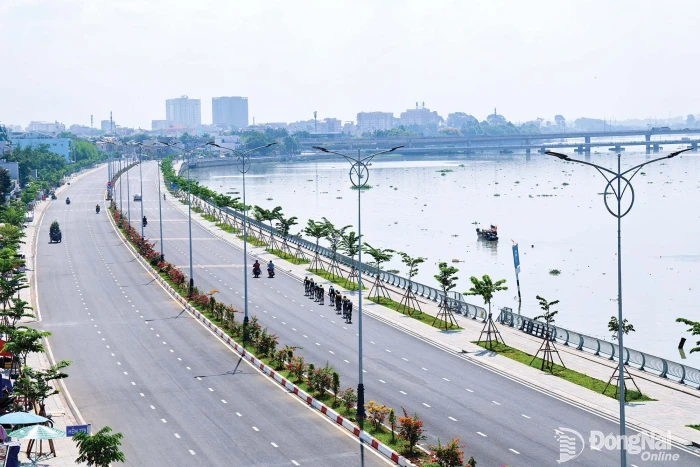
| A view of Tran Bien ward, the central urban area of Dong Nai City. |
Accordingly, Dong Nai will prioritize public and non-motorized transport and limit the use of private vehicles in TOD areas. It will also promote smart, green and flexible urban development, while encouraging innovative commercial activities and diverse, environmentally friendly services in TOD areas. The adoption of the resolution marks an important milestone in developing the city's public transport system and opens a new direction for urban development and restructuring. In practice, TOD is increasingly regarded as a development model capable of addressing traffic congestion, expanding urban space and improving quality of life over the long term.
According to the city People's Committee, following the consolidation of administrative boundaries, Dong Nai faces the challenge of managing a sprawling, multi-polar urban structure with uneven development densities. If the city continues to follow the traditional pattern of outward, sprawling development, infrastructure investment costs will be extremely high and land resources will become fragmented. Against this backdrop, TOD is seen as the only solution for reshaping growth poles such as Bien Hoa, Long Thanh, Nhon Trach, Chon Thanh and Dong Xoai into compact urban clusters centered around transport hubs.
Dong Nai is emerging as a major transport hub for the country and the southern key economic region, with major projects including Long Thanh International Airport, the extension of Metro Line No. 1, the North-South high-speed railway and regional railway lines such as Thu Thiem-Long Thanh and Bien Hoa-Vung Tau. This situation calls for a breakthrough mechanism such as TOD to prepare for future development and maximize the transport capacity of these strategic corridors.
According to Dr. Le Thanh Hoa, Head of the Department of Urban Geography at the University of Social Sciences and Humanities under Vietnam National University, Ho Chi Minh City (USSH-VNUHCM), TOD-based urban development can help address some of the most pressing challenges facing today's cities, including high travel demand, traffic congestion, social welfare and public service issues.
Tapping into major potential
Huynh Ho Dai Nghia, a public policy expert at the USSH-VNUHCM, said Dong Nai has enormous potential for TOD because it still has substantial land reserves and an opportunity to develop a new generation of urban areas.
“Dong Nai can plan TOD areas from the outset around strategic connectivity points such as Long Thanh, Nhon Trach and Bien Hoa, as well as ring roads, railway stations and future metro stations. This would help the city avoid problems commonly seen in large cities, including traffic congestion, sprawling development, a shortage of public spaces and poor connections between residential areas and workplaces,” Nghia said.
 |
| The planned extension of the Ben Thanh-Suoi Tien metro line to Dong Nai City's administrative center and Long Thanh International Airport offers significant potential for TOD development. |
However, Nghia noted that TOD would not succeed simply by “drawing urban areas around stations.” The most important condition is integrated planning covering transport, land, housing, commercial and public services, and urban finance. The city needs to clearly identify priority TOD areas, control development density, protect land reserves around railway stations and prevent scattered development. At the same time, it needs to establish mechanisms to attract investors and effectively manage investment.
The resolution also stipulates that plans specifying railway alignments, facility locations and overall site layouts are mandatory for approving urban development plans, managing land boundaries and ensuring synchronized infrastructure connectivity. They will also serve as a legal basis for developing investment projects, particularly those based on the TOD model.
Under the resolution, a TOD area comprises a railway station or depot and its surrounding area, extending to land boundaries within a maximum radius of 2 kilometers from the designated center of the station or depot. The Dong Nai City People's Committee will determine the scope and boundaries of each TOD area based on the location and scale of stations and railway lines, the capacity for integrated connectivity within the public transport system, and relevant technical and social infrastructure conditions.
At the same time, TOD in Dong Nai will go beyond the traditional concept of inner-city TOD and evolve into regional-scale models. These include airport TOD, which links urban development with airport infrastructure; logistics TOD and industrial TOD, which orient urban, industrial and logistics development around mass-transit and high-capacity transport infrastructure; and metropolitan corridor TOD, which promotes transit-oriented development along major urban corridors within a metropolitan area or megacity.
By P.Tung – Translated by M.Nguyet, Thu Ha


Thông tin bạn đọc
Đóng Lưu thông tin