
Building new-style rural areas (NRAs) has not only transformed central communes but also gradually given a "new look" to remote, disadvantaged, and mountainous communes. Rural areas have received coordinated investment, especially through increasingly comprehensive rural infrastructure and growing economic development. Continuously improving the material and spiritual lives of rural residents remains the program's ongoing objective.
 |
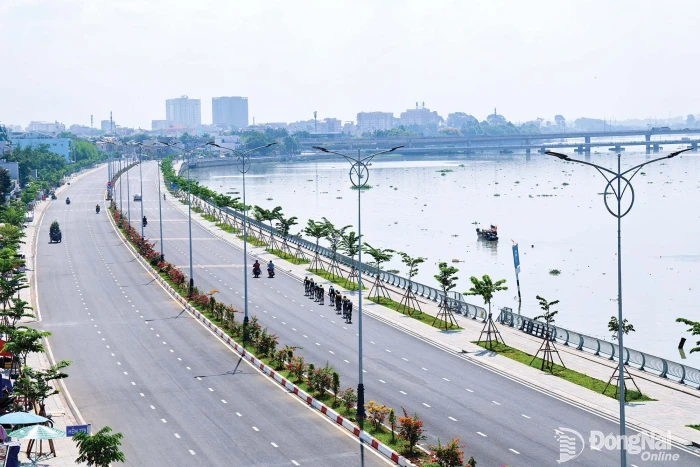
| A bright, green, clean, and beautiful road in Xuan Thanh Commune. Photo: Binh Nguyen |
For this reason, the national target program on building new-style rural areas across localities in the city has always been closely intertwined with the sustainable poverty reduction program. Both the spiritual and material well-being of rural populations receive dedicated care.
Rural areas undergoing transformation
Reflecting on the remarkable changes in what was once a poor rural region, Pham Thi Lien, Head of Lang Lon Hamlet in Cam My Commune, noted that Cam My once faced numerous challenges. Many roads were dusty during the dry season and muddy during the rainy season. Today, rural transportation infrastructure has been substantially improved, with asphalt roads extending to fields and residential areas, making production and daily life much more convenient. Through initiatives such as the movement to build model residential areas and model new-style rural roads, local residents have become increasingly conscious of maintaining environmental cleanliness, planting and caring for trees, contributing funds for flagpoles, installing street lighting systems, and setting up security cameras. More and more model residential areas and roads characterized by brightness, greenery, cleanliness, beauty, and security are being developed.
The transformation of formerly impoverished rural areas is considered one of the greatest achievements of the new-style rural area building program. Rural infrastructure has received comprehensive investment. By the end of 2025, the city's rural transportation network had expanded significantly both in quantity and quality, with nearly 89.5% of commune roads paved with concrete.
Educational infrastructure in rural areas, including preschools, primary schools, and lower secondary schools, has also been strengthened and upgraded. More than 70.6% of public preschools and general education schools throughout the city now meet national standards. Healthcare services for rural residents have likewise improved. Currently, 100% of communes have health stations, many of which have been upgraded into polyclinics or regional healthcare centers. By the end of 2025, the health insurance participation rate had reached 95%.
Particularly noteworthy is the investment in rural commercial infrastructure. The city now has 136 markets that meet regulatory standards, effectively serving the trading and shopping needs of rural residents. Dong Nai City's e-commerce trading platform has also begun attracting participation from numerous businesses and production establishments.
Sustainable poverty reduction
The most vital milestone achieved by Dong Nai City in building new-style rural areas is the increasingly prosperous development of its countryside. Nguyen Khac Thuoc, a farmer in Bu Dang Commune, recalled: "This used to be one of the localities with a massive cashew-growing acreage. The income from this crop was low, and the people's lives were filled with hardships. Gradually, farmers were supported and encouraged to restructure their crops. Many aging cashew orchards were intercropped with cocoa, coffee, black pepper, and other varieties, helping farmers’ incomes have steadily increased."
Thuoc compared: "Many cashew-growing households locally have now adopted the multi-crop intercropping model. My own family currently owns more than 4.5 hectares of cashews intercropped with cocoa. This intercropping model yields immense benefits because both the cashew and cocoa crops achieve high productivity. Over the past few years, cocoa prices have risen sharply, allowing many households to accumulate wealth through this intercropping approach. Both cashew and cocoa have stable markets with companies purchasing the harvest, giving farmers confidence to continue investing in production.”
Over recent years, formerly poor communes with large cashew-growing areas such as Bu Gia Map, Phu Hoa, Da Kia, Dak O, Nam Cat Tien, Tan Phu, Xuan Bac, Dak Nhau, and Bom Bo have experienced remarkable economic improvements. Farmers have actively expanded intercropping models or switched to crops with higher economic value. The movement encouraging farmers to excel in production and business while supporting one another in wealth creation and sustainable poverty reduction has gained strong momentum across these localities.
These positive changes are reflected in tangible figures. During the 2021–2025 period, agricultural production in Dong Nai maintained stable growth of approximately 3.8–4% annually, exceeding the national average. Rural per capita income reached an impressive level of over VND 86 million per person per year by the end of 2025.
The sustainable poverty reduction program has also achieved remarkable success. In 2022, Dong Nai had more than 11,900 poor households. By the end of 2025, that number had fallen to just over 2,900 households. The poverty rate decreased by an average of 0.2 percentage points annually.
According to Le Thi Anh Tuyet, Deputy Director of the Dong Nai Department of Agriculture and Environment, all eligible poor and near-poor households throughout the city have long benefited from government support policies in healthcare, education, housing, vocational training, employment, production transformation, and livelihood diversification. Between 2021 and 2025, Dong Nai implemented 116 livelihood-support production projects for poor households, with approximately VND 90 billion provided from the state budget. More than 2,700 households received assistance and contributed labor, materials, livestock, crops, and financial resources to carry out these projects. Housing support has also been prioritized. More than 2,000 temporary or dilapidated houses have been newly built or renovated.
For the 2025-2030 period, Dong Nai City aims to reduce the rate of poor households under the multidimensional poverty standard by 1.15% annually. In ethnic minority and mountainous areas, the city aims to reduce the multidimensional poverty rate to below 2% and eliminate all especially disadvantaged communes and villages. It has also set a target for more than 85% of communes and villages in ethnic minority and mountainous areas to have adequate infrastructure to support socio-economic development and improve residents’ living conditions.
By Binh Nguyen – Translated by Mai Nga, Minho


Thông tin bạn đọc
Đóng Lưu thông tin