
Dong Nai has officially become Vietnam’s seventh city since late April 2026. The historic milestone has opened a new chapter of development for the land known for its rich cultural identity and historical traditions, long regarded as the country’s industrial hub.
 |
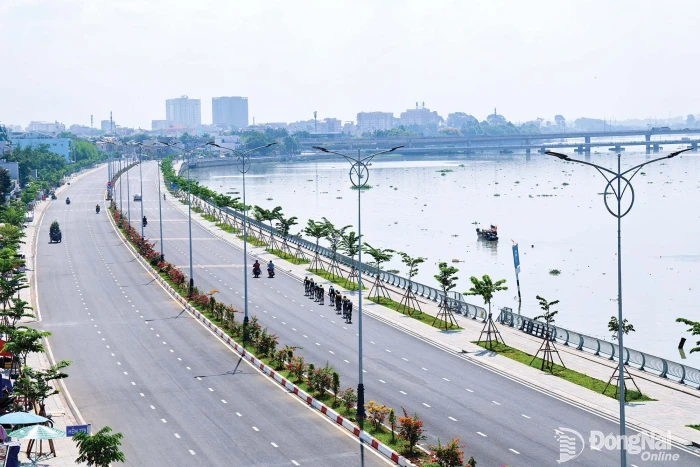
| Dong Nai Bridge connects Dong Nai City and Ho Chi Minh City. File photo |
As it enters a new development phase, Dong Nai aspires to become a strategic national growth pole as well as a green, modern, smart and livable urban center.
Shaping a green growth pole
Green and sustainable development has remained a consistent orientation of Dong Nai over recent years. This direction continues to be reaffirmed in the Resolution of the first Congress of the Dong Nai Party Organization for the 2025-2030 tenure and the city’s master plan for the 2021-2030 period with a vision to 2050.
Accordingly, Dong Nai will gradually shift from a growth model dependent on traditional industries to one driven by high technology, innovation, green economy and digital economy. Key breakthroughs have been identified as the development of high-tech industries and the establishment of a service ecosystem associated with Long Thanh International Airport.
Nguyen Kim Long, Member of the City Party Standing Committee and Standing Vice Chairman of the City People’s Committee, said that in the new development phase, Dong Nai aims to become an advanced manufacturing center of the region with strengths in high-tech industries, green industries, semiconductors, artificial intelligence, robotics, automation equipment and next-generation supporting industries.
At the same time, building upon its industrial foundation, the city is leveraging the strategic advantage of Vietnam’s largest airport to develop a modern airport urban model featuring multimodal logistics systems, free trade, financial centers, tourism and internationally oriented aviation services.
Under its master plan, Dong Nai is envisioned as a multi-center urban area integrating airport urban zones and international-standard eco-urban models. The city will strengthen connectivity among industry, services, logistics, high-tech agriculture and ecological spaces, while economic growth linked with social progress and sustainable development will remain the overarching orientation.
One of Dong Nai’s development directions that has won strong support from experts and businesses is its commitment to achieving net-zero emissions by 2050. To realize this goal, the city is implementing a range of projects, programs and initiatives aimed at transforming existing industrial parks into eco-industrial zones, developing low-emission industries, expanding the share of clean energy, promoting high-tech agriculture linked with deep processing, and developing smart, eco-friendly urban areas.
Associate Professor and Dr. Tran Dinh Thien, former Director of the Vietnam Institute of Economics, remarked while contributing opinions to the city’s planning adjustments that Dong Nai possesses rare advantages by simultaneously hosting an international airport, seaports, international border gates, inter-regional transport infrastructure and a strong industrial foundation. If these advantages are effectively utilized alongside flexible development strategies, the locality will have substantial room for breakthroughs in the coming period. Amid increasingly fierce competition, localities capable of building innovation ecosystems, high-quality living environments and sustainable development spaces will gain advantages in attracting investment flows and highly skilled human resources.
Meanwhile, Nguyen Van Ut, Deputy Secretary of the City Party Committee and Chairman of the City People’s Committee, stated that from now until 2030, Dong Nai aims to maintain double-digit economic growth in order to create new development momentum for the locality. However, such rapid and sustained growth does not mean sacrificing the environment or overlooking social issues. According to him, economic development must go hand in hand with improving people’s quality of life, ensuring social welfare and preserving a sustainable environment so that residents can genuinely benefit from development achievements.
Gradually building a livable city
At present, the resolutions, plans and action programs of the city’s Party organization and administration all share the common goal of achieving rapid and sustainable development while improving living standards and creating a better living environment for residents.
Following this orientation, immediately after the Resolution of the first Congress of the Dong Nai Party Organization for the 2025–2030 tenure was issued, the Standing Board of the provincial Party Committee, now the Standing Board of City Party Committee, promptly developed concrete action programs with clearly defined tasks, responsibilities, timelines and resource allocation to ensure effective and coordinated implementation of its development goals.
In 2025, Dong Nai recorded economic growth of 9.63%, surpassing the target assigned by the Government and ranking seventh among the country’s 34 provinces and cities. Entering the first quarter of 2026, the locality achieved growth of 9.76%, while the target for the whole year stands at 10%.
To unlock development resources, the city has focused on removing bottlenecks related to infrastructure, planning, public investment disbursement, administrative procedures and digital transformation. Several key programs have also been launched, including the development of the Long Thanh Airport service urban area, acceleration of the formation of a free trade zone, expansion of logistics centers, implementation of plans to transform industrial parks into eco-industrial models and the building of digital government, digital economy and smart urban systems.
More importantly, the city is concentrating resources on strategic transport corridors to create breakthroughs in regional and international connectivity. These include the North-South corridor linking Hoa Lu International Border Gate, Long Thanh International Airport, Phuoc An Port and the international seaport system, alongside the Dong Nai riverside urban corridor and transport axes connecting Ho Chi Minh City with the Central Highlands.
Speaking at a conference reviewing socio-economic performance in April 2026, Nguyen Van Ut emphasized that becoming a city is a great source of pride, but it also places increasingly high demands on governance capacity, management quality and development vision. In the new position, cadres, civil servants and public employees are required to proactively renew their mindset and working methods while enhancing professionalism and responsibility in public service. The city has identified people and businesses as the center of public service delivery, while innovation, digital transformation and green development are considered key growth drivers forming the foundation for rapid and sustainable development in the coming years.
For his part, Ishii Hiroyuki, General Director of Long Duc Investment Co., Ltd., shared that in line with Dong Nai’s green growth and sustainable development strategy, the company is completing documentation, upgrading technical infrastructure and promoting industrial symbiosis models so that Long Duc Industrial Park can obtain eco-industrial park certification. Meanwhile, the enterprise is strengthening cooperation with leading Japanese companies and corporations to develop rooftop solar power systems and improve environmental treatment capacity. According to him, such green transformation efforts are aimed at enhancing the competitiveness of both the industrial park and the locality.
Alongside economic growth targets, Dong Nai has also identified improving residents’ quality of life through synchronized investment in social infrastructure, public spaces, education, healthcare, housing and environmental protection solutions.
Beyond creating additional momentum for growth, the above-mentioned works and projects are expected to bring better living conditions to residents while building a transparent and attractive investment environment for businesses. These efforts are expected to lay the groundwork for Dong Nai to realize its ambition of becoming a green, modern and livable city.
By Hoang Loc - Translated by M.Nguyet, Thu Ha


Thông tin bạn đọc
Đóng Lưu thông tin