
Dong Nai is transforming the former Bien Hoa 1 Industrial Park (IP) into the city’s future administrative center. Among various proposals, the “Bien Hoa Dong Pho” concept by the consortium of Encity International Consulting Joint Stock Company and PT Studio Rancang Urban Selaras (URBAN+) received the highest evaluation and won first prize in the competition for converting Vietnam’s oldest industrial park.
 |
| Above photo: A rendering of part of Dong Nai City’s future political-administrative center under the enCity and URBAN+ master plan. Photo: courtesy of enCity |
The “Bien Hoa Dong Pho” proposal has drawn particular attention for its different approach: instead of completely wiping away the past to build an anonymous new urban area, it seeks to revive the old industrial land through the memories, culture, and heritage of Bien Hoa itself.
A new urban center for Dong Nai
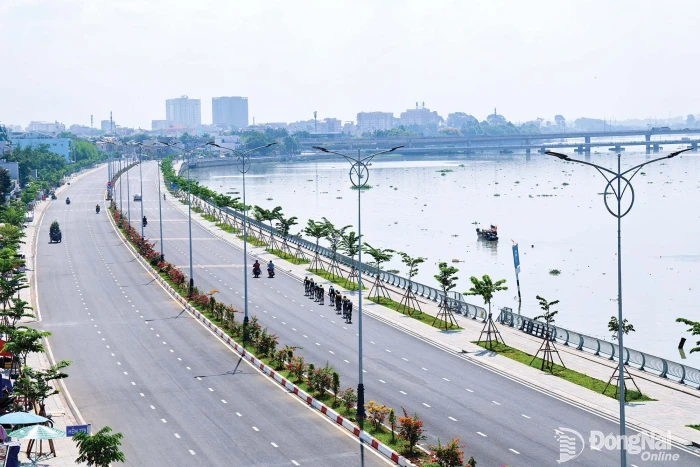
Covering more than 300 hectares, the transformation project of Bien Hoa 1 Industrial Park is envisioned as a new administrative and commercial hub, developed under a transit-oriented urban model and aligned with net-zero sustainable development goals. Under the master plan, the new urban area will feature an extensive green-space system linking squares, urban parks, and the Dong Nai River into a continuous landscape corridor throughout the development.
The project is built around five key planning strategies: creating a continuous ecological corridor across the urban area; developing riverside urban spaces with water-based activities; transforming industrial heritage into cultural destinations; organizing infrastructure in a hidden way to free up urban space; and building landmark structures on hilltops to form a distinctive skyline.
According to experts, historic Bien Hoa was a land rich in river culture, ceramic craft villages, ancient relics, and a long-standing trading tradition. Integrating these elements into the planning process would help newly created urban areas avoid becoming “uniform,” while preserving and incorporating local cultural identity.
Within the overall design concept, the public transportation system is planned to meet approximately 70% of travel demand, integrating three metro lines and reducing CO₂ emissions by around 10,000 tons per day compared to conventional transport models.
Nguyen Do Dung, General Director of enCity, noted that Bien Hoa 1 Industrial Park was established in 1963 as Vietnam’s first industrial park and once symbolized southern Vietnam’s industrial development. In the context of Dong Nai officially becoming Vietnam’s seventh city from April 30, 2026, the transformation of this historic industrial park carries special significance.
According to Nguyen Do Dung, the Bien Hoa Dong Pho area is envisioned not only as an administrative center but also as one of the city’s most dynamic commercial and service areas and a residential destination. Historically, the area served as a transportation hub connecting residents and visitors to Dong Nai, making it essential to develop modern infrastructure without obstructing views or creating overly heavy urban spaces.
Development rooted in local identity
Development based on local identity is a lesson many cities and countries around the world have embraced. Numerous cities have successfully converted former industrial zones into creative and cultural spaces. Old factories were not entirely demolished but repurposed into museums, libraries, artistic plazas, and community centers.
At the former Bien Hoa 1 Industrial Park site, planners also chose a design inspired by multiple layers of Dong Nai’s identity, including its pioneering spirit, industrial heritage, memories of plantation agriculture, and the cultural depth of traditional handicraft villages, especially pottery-making.
A key architectural highlight is the twin administrative towers designed to rise like two torches, symbolizing Dong Nai’s pioneering spirit — from a southern frontier settlement to an industrial center and an international gateway of the Southeast region.
The administrative center features the twin towers as its focal point. Meanwhile, the convention center will feature ceramic-panel facades that honor the traditional ceramic craft while creating an architectural surface deeply rooted in local identity.
The open-space system, including riverside parks, event plazas, and landscaped water features, is envisioned as a new “urban gateway” for Dong Nai, capable of hosting large-scale festivals, light shows, contemporary art performances, and provincial and regional community events.
The new commercial-service-administrative center is expected to become a model of sustainable urban development in the Southeast region, harmoniously combining urban architecture, natural landscapes, and preservation of industrial heritage.
In the Bien Hoa Dong Pho master plan, architecture is intended not only to solve functional needs but also to tell the story of the land itself, a story of a Dong Nai that once pioneered industrialization, is now accelerating with new growth drivers such as Long Thanh International Airport, while still preserving the cultural memories and occupational traditions that define its identity.
Speaking about development rooted in local culture, Tran Quang Toai, Chairman of the Dong Nai Historical Science Association, stated that the Dong Nai River is both a cultural and historical river, closely associated with many historical and cultural events dating back to the early period of southern expansion. During the process of urban development, conflicts often arise between preservation and development. Resolving these conflicts in a balanced way is extremely challenging to achieve a harmonious balance between preservation and development goals. Industrial heritage is also one of the special values that needs to be properly recognized, preserved, and promoted.
As a resident living along the Dong Nai River, Nguyen Van Duong of Tran Bien Ward said the change in the project’s function would not only be an internal matter for the project area but would also affect surrounding regions, especially Cu Lao Pho Island and riverside locations that still preserve many traces of the pioneers who first opened up the land. Therefore, how to harmoniously connect this future center with neighboring areas is something residents are very concerned about and hope for.
By Vuong The – Translated by Mai Nga, Minho


Thông tin bạn đọc
Đóng Lưu thông tin