
With Long Thanh International Airport located within its boundaries, Long Thanh Ward is set to become the central area and a crucial “core” for forming an airport urban ecosystem.
 |
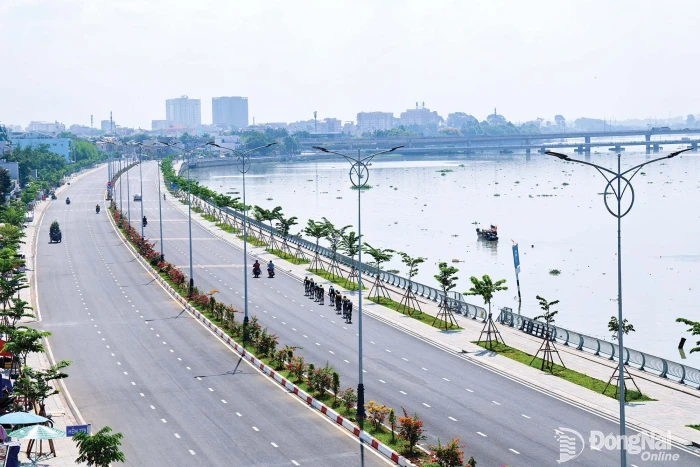
| Long Thanh Ward is home to many key national and Dong Nai city transport infrastructure projects. Photo: Pham Tung |
Building an integrated modern development ecosystem
Long Thanh urban area, centered on Long Thanh Ward, holds a strategically important geographic position at the heart of the Southern Key Economic Region, approximately 40 kilometers east of downtown Ho Chi Minh City. It is also adjacent to dynamic industrial hubs such as Nhon Trach and the industrial-port complex of Ba Ria-Vung Tau. This location provides favorable conditions for Long Thanh to strengthen its role as a gateway, connectivity hub, and urban development center within the region.
More importantly, with Long Thanh International Airport currently under construction in the area, Long Thanh Ward offers enormous growth potential. Under Dong Nai City’s development plans, authorities are preparing urban planning schemes for the Long Thanh Airport urban area model and a free trade zone (FTZ) associated with the airport to maximize its strategic advantages.
According to Nguyen Kim Long, Member of the City Party Standing Committee and Standing Vice Chairman of the Dong Nai City People’s Committee, Long Thanh concentrates many of the nation’s and the city’s major growth drivers, most notably Long Thanh International Airport alongside strategic infrastructure projects such as the Bien Hoa–Vung Tau Expressway, high-speed railways, ring roads connecting to Ho Chi Minh City, as well as emerging urban areas, industrial zones, and modern commercial-service centers. These key projects will create new development spaces, accelerate economic restructuring, attract investment, improve people’s quality of life, and transform Long Thanh into one of Dong Nai’s major growth poles in the future.
Speaking at a working session with the Standing Board of the Dong Nai City Party Committee on May 18, Party General Secretary and State President To Lam emphasized that
Long Thanh, with its existing industrial system, logistics network, gateway position, and new urban space, must be integrated into a modern development ecosystem, with high-tech industry and aviation services forming a high-value service ecosystem that supports industries, the digital economy, the green economy, and high-tech agriculture as pillars. "From Long Thanh, an airport urban ecosystem, aviation services, commerce, finance, conferences, exhibitions, training, healthcare, tourism, and high-quality services must be formed," Party General Secretary and State President To Lam emphasized.
Dong Nai City is coordinating with ministries and agencies to ensure progress on Long Thanh Airport’s Phase 2 expansion, the Bien Hoa–Vung Tau railway, airport connection routes, and inter-regional infrastructure projects. Long Thanh must be positioned within broader connectivity networks linking Ho Chi Minh City, Tay Ninh, the Mekong Delta, the Central Highlands, the south-central coastal region, and cross-border economic corridors to become a genuine regional growth engine.
Party General Secretary and State President To Lam
Creating a professional urban governance model
From a rural commune, Long Thanh has undergone a remarkable transformation driven by determination and ambition. Officially becoming a ward on April 30, 2026, Long Thanh has transitioned into an urban administrative unit carrying high expectations for a modern, civilized, and internationally integrated future.
Chairman of Long Thanh Ward People’s Committee Le Hoang Son said becoming a ward represents far more than a change in administrative status. “Long Thanh is no longer a rural commune operating under traditional governance models. It is now an urban ward that requires professionalism, synchronization, and a people-centered approach in every decision,” Son said.
According to Son, the ward must also confront major challenges associated with its new role, including population pressure driven by migration and Long Thanh Airport-related labor demand; higher standards for urban management, transportation, environment, public safety, and digital infrastructure; increasing demand for highly skilled human resources; and balancing economic growth with preserving cultural values.
To fully capitalize on opportunities while addressing challenges, Long Thanh Ward has identified building a smart urban government focused on serving residents and measuring performance through citizen satisfaction as one of its top priorities.
Authorities also plan to continue investing heavily in urban infrastructure, including transportation systems, water supply and drainage networks, parks, public spaces, digital infrastructure, and public security systems. At the same time, the ward aims to accelerate investment attraction under the airport city model, prioritizing high-value service sectors such as logistics, commerce, tourism, smart urban development, and the establishment of a free trade zone to maximize advantages created by Long Thanh International Airport.
In parallel, local authorities plan to expand education, training, and healthcare services in line with modern standards to meet demand for high-quality human resources. Long Thanh also intends to pursue sustainable development based on environmental protection, using the principles of being “green, clean, safe, and civilized” as guiding values throughout its urbanization and socio-economic development process.
By Pham Tung – Translated by Mai Nga, Minho


Thông tin bạn đọc
Đóng Lưu thông tin