
Dong Nai is positioning the low-altitude economy as a new growth driver to support economic restructuring and transformation, alongside other emerging sectors such as aviation, circular economy, green growth, digital economy, and innovation.
An emerging global trend
The low-altitude economy is increasingly viewed as a new global development trend, offering breakthrough potential in the context of the Fourth Industrial Revolution.
The term refers to economic activities conducted at altitudes below 1,000 meters, and in some cases extending to under 5,000 meters above ground level, generating value through drones, unmanned aerial vehicles (UAVs), and related technologies.
 |
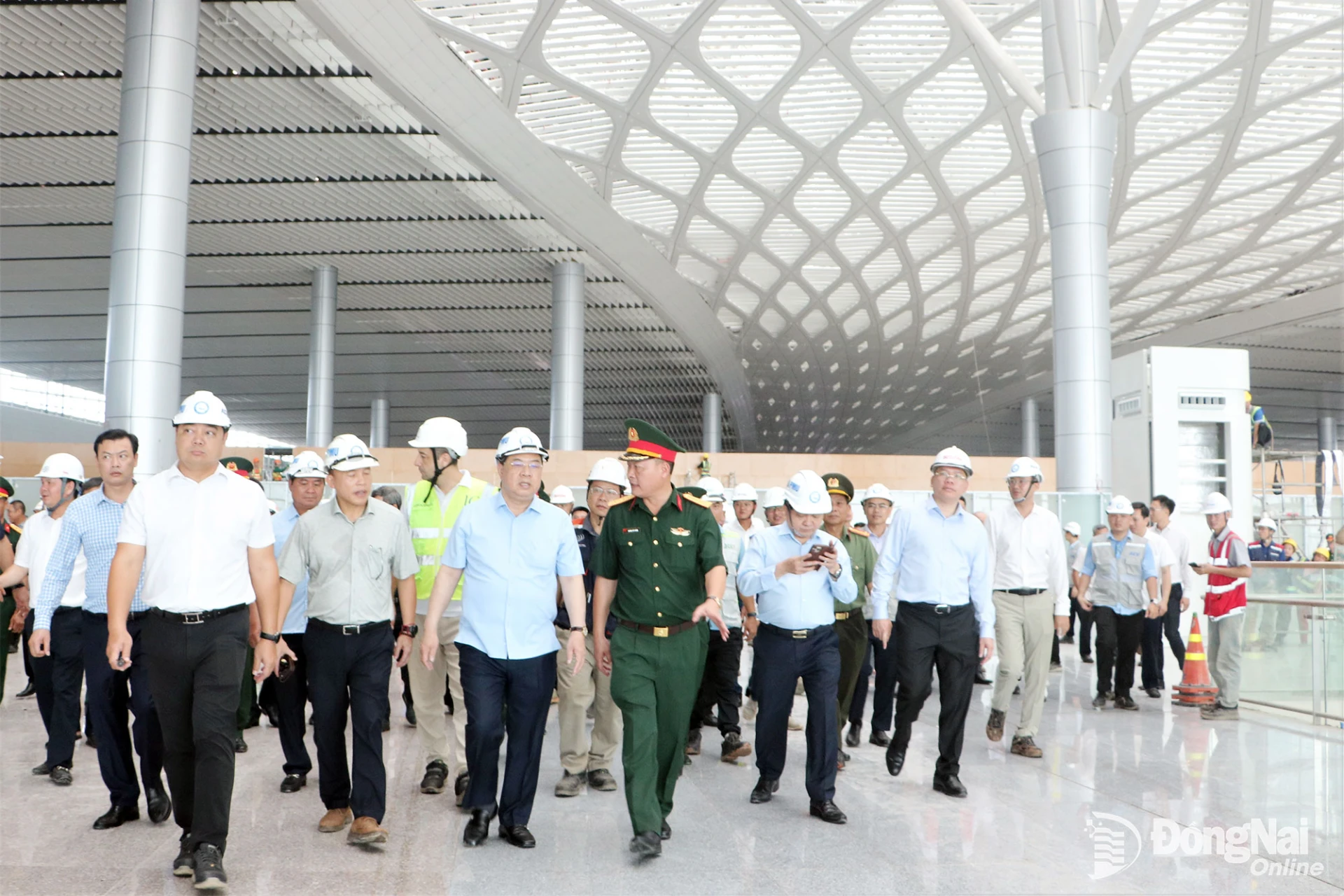
| Long Thanh Airport and its associated functional zones are opening up opportunities for Dong Nai to develop the low-altitude economy. Photo: Pham Tung |
According to experts, the core of the low-altitude economy lies in exploiting low-altitude airspace to reduce operating costs while improving efficiency. Its development typically involves two key aspects: manufacturing low-altitude aircraft and applying these technologies across economic activities.
In Vietnam, including Dong Nai, such activities have already been put into practice. In agriculture, for instance, drones are being used for crop spraying, seeding, field monitoring, and terrain analysis, boosting productivity by 20–30% while reducing labor costs. In localities such as Song Ray and Dinh Quan, farmers and agricultural cooperatives have for years adopted drones for fertilizer spreading and crop protection spraying.
Meanwhile, in logistics, drones and UAVs are being deployed to support fast delivery in rural or hard-to-reach areas, thereby easing pressure on traditional transport systems. In addition, several hospitals in Vietnam have begun using UAVs to transport medical supplies, medicines, and test samples.
Opportunities ahead for Dong Nai
Under the adjusted master plan for Dong Nai for the 2021–2030 period, with a vision to 2050, development space is divided into five socio-economic zones. Among them, Zone 1, focused on innovation, aviation, and high technology, covers the Southwestern area of the province.
This zone is closely associated with Long Thanh International Airport. Meanwhile, it is planned to prioritize the development of riverside urban areas, high-end residential zones, and quality healthcare and education services, along with commercial centers integrated with river landscapes. In addition, it will promote free trade zones, light manufacturing, the aviation industry, tourism services, and logistics, supported by special incentives to attract high-quality foreign direct investment in sectors such as semiconductors, optics, robotics, and aviation.
At the same time, the province aims to develop multimodal logistics systems ensuring seamless connectivity between air transport, seaports, road, and rail. It also plans to establish clusters for knowledge-based services, digital services, research and development, and innovation. With such orientations, the area is considered to hold strong potential for developing the low-altitude economy, particularly in manufacturing aerial vehicles.
According to Nguyen Bao Long, Associate Director of The Boston Consulting Group (BCG), which is part of the consulting consortium for the provincial master plan, Dong Nai is well-positioned to develop the low-altitude economy thanks to Long Thanh Airport and the presence of high-tech zones, concentrated digital technology parks, and innovation hubs. In particular, the production of drones is seen as a promising segment.
In line with the plan, Dong Nai will establish a high-tech park focusing on advanced sectors such as information technology, electronics, automation, aviation technology, and artificial intelligence.
Furthermore, an innovation hub will be developed within the Long Thanh Airport urban area to support startup ecosystems, promote research and application of advanced technologies, and attract international education and science-technology institutions. This undertaking is expected to contribute to reshaping the province’s growth model based on science and technology.
To foster the low-altitude economy, enterprises are encouraged to invest in standardizing components and enhancing system integration capabilities, with a view to building scalable supply chains for UAV and robotics equipment targeting regional markets.
From an industrial perspective, high-tech manufacturing has been identified as one of Dong Nai’s key sectors and a new growth driver, enabling the province to integrate more deeply into global technology value chains. Priority will be given to feasible segments that leverage existing strengths, including semiconductor packaging and testing, aviation component manufacturing, as well as MRO (maintenance, repair, and overhaul) services, alongside robotics and UAV production for industrial applications.
Meanwhile, efforts will be made to strengthen production capacity in robotics and UAV equipment serving both industry and services. Development will focus on practical segments capable of supporting other sectors, such as lightweight industrial robots for small and medium-sized manufacturing, and control modules for UAVs used in agricultural monitoring, logistics, and infrastructure management.
By P.Tung – Translated by M.Nguyet, Minho


Thông tin bạn đọc
Đóng Lưu thông tin